
NOD1 Antibody (626919) [Janelia Fluor® 646]
Novus Biologicals, part of Bio-Techne | Catalog # FAB7090J

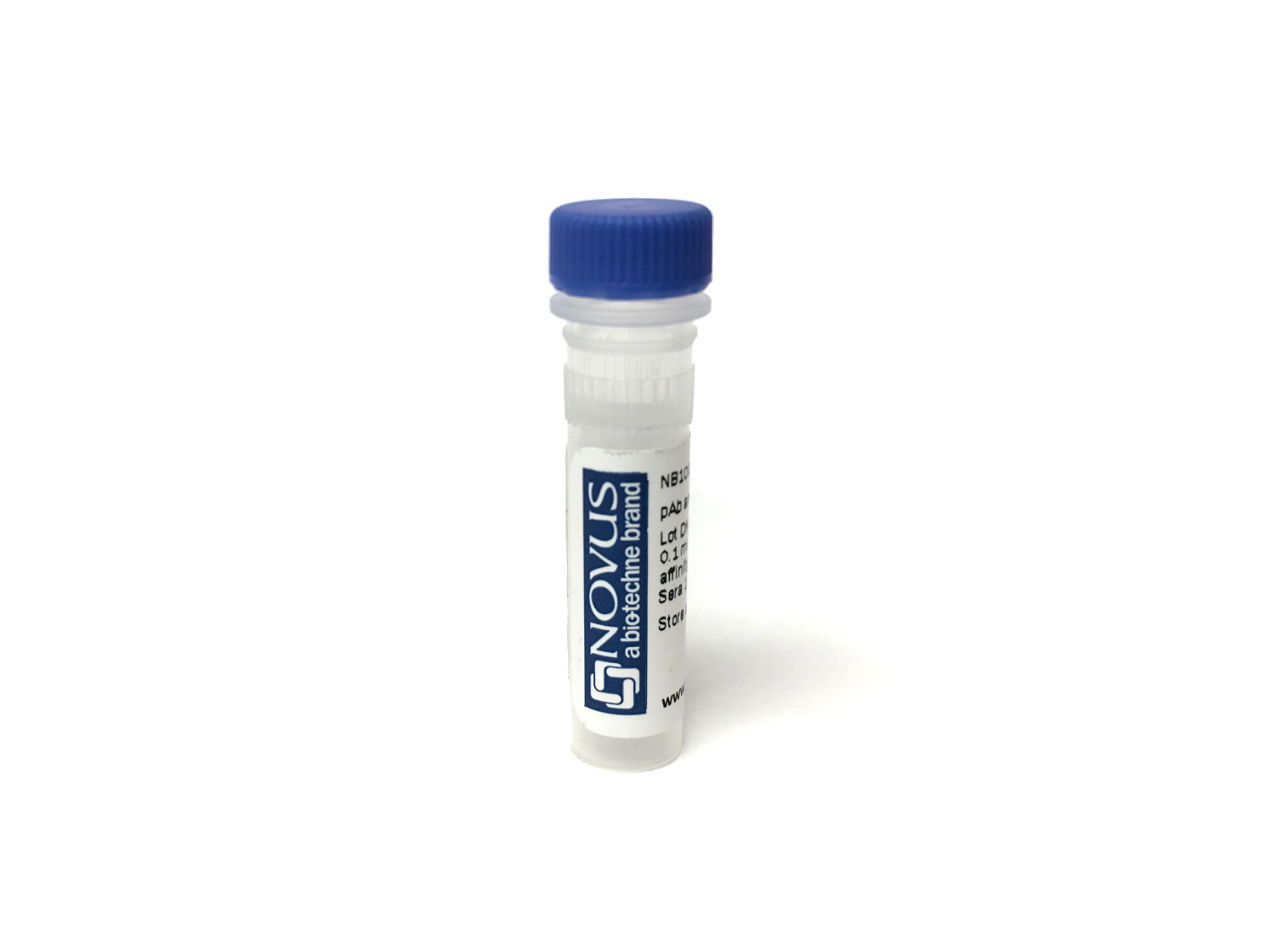
Conjugate
Catalog #
Key Product Details
Species Reactivity
Human
Applications
Immunohistochemistry, Western Blot
Label
Janelia Fluor 646
Antibody Source
Monoclonal Mouse IgG2B Clone # 626919
Concentration
Please see the vial label for concentration. If unlisted please contact technical services.
Product Specifications
Immunogen
E. coli-derived recombinant human NOD1
Lys830-Phe953
Accession # Q9Y239
Lys830-Phe953
Accession # Q9Y239
Specificity
Detects human NOD1 in direct ELISAs and Western blots. In direct ELISAs and Western blots, no cross-reactivity with recombinant human NOD2 is observed.
Clonality
Monoclonal
Host
Mouse
Isotype
IgG2B
Description
This conjugate is made on demand and is not held in inventory. Each order represents a unique lot. All conjugates are generated using validated conjugation protocols and meet strict degree of labeling (F/P) specifications; additional information is available upon request. The antibody concentration is provided on the individual product label.
For specialized conjugation needs, like large quantities, specific concentrations, and defined F/P ratios, bulk and custom antibody conjugation services are available.
For specialized conjugation needs, like large quantities, specific concentrations, and defined F/P ratios, bulk and custom antibody conjugation services are available.
Applications for NOD1 Antibody (626919) [Janelia Fluor® 646]
Application
Recommended Usage
Immunohistochemistry
Optimal dilutions of this antibody should be experimentally determined.
Western Blot
Optimal dilutions of this antibody should be experimentally determined.
Application Notes
Recommended applications are based on validated applications from the unconjugated base product MAB7090. This conjugated antibody is not kept in inventory and is made to order using validated conjugation protocols.
Formulation, Preparation, and Storage
Purification
Protein A or G purified from hybridoma culture supernatant
Formulation
50mM Sodium Borate
Preservative
0.05% Sodium Azide
Concentration
Please see the vial label for concentration. If unlisted please contact technical services.
Shipping
The product is shipped with polar packs. Upon receipt, store it immediately at the temperature recommended below.
Stability & Storage
Store at 4C in the dark.
Background: NOD1
Long Name
Nucleotide-binding Oligomerization Domain-containing Protein 1
Alternate Names
CARD4, CLR7.1, NLRC1
Gene Symbol
NOD1
Additional NOD1 Products
Product Documents for NOD1 Antibody (626919) [Janelia Fluor® 646]
Product Specific Notices for NOD1 Antibody (626919) [Janelia Fluor® 646]
Sold under license from the Howard Hughes Medical Institute, Janelia Research Campus.
This product is for research use only and is not approved for use in humans or in clinical diagnosis. Primary Antibodies are guaranteed for 1 year from date of receipt.
Loading...
Loading...
Loading...
Loading...