
Mouse Leptin R Biotinylated Antibody Best Seller
R&D Systems, part of Bio-Techne | Catalog # BAF497

Scientific images may be resized, cropped, or adjusted for brightness or contrast for presentation purposes. These updates are limited to presentation and do not affect the underlying scientific interpretation of the data. Where available, additional source data may be provided upon request.
Conjugate
Catalog #
Key Product Details
Species Reactivity
Validated:
Mouse
Cited:
Human, Mouse, Transgenic Mouse
Applications
Validated:
Western Blot, ELISA Detection (Matched Antibody Pair), Flow Cytometry
Cited:
Immunohistochemistry, Immunohistochemistry-Frozen, Western Blot, Flow Cytometry, Immunocytochemistry, Bioassay, Cell Selection, Flow Cytomery, In vivo assay, MACS
Label
Biotin
Antibody Source
Polyclonal Goat IgG
Product Specifications
Immunogen
Mouse myeloma cell line NS0-derived recombinant mouse Leptin R
Ala20-Gly839
Accession # Q3US58
Ala20-Gly839
Accession # Q3US58
Specificity
Detects mouse Leptin R in ELISAs and Western blots.
Clonality
Polyclonal
Host
Goat
Isotype
IgG
Scientific Data Images for Mouse Leptin R Biotinylated Antibody
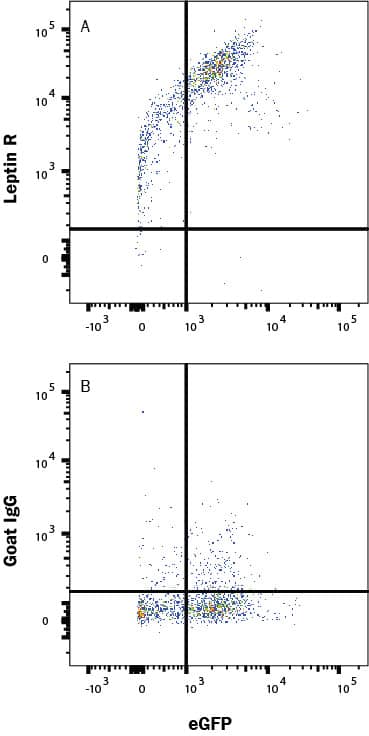
Detection of Leptin R in HEK293 Human Cell Line transfected with Mouse Leptin R and EGFP by Flow Cytometry.
HEK293 human cell line transfected with Mouse Leptin R and EGFP was stained with (A) Goat Anti-Mouse Leptin R Biotinylated Polyclonal Antibody (Catalog # BAF497) or (B) control antibody (BAF108), followed by Allophycocyanin-conjugated Streptavidin (F0050). Staining was performed using our Staining Membrane-associated Proteins protocol.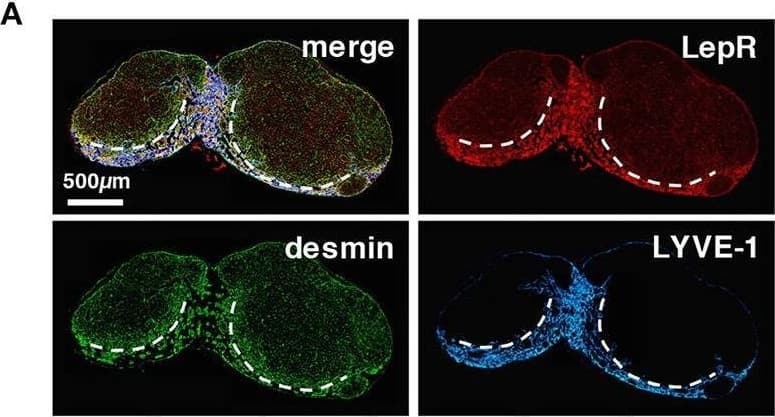
Detection of Mouse Leptin R by Immunohistochemistry
The MC in the mouse LN is a unique structure comprising MCRCs. (A) LepR is highly expressed in the medulla. A section of a brachial LN from a wild type B6 mouse was stained with the indicated markers. The dotted lines indicate the boundary between the DCP and medulla. (B) FSCs in the MC showed the highest expression of LepR. The inset shows a higher magnification view of a MC. (C) Average fluorescent intensity profiles of B220, desmin, and LepR along the cortex–medulla axis. Note that LepR expression is prominent in the medulla, and shows a similar pattern to LYVE-1 in Figure 3D, indicating preferential expression in the medulla. (D) Plasma cells preferentially accumulate in the MCs. Shown is a wild type B6 mouse LN. (E) Plasma cells make close contacts with MCRCs. Shown is a Cxcl12-EGFP mouse LN. (F,G) Quantitative analysis of plasma cell localization in LN subcompartments (bars: mean; asterisks: significantly different compared to the follicles, p < 0.0001). (F) A representative image of plasma cells. The dotted lines indicate the boundary between the DCP and medulla. (G) Proportions of plasma cells in each subcompartment compared to the total number in the LN were plotted (open circles; bars: mean; *p < 0.0001). Image collected and cropped by CiteAb from the following open publication (https://pubmed.ncbi.nlm.nih.gov/30333825), licensed under a CC-BY license. Not internally tested by R&D Systems.
Mouse Leptin R ELISA Standard Curve
Recombinant Mouse Leptin R Fc Chimera (Catalog # 497-LR) was serially diluted and captured by Rat Anti-Mouse Leptin R Monoclonal Antibody (Catalog # MAB497) coated on a Clear Polystyrene Microplate (Catalog # DY990). Goat Anti-Mouse Leptin R Antigen Affinity-purified Polyclonal Antibody (Catalog # AF497) was biotinylated and incubated with the protein captured on the plate. Detection of the standard curve was achieved by incubating Streptavidin-HRP (Catalog # DY998)Applications for Mouse Leptin R Biotinylated Antibody
Application
Recommended Usage
Flow Cytometry
0.25 µg/106 cells
Sample: HEK293 human cell line transfected with mouse Leptin R and EGFP
Sample: HEK293 human cell line transfected with mouse Leptin R and EGFP
Western Blot
0.1 µg/mL
Sample: Recombinant Mouse Leptin R Fc Chimera (Catalog # 497-LR)
Sample: Recombinant Mouse Leptin R Fc Chimera (Catalog # 497-LR)
Mouse Leptin R Sandwich Immunoassay
Please Note: Optimal dilutions of this antibody should be experimentally determined.
Formulation, Preparation, and Storage
Purification
Antigen Affinity-purified
Reconstitution
Reconstitute at 0.2 mg/mL in sterile PBS.
Formulation
Lyophilized from a 0.2 μm filtered solution in PBS with BSA as a carrier protein.
Shipping
The product is shipped at ambient temperature. Upon receipt, store it immediately at the temperature recommended below.
Stability & Storage
Use a manual defrost freezer and avoid repeated freeze-thaw cycles.
- 12 months from date of receipt, -20 to -70 °C as supplied.
- 1 month, 2 to 8 °C under sterile conditions after reconstitution.
- 6 months, -20 to -70 °C under sterile conditions after reconstitution.
Background: Leptin R
Leptin receptor (OB-R), also named B219, is a type I cytokine receptor family protein with significant amino acid sequence identity with gp130, G-CSF receptor, and the LIF receptor. Multiple isoforms of human and mouse OB-R, including a long form (OB-RL) with a large cytoplasmic domain capable of signal-transduction, and several receptor isoforms with short cytoplasmic domains (OB-Rs) lacking signal-transducing capabilities, have been identified. The extracellular domains of the short and long forms of OB-R are identical. An OB-R transcript lacking a transmembrane domain and potentially encoding a soluble form of the receptor has also been described. Circulating soluble OB-R, complexed to leptin, has been detected in mouse serum. Serum soluble OB-R levels have been shown to increase during pregnancy. OB-RL transcripts were reported to be expressed predominantly in regions of the hypothalamus previously thought to be important in body weight regulation. Expression of OB-Rs transcripts have been found in multiple tissues, including the choroid plexus, lung, kidney and primitive hematopoietic cell populations. OB-R has recently been shown to be encoded by the mouse diabetes (db) and rat fatty (fa) genes. Rodents homozygous for the db or fa mutations have been known to exhibit an obesity phenotype.
Mouse OB-R long form encodes a 1162 amino acid (aa) residue precursor protein with a 22 aa residue signal peptide, an 817 aa residue extracellular domain, a 21 aa residue transmembrane domain, and a 302 aa residue cytoplasmic domain. The extracellular domain of OB-R contains two hemopoietin receptor domains, a fibronectin type III domain and the WSXWS domain. Recombinant murine soluble OB-R has been shown to bind leptin with high affinity and is a potent leptin antagonist.
References
- Tartaglia, L.A. et al. (1995) Cell 83:1263.
- Cioffi, J.A. et al. (1996) Nature Medicine 2:585.
- Lee, J.I. and J.M. Friedman (1996) Nature 379:632.
- Tartaglia, L.A. (1997) J. Biol. Chem. 272:6093.
- Gavrilova, O. et al. (1997) J. Biol. Chem. 272:30546.
Long Name
Leptin Receptor
Alternate Names
B219, CD295, LEPR, LeptinR, OB R
Gene Symbol
LEPR
UniProt
Additional Leptin R Products
Product Documents for Mouse Leptin R Biotinylated Antibody
Product Specific Notices for Mouse Leptin R Biotinylated Antibody
For research use only
Loading...
Loading...
Loading...
Loading...
Loading...
Loading...