
Human VCAM-1/CD106 Antibody
R&D Systems, part of Bio-Techne | Catalog # AF809


Conjugate
Catalog #
Key Product Details
Validated by
Biological Validation
Species Reactivity
Validated:
Human
Cited:
Human
Applications
Validated:
Western Blot, Adhesion Blockade, Simple Western
Cited:
Western Blot, Neutralization, Flow Cytometry, Immunocytochemistry, Bioassay, ELISA Development
Label
Unconjugated
Antibody Source
Polyclonal Sheep IgG
Product Specifications
Immunogen
Chinese hamster ovary cell line (CHO)-derived recombinant human VCAM-1
Extracellular domain
Extracellular domain
Specificity
Detects VCAM-1 in direct ELISAs and Western blots. In direct ELISAs, less than 10% cross-reactivity with recombinant mouse VCAM-1 is observed.
Clonality
Polyclonal
Host
Sheep
Isotype
IgG
Endotoxin Level
<0.10 EU per 1 μg of the antibody by the LAL method.
Scientific Data Images for Human VCAM-1/CD106 Antibody
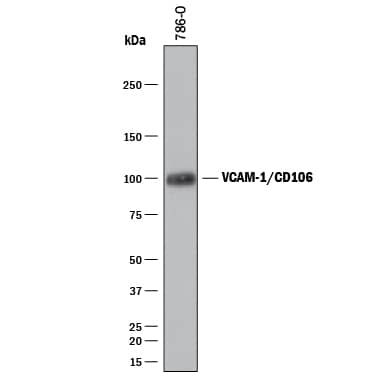
Detection of Human VCAM‑1/CD106 by Western Blot.
Western blot shows lysates of 786-O human renal cell adenocarcinoma cell line. PVDF membrane was probed with 2 µg/mL of Sheep Anti-Human VCAM-1/ CD106 Antigen Affinity-purified Polyclonal Antibody (Catalog # AF809) followed by HRP-conjugated Anti-Sheep IgG Secondary Antibody (Catalog # HAF016). A specific band was detected for VCAM-1/CD106 at approximately 100 kDa (as indicated). This experiment was conducted under reducing conditions and using Immunoblot Buffer Group 1.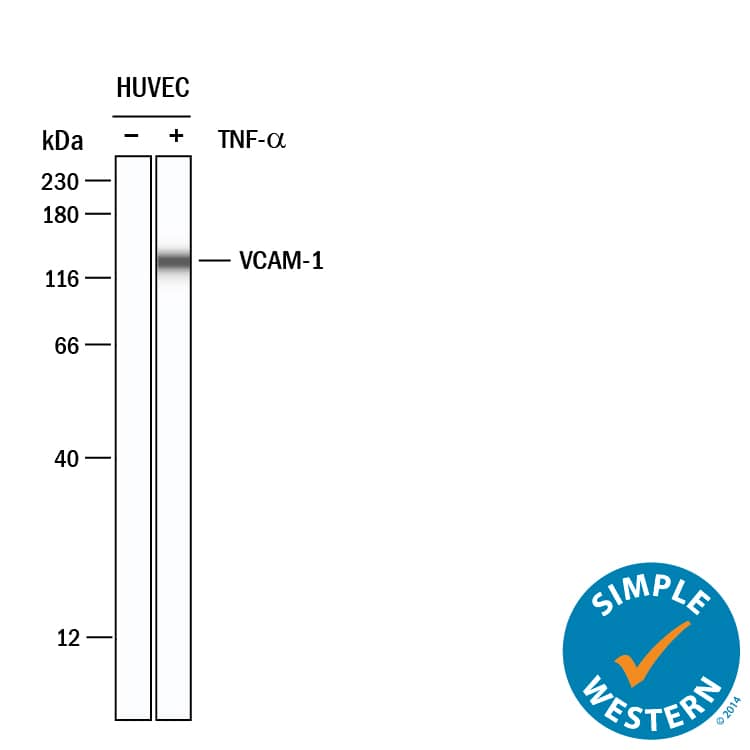
Detection of Human VCAM-1/CD106 by Simple WesternTM.
Simple Western lane view shows lysates of HUVEC human umbilical vein endothelial cells untreated (-) or treated (+) with 10 ng/ml Recombinant Human TNF-alpha (210-TA) for 24 hrs, loaded at 0.2 mg/mL. A specific band was detected for VCAM-1/CD106 at approximately 132 kDa (as indicated) using 20 µg/mL of Sheep Anti-Human VCAM-1/CD106 Antigen Affinity-purified Polyclonal Antibody (Catalog # AF809) followed by 1:50 dilution of HRP-conjugated Anti-Sheep IgG Secondary Antibody (HAF016). This experiment was conducted under reducing conditions and using the 12-230 kDa separation system.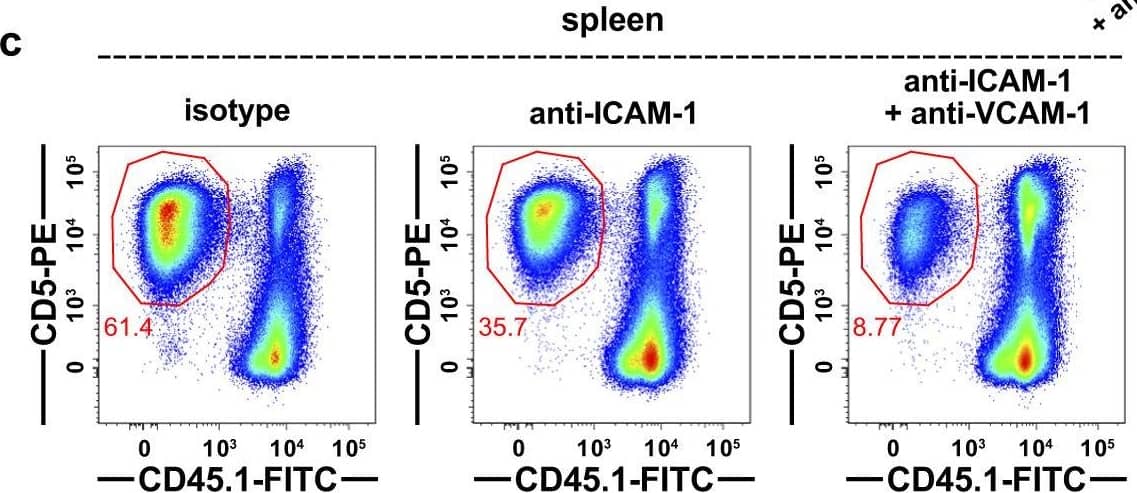
Detection of Mouse VCAM-1/CD106 by Flow Cytometry
Inhibition of ICAM-1- and VCAM-1-mediated cell adhesion reduces T-ALL burden in vivo. A Experimental schematic depicting dosing schedule for anti-ICAM-1, anti-VCAM-1, or isotype control antibodies following establishment of LN3 T-ALL ( > 1% spleen chimerism) in congenic hosts. Leukemia burden was assessed 2 days after the final antibody injection. b Quantification of spleen and liver weights from the experiments depicted in (a). Tumor-free, age-matched mice were included for comparison. Bars depict the mean + SEM of cumulative data from n = 5 experiments, each with a distinct color-coded primary T-ALL; symbols represent individual mice. c Representative flow cytometry plots showing a decrease in T-ALL burden in the spleens of LN3 T-ALL-transplanted mice following treatment with anti-ICAM-1 +/- anti-VCAM-1 antibodies (100 µg each per mouse). d, e Quantification of the (d) frequency of circulating T-ALL blasts in the blood and (e) number of T-ALL cells in the spleen, BM, LN, and liver from the same experiments as in (b). f Quantification of the indicated myeloid subsets or TCR beta+ or B220+ host cells in the spleens of mice from the same experiments as in (d, e). Statistical significance was determined by (b, d, e, f) a two-sided repeated measures one-way ANOVA with the Holm-Sidak correction; P-values: *<0.05, **<0.01, ***<0.001. ns, not significant. Source data are provided as a Source Data file. Image collected and cropped by CiteAb from the following open publication (https://pubmed.ncbi.nlm.nih.gov/37805579), licensed under a CC-BY license. Not internally tested by R&D Systems.Applications for Human VCAM-1/CD106 Antibody
Application
Recommended Usage
Adhesion Blockade
The adhesion of U937 human histiocytic lymphoma cells (5 x 10⁴ cells/well) to immobilized Recombinant Human VCAM-1/CD106 (Catalog # ADP5, 2.5 µg/mL, 100 µL/well) was maximally inhibited (80-100%) by 25 µg/mL of the antibody.
Simple Western
20 µg/mL
Sample: HUVEC human umbilical vein endothelial cells
Sample: HUVEC human umbilical vein endothelial cells
Western Blot
2 µg/mL
Sample: 786‑O human renal cell adenocarcinoma cell line
Sample: 786‑O human renal cell adenocarcinoma cell line
Reviewed Applications
Read 3 reviews rated 4.3 using AF809 in the following applications:
Formulation, Preparation, and Storage
Purification
Antigen Affinity-purified
Reconstitution
Reconstitute at 0.2 mg/mL in sterile PBS. For liquid material, refer to CoA for concentration.
Formulation
Lyophilized from a 0.2 μm filtered solution in PBS with Trehalose. *Small pack size (SP) is supplied either lyophilized or as a 0.2 µm filtered solution in PBS.
Shipping
Lyophilized product is shipped at ambient temperature. Liquid small pack size (-SP) is shipped with polar packs. Upon receipt, store immediately at the temperature recommended below.
Stability & Storage
Use a manual defrost freezer and avoid repeated freeze-thaw cycles.
- 12 months from date of receipt, -20 to -70 °C as supplied.
- 1 month, 2 to 8 °C under sterile conditions after reconstitution.
- 6 months, -20 to -70 °C under sterile conditions after reconstitution.
Background: VCAM-1/CD106
VCAM-1 (CD106), a member of the immunoglobulin superfamily, is a cell surface protein expressed by activated endothelial cells and certain leukocytes (such as macrophages). VCAM-1 expression is induced by IL-1 beta, IL-4, TNF-alpha, and IFN-gamma. VCAM-1 binds to leukocyte integrins VLA-4 and alpha4 beta7. The human and mouse VCAM-1 proteins share approximately 76% amino acid similarity.
During the inflammatory adhesion mechanism, activated integrins halt rolling leukocytes and attach them firmly to the vascular endothelium. They do this by binding to their ligands, for example VCAM-1, on endothelium. The VCAM-1: VLA-4/ alpha4 beta7 interaction is also thought to be involved in the extravasation of white blood cells through the blood vessel wall to sites of inflammation.
ELISA techniques have shown that detectable levels of soluble VCAM-1 are present in the biological fluids of apparently normal individuals. Furthermore, a number of studies have reported that levels of VCAM-1 may be elevated or lowered in subjects with a variety of pathological conditions.
Long Name
Vascular Cell Adhesion Molecule 1
Alternate Names
CD106, VCAM1
Gene Symbol
VCAM1
Additional VCAM-1/CD106 Products
Product Documents for Human VCAM-1/CD106 Antibody
Product Specific Notices for Human VCAM-1/CD106 Antibody
For research use only
Loading...
Loading...
Loading...
Loading...
Loading...