
Human TSPAN7 Alexa Fluor® 647-conjugated Antibody
R&D Systems, part of Bio-Techne | Catalog # FAB9179R


Conjugate
Catalog #
Key Product Details
Species Reactivity
Validated:
Human
Cited:
Human
Applications
Validated:
Flow Cytometry
Cited:
Immunohistochemistry, Flow Cytometry, Immunocytochemistry
Label
Alexa Fluor 647 (Excitation = 650 nm, Emission = 668 nm)
Antibody Source
Monoclonal Mouse IgG2A Clone # 482618
Product Specifications
Immunogen
HEK293 human embryonic kidney cell line transfected with human TSPAN7
Accession # P41732
Accession # P41732
Specificity
Stains human TSPAN7 transfectants but not irrelevant transfectants in flow cytometry.
Clonality
Monoclonal
Host
Mouse
Isotype
IgG2A
Scientific Data Images for Human TSPAN7 Alexa Fluor® 647-conjugated Antibody
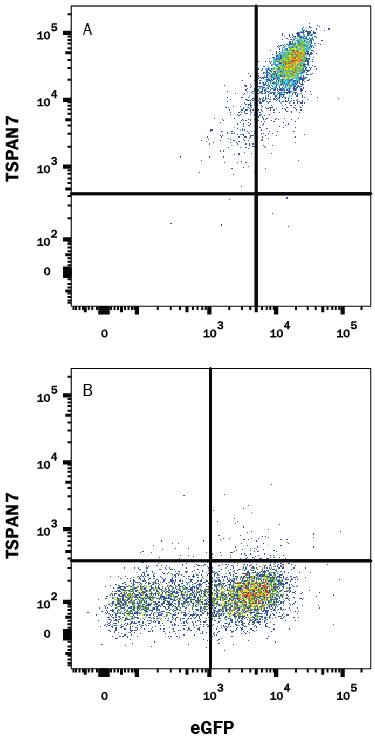
Detection of TSPAN7 in HEK Human Cell Line Transfected with Human TSPAN7 and eGFP by Flow Cytometry.
HEK293 human embryonic kidney cell line transfected with either (A) human TSPAN7 or (B) irrelevant transfectants and eGFP was stained with Mouse Anti-Human TSPAN7 Alexa Fluor® 647-conjugated Monoclonal Antibody (Catalog # FAB9179R). Quadrant markers were set based on control antibody staining (Catalog # IC003R). View our protocol for Staining Membrane-associated Proteins.
Detection of TSPAN7 by Flow Cytometry
Kro68-D9 CAR can detect TSPAN7 protein and peptide but not surface-expressed TSPAN7 on cells. (A) 2nd generation CAR constructs used for cloning of scFvs. Short-hinge CAR shown left and long-hinge CAR right, respectively. (B) Schematic overview of used CAR construct—short- and long-hinge CAR, respectively. (C) TSPAN7 can be stained on the surface of transfected HEK293T cells. Anti-TSPAN7 antibody staining on untransfected (blue) and transfected cells (red). (D) CAR activation in murine hybridoma cells following stimulation by target. NFAT activation is reported by GFP and anti-Fab antibody was used for CAR staining. Activation patterns are shown for short-hinge (above) and long-hinge (below) CARs. CARs were tested with TSPAN7 peptide used for panning, TSPAN7 protein, medium (control), HEK293T transfected with human TSPAN7 and untransfected HEK293T (control). Image collected and cropped by CiteAb from the following open publication (https://pubmed.ncbi.nlm.nih.gov/37296574), licensed under a CC-BY license. Not internally tested by R&D Systems.
Detection of TSPAN7 by Flow Cytometry
Peptide panning generated a single binder detecting a TSPAN7 peptide. (A) Screening ELISA of scFv binders generated by peptide panning. Change fold of A450-620 absorption signals of ELISA on TSPAN7 peptide and streptavidin control antigen. ScFv binder Kro68-D9 indicated with asterisk. (B) Flow cytometric staining of Kro68-D9 on TSPAN7-transfected HEK293T cells. ScFv staining with anti-His-PE antibody. TSPAN7 expression reported by GFP. Medium-control left, Kro68-D9 scFv staining on human TSPAN7 and murine TSPAN7-transfected HEK293T cells middle and right, respectively. (C) Staining of peptide binder Kro68-D9 on murine beta cell line MIN6. Binding of Kro68-D9 on MIN6 shown in blue. Binding of an unspecific control scFv in red. (D) Immunohistochemistry staining on paraffin pancreas sections. Murine and human sections left and right, respectively. First row shows isotype control antibody. Second row shows the positive control with insulin staining, respectively. Below, staining of islets with Kro68-D9 is shown. All pictures 20× magnification. Image collected and cropped by CiteAb from the following open publication (https://pubmed.ncbi.nlm.nih.gov/37296574), licensed under a CC-BY license. Not internally tested by R&D Systems.


Applications for Human TSPAN7 Alexa Fluor® 647-conjugated Antibody
Application
Recommended Usage
Flow Cytometry
5 µL/106 cells
Sample: HEK293 human embryonic kidney cell line transfected with human TSPAN7 and eGFP
Sample: HEK293 human embryonic kidney cell line transfected with human TSPAN7 and eGFP
Spectra Viewer
Plan Your Experiments
Use our spectra viewer to interactively plan your experiments, assessing multiplexing options. View the excitation and emission spectra for our fluorescent dye range and other commonly used dyes.
Spectra Viewer
Formulation, Preparation, and Storage
Purification
Protein A or G purified from hybridoma culture supernatant
Formulation
Supplied in a saline solution containing BSA and Sodium Azide.
Shipping
The product is shipped with polar packs. Upon receipt, store it immediately at the temperature recommended below.
Stability & Storage
Protect from light. Do not freeze.
- 12 months from date of receipt, 2 to 8 °C as supplied.
Background: TSPAN7
Long Name
Tetraspanin 7
Alternate Names
A15, CCG-B7, CD231, DXS1692E, MRX58, MXS1, TALLA-1, TM4SF2, TM4SF2b
Gene Symbol
TSPAN7
UniProt
Additional TSPAN7 Products
Product Specific Notices for Human TSPAN7 Alexa Fluor® 647-conjugated Antibody
This product is provided under an agreement between Life Technologies Corporation and R&D Systems, Inc, and the manufacture, use, sale or import of this product is subject to one or more US patents and corresponding non-US equivalents, owned by Life Technologies Corporation and its affiliates. The purchase of this product conveys to the buyer the non-transferable right to use the purchased amount of the product and components of the product only in research conducted by the buyer (whether the buyer is an academic or for-profit entity). The sale of this product is expressly conditioned on the buyer not using the product or its components (1) in manufacturing; (2) to provide a service, information, or data to an unaffiliated third party for payment; (3) for therapeutic, diagnostic or prophylactic purposes; (4) to resell, sell, or otherwise transfer this product or its components to any third party, or for any other commercial purpose. Life Technologies Corporation will not assert a claim against the buyer of the infringement of the above patents based on the manufacture, use or sale of a commercial product developed in research by the buyer in which this product or its components was employed, provided that neither this product nor any of its components was used in the manufacture of such product. For information on purchasing a license to this product for purposes other than research, contact Life Technologies Corporation, Cell Analysis Business Unit, Business Development, 29851 Willow Creek Road, Eugene, OR 97402, Tel: (541) 465-8300. Fax: (541) 335-0354.
For research use only
Loading...
Loading...
Loading...
Loading...
Loading...