
Human Teneurin-1 Antibody
R&D Systems, part of Bio-Techne | Catalog # AF6324

Conjugate
Catalog #
Key Product Details
Species Reactivity
Validated:
Human
Cited:
Human
Applications
Validated:
Western Blot
Cited:
Western Blot
Label
Unconjugated
Antibody Source
Polyclonal Sheep IgG
Product Specifications
Immunogen
E. coli-derived recombinant human Teneurin‑1
Met1-Lys317
Accession # AAF04723
Met1-Lys317
Accession # AAF04723
Specificity
Detects human Teneurin-1 in direct ELISAs and Western blots. In direct ELISAs, approximately 15% cross-reactivity with recombinant human Teneurin-3 is observed.
Clonality
Polyclonal
Host
Sheep
Isotype
IgG
Scientific Data Images for Human Teneurin-1 Antibody
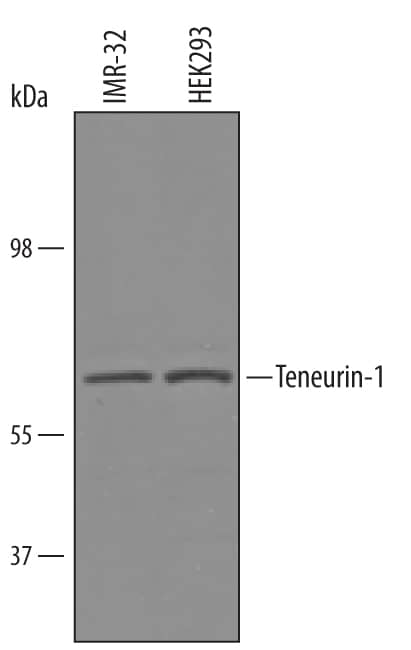
Detection of Human Teneurin‑1 by Western Blot.
Western blot shows lysates of IMR-32 human neuroblastoma cell line and HEK293 human embryonic kidney cell line. PVDF Membrane was probed with 1 µg/mL of Human Teneurin-1 Antigen Affinity-purified Polyclonal Antibody (Catalog # AF6324) followed by HRP-conjugated Anti-Sheep IgG Secondary Antibody (Catalog # HAF016). A specific band was detected for Teneurin-1 at approximately 65 kDa (as indicated). This experiment was conducted under reducing conditions and using Immunoblot Buffer Group 8.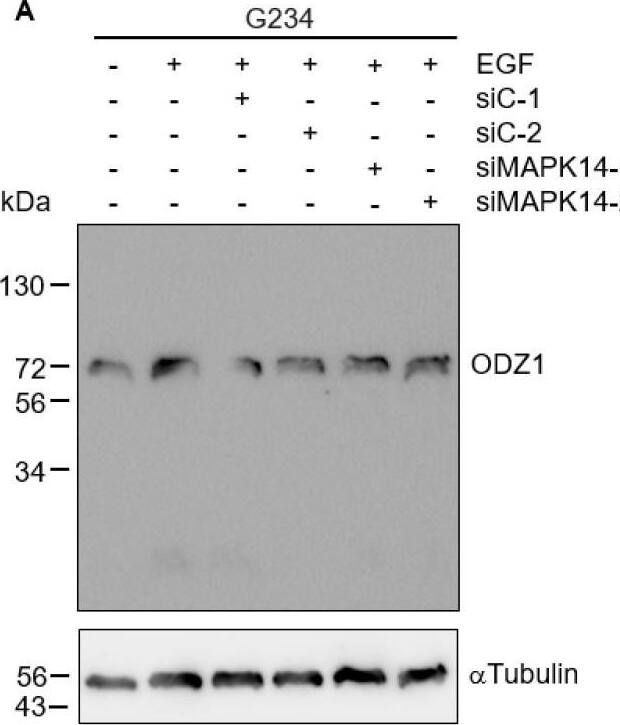
Detection of Teneurin-1 by Western Blot
RNA interference by p38-specific siRNAs neutralizes the EGF-promoted upregulation of ODZ1. (A) GBM cells were transfected with two MAPK14-specific siRNAs or two control siRNAs. Following incubation with EGF, the protein levels of ODZ1 were determined by Western Blot analysis. (B) Same experimental design as in A but uses MAPK11-specific siRNAs. Additionally, alphaTubulin was used to ensure equal loading. (C) Quantification of ODZ1 protein levels of the experiment shown in B by using imageJ software (v1.53k). (D) Cells carrying siRNAs specific to MAPK11 were analyzed for the expression of either MAPK11 or MAPK14 mRNA by qPCR. Histograms represent the mean of three independent experiments ± S.D. ** p < 0.01. Image collected and cropped by CiteAb from the following open publication (https://pubmed.ncbi.nlm.nih.gov/38727302), licensed under a CC-BY license. Not internally tested by R&D Systems.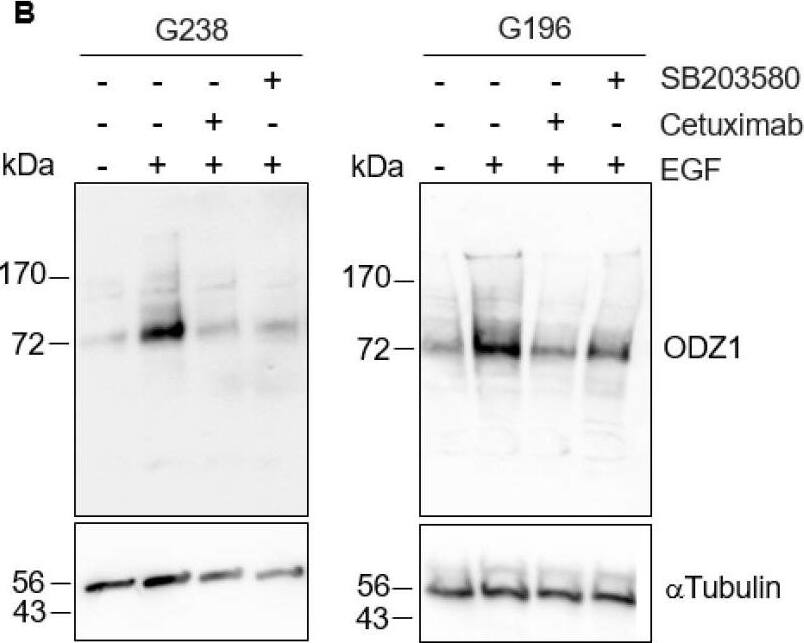
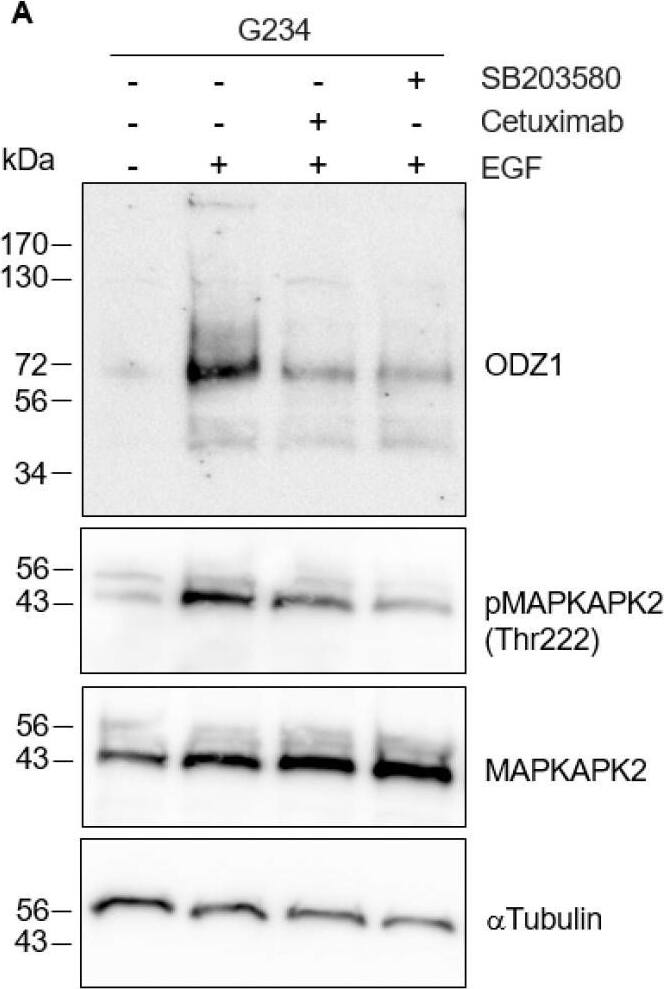
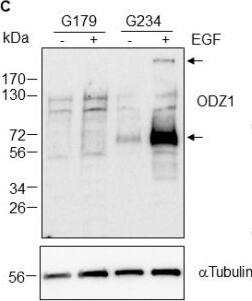
Detection of Teneurin-1 by Western Blot
The blockade of the EGFR–p38 signaling downregulates the levels of ODZ1. (A) GBM cells were treated with EGF in the absence or in the presence of the EGFR-blocking antibody Cetuximab or the specific p38 MAPK inhibitor SB203580. Western Blot analysis confirmed that the blockade of EGFR/p38 inhibited the phosphorylation of MAPKAPK2 at Thr222, a target of p38, and reduced the expression of the ODZ1 protein. (B) Downregulation of ODZ1 following inhibition of EGFR/p38 was confirmed in two additional GBM cell lines. MAPKAPK2 and alphaTubulin were used to ensure equal loading. Image collected and cropped by CiteAb from the following open publication (https://pubmed.ncbi.nlm.nih.gov/38727302), licensed under a CC-BY license. Not internally tested by R&D Systems.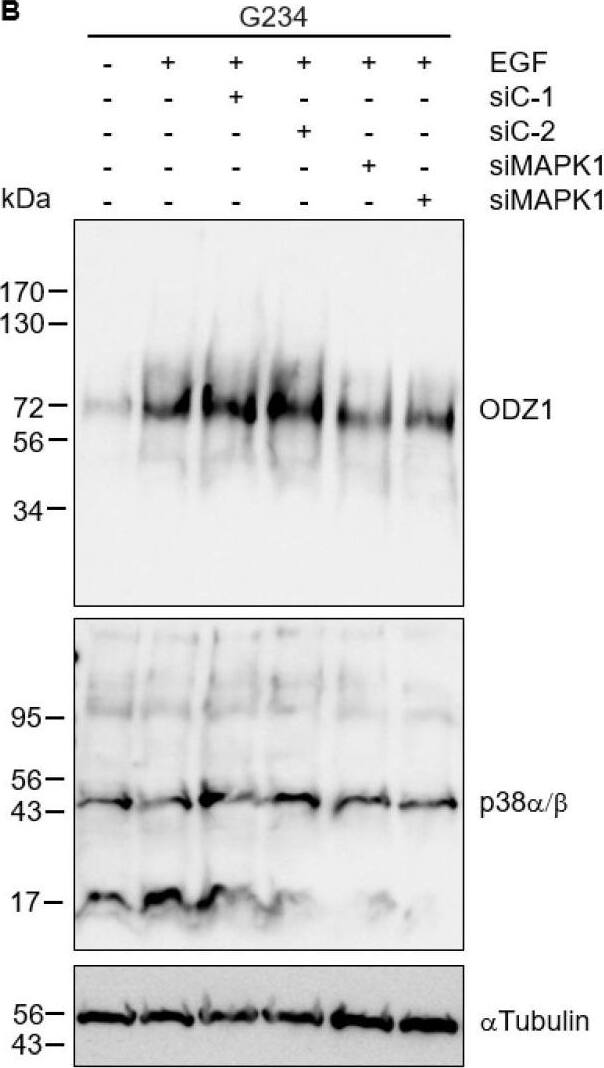
Applications for Human Teneurin-1 Antibody
Application
Recommended Usage
Western Blot
1 µg/mL
Sample: IMR‑32 human neuroblastoma cell line and HEK293 human embryonic kidney cell line
Sample: IMR‑32 human neuroblastoma cell line and HEK293 human embryonic kidney cell line
Formulation, Preparation, and Storage
Purification
Antigen Affinity-purified
Reconstitution
Sterile PBS to a final concentration of 0.2 mg/mL. For liquid material, refer to CoA for concentration.
Formulation
Lyophilized from a 0.2 μm filtered solution in PBS with Trehalose. *Small pack size (SP) is supplied either lyophilized or as a 0.2 µm filtered solution in PBS.
Shipping
Lyophilized product is shipped at ambient temperature. Liquid small pack size (-SP) is shipped with polar packs. Upon receipt, store immediately at the temperature recommended below.
Stability & Storage
Use a manual defrost freezer and avoid repeated freeze-thaw cycles.
- 12 months from date of receipt, -20 to -70 °C as supplied.
- 1 month, 2 to 8 °C under sterile conditions after reconstitution.
- 6 months, -20 to -70 °C under sterile conditions after reconstitution.
Background: Teneurin-1
Teneurin-1 (also Ten-m1, tenascin-M1, and Ten-m/Odz1) is a 250-300 kDa member of the tenascin family, teneurin subfamily of transmembrane (TM) molecules. It is a covalently-linked homodimer that is expressed in both embryonic and adult neurons, among which are cerebellar granule cells and CA2 pyramidal hippocampal neurons. Teneurin 1 appears to promote neurite outgrowth and mediate cell-to-cell adhesion via homophilic interactions. Human Teneurin-1 is a 2725 amino acid (aa) type II TM glycoprotein. It contains a 324 aa cytoplasmic region (aa 1-324) that contains an NLS (aa 62‑65), plus a 2380 aa extracellular domain (ECD). The ECD possesses eight sequential EGF-like domains (aa 528-796), five NHL repeats, each of which form a beta-propeller (aa 1194-1524), and 23 YD/TyrAsp-containing repeats that bind carbohydrates. Cleavage at the N-terminus generates an initial 65 kDa membrane spanning fragment, followed by TM cleavage that generates a 45 kDa cytosolic fragment. C-terminal cleavage generates a short 5 kDa, 41 aa peptide (aa 2682-2722) termed TCAP-1 that shows bioactivity. One splice variant shows a deletion of aa 1232-1239. Over aa 1-317, human Teneurin-1 shares 96% aa identity with mouse Teneurin-1.
Alternate Names
ODZ1, ODZ3, Ten-1, TEN-M1, Tenascin-M1, Teneurin1, TNM
Gene Symbol
TENM1
UniProt
Additional Teneurin-1 Products
Product Documents for Human Teneurin-1 Antibody
Product Specific Notices for Human Teneurin-1 Antibody
For research use only
Loading...
Loading...
Loading...
Loading...
Loading...