
Human SOST/Sclerostin Antibody
R&D Systems, part of Bio-Techne | Catalog # MAB1406


Scientific images may be resized, cropped, or adjusted for brightness or contrast for presentation purposes. These updates are limited to presentation and do not affect the underlying scientific interpretation of the data. Where available, additional source data may be provided upon request.
Conjugate
Catalog #
Key Product Details
Species Reactivity
Validated:
Human
Cited:
Human, Mouse
Applications
Validated:
Western Blot, ELISA Capture (Matched Antibody Pair)
Cited:
Immunohistochemistry, Immunohistochemistry-Paraffin, Western Blot, Immunocytochemistry, ELISA Capture, ELISA Development
Label
Unconjugated
Antibody Source
Monoclonal Mouse IgG2B Clone # 220902
Product Specifications
Immunogen
Mouse myeloma cell line NS0-derived recombinant human SOST/Sclerostin
Gln24-Tyr213
Accession # Q9BQB4
Gln24-Tyr213
Accession # Q9BQB4
Specificity
Detects human SOST/Sclerostin in ELISAs and Western blots. In direct ELISAs and Western blots, no cross-reactivity with recombinant mouse SOST is observed.
Clonality
Monoclonal
Host
Mouse
Isotype
IgG2B
Scientific Data Images for Human SOST/Sclerostin Antibody
Detection of SOST/Sclerostin by Western Blot
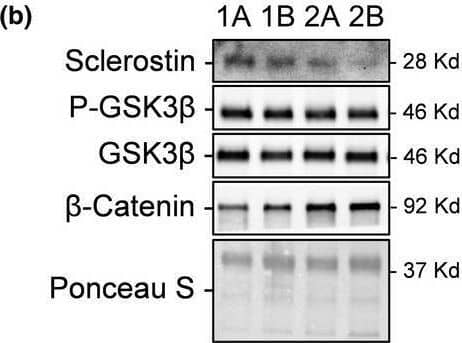
Response of serum sclerostin and Wnt/ beta‐catenin signaling within scWAT to 4 weeks of SIT. (a) Serum sclerostin response to SIT. (b) Representative immunoblots of sclerostin, phosphorylated and total GSK3 beta, beta‐catenin, and total protein loading control (Ponceau S) at pre‐SIT (labeled “a”) and post‐SIT (labeled “b”) with estimated molecular weights on the right. These representative samples are the same two participants (“1” and “2”) in sequence across proteins that highlight their response from pre‐ to post‐SIT. scWAT (c) sclerostin content, (d) total and phosphorylated GSK3 beta, and (e) total beta‐catenin response to SIT relative to pre‐SIT. Bar charts have black lines that represent individual responses to SIT with group means presented as white (pre‐SIT) and gray (post‐SIT) bars ± SD. Paired t‐tests were used to examine changes pre‐ to post‐SIT Image collected and cropped by CiteAb from the following open publication (https://pubmed.ncbi.nlm.nih.gov/35312183), licensed under a CC-BY license. Not internally tested by R&D Systems.
Detection of SOST/Sclerostin by Western Blot
Response of eWAT sclerostin content (A), serine9 phosphorylation status (B,D) both total GSK3b content (C), and total b-catenin content (E) to HFD and acute exercise, as well as representative immunoblots (F). Light grey bars represent sedentary mice and dark grey bars represent mice sampled 2 h following 2 h of acute endurance exercise and are grouped by diet; LFD = low fat diet; HFD = high fat diet. Proteins are corrected for by the house keeping protein vinculin and are all relative to LFD sedentary mice, data are presented as means ± SD and main effects are presented on graphs only if they are either close to or are significant. A two-way factorial ANOVA was used to examine main effects for diet and exercise as well their interaction. Tukey correction was used for multiple pairwise comparisons. Image collected and cropped by CiteAb from the following open publication (https://pubmed.ncbi.nlm.nih.gov/36685192), licensed under a CC-BY license. Not internally tested by R&D Systems.
Detection of SOST/Sclerostin by Western Blot
Response of eWAT sclerostin content (A), serine9 phosphorylation status (B,D) both total GSK3b content (C), and total b-catenin content (E) to HFD and acute exercise, as well as representative immunoblots (F). Light grey bars represent sedentary mice and dark grey bars represent mice sampled 2 h following 2 h of acute endurance exercise and are grouped by diet; LFD = low fat diet; HFD = high fat diet. Proteins are corrected for by the house keeping protein vinculin and are all relative to LFD sedentary mice, data are presented as means ± SD and main effects are presented on graphs only if they are either close to or are significant. A two-way factorial ANOVA was used to examine main effects for diet and exercise as well their interaction. Tukey correction was used for multiple pairwise comparisons. Image collected and cropped by CiteAb from the following open publication (https://pubmed.ncbi.nlm.nih.gov/36685192), licensed under a CC-BY license. Not internally tested by R&D Systems.

Applications for Human SOST/Sclerostin Antibody
Application
Recommended Usage
Western Blot
1 µg/mL
Sample: Recombinant Human SOST/Sclerostin (Catalog # 1406-ST)
Sample: Recombinant Human SOST/Sclerostin (Catalog # 1406-ST)
Human SOST Sandwich Immunoassay
Please Note: Optimal dilutions of this antibody should be experimentally determined.
Formulation, Preparation, and Storage
Purification
Protein A or G purified from hybridoma culture supernatant
Reconstitution
Reconstitute at 0.5 mg/mL in sterile PBS. For liquid material, refer to CoA for concentration.
Formulation
Lyophilized from a 0.2 μm filtered solution in PBS with Trehalose. *Small pack size (SP) is supplied either lyophilized or as a 0.2 µm filtered solution in PBS.
Shipping
Lyophilized product is shipped at ambient temperature. Liquid small pack size (-SP) is shipped with polar packs. Upon receipt, store immediately at the temperature recommended below.
Stability & Storage
Use a manual defrost freezer and avoid repeated freeze-thaw cycles.
- 12 months from date of receipt, -20 to -70 °C as supplied.
- 1 month, 2 to 8 °C under sterile conditions after reconstitution.
- 6 months, -20 to -70 °C under sterile conditions after reconstitution.
Background: SOST/Sclerostin
Alternate Names
sclerostin, VBCHsclerosteosis
Gene Symbol
SOST
UniProt
Additional SOST/Sclerostin Products
Product Documents for Human SOST/Sclerostin Antibody
Product Specific Notices for Human SOST/Sclerostin Antibody
For research use only
Loading...
Loading...
Loading...
Loading...
Loading...