
Human Siglec-3/CD33 LlaMABodyTM Bivalent VHH HuIgG2 Fusion Antibody
R&D Systems, part of Bio-Techne | Catalog # LMAB10888
Recombinant Monoclonal Antibody. Bivalent Llama VHH domain, Human IgG2 Fusion Antibody.

Key Product Details
Species Reactivity
Human
Applications
Flow Cytometry
Label
Unconjugated
Antibody Source
Recombinant Monoclonal Llama VHH domain Clone # L008.2.25H
Product Specifications
Immunogen
Mouse myeloma cell line NS0-derived human Siglec-3/CD33
Asp18--His259
Accession # AAA51948
Asp18--His259
Accession # AAA51948
Specificity
Detects human Siglec-3/CD33 in direct ELISAs.
Clonality
Monoclonal
Host
Llama
Isotype
VHH domain
Scientific Data Images
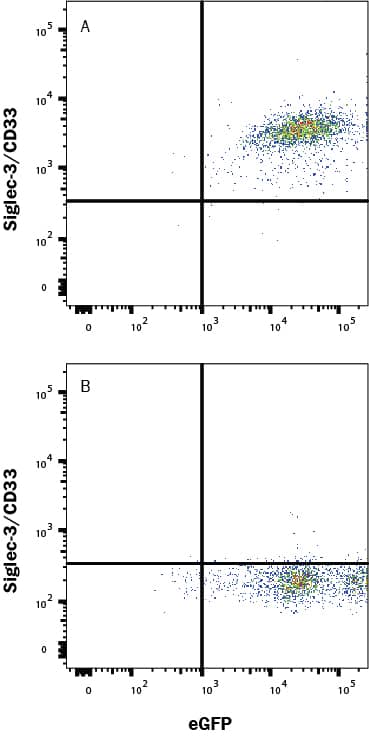
Detection of Siglec-3/CD33 in HEK293 Human Cell Line Transfected with Human Siglec-3/CD33 and eGFP by Flow Cytometry.
HEK293 human embryonic kidney cell line transfected with either (A) human Siglec-3/CD33 or (B) irrelevant protein and eGFP was stained with Llama Anti-Human Siglec-3/CD33 Llamabody VHH hIgG2 Monoclonal Antibody (Catalog # LMAB10888) followed by Allophycocyanin-conjugated Goat Anti-Human Secondary Antibody (F0135). Staining was performed using our Staining Membrane-associated Proteins protocol.Applications
Application
Recommended Usage
Flow Cytometry
0.25 µg/106 cells
Sample: HEK293 Human Cell Line Transfected with Human Siglec-3/CD33 and eGFP
Sample: HEK293 Human Cell Line Transfected with Human Siglec-3/CD33 and eGFP
Formulation, Preparation, and Storage
Purification
Protein A or G purified from cell culture supernatant
Reconstitution
Reconstitute at 0.5 mg/mL in sterile PBS. For liquid material, refer to CoA for concentration.
Formulation
Lyophilized from a 0.2 μm filtered solution in PBS with Trehalose. *Small pack size (SP) is supplied either lyophilized or as a 0.2 µm filtered solution in PBS.
Shipping
Lyophilized product is shipped at ambient temperature. Liquid small pack size (-SP) is shipped with polar packs. Upon receipt, store immediately at the temperature recommended below.
Stability & Storage
Use a manual defrost freezer and avoid repeated freeze-thaw cycles.
- 12 months from date of receipt, -20 to -70 °C as supplied.
- 1 month, 2 to 8 °C under sterile conditions after reconstitution.
- 6 months, -20 to -70 °C under sterile conditions after reconstitution.
Background: Siglec-3/CD33
References
- Crocker, P.R. and A. Varki (2001) Trends Immunol. 22:337.
- Crocker, P.R. and A. Varki (2001) Immunology 103:137.
- Angata, T. et al. (2002) J. Biol. Chem. 277:24466.
- Simmons, D. and B. Seed (1988) J. Immunol. 141:2797.
- Freeman, S.D. et al. (1995) Blood 85:2002.
- Taylor, V.C. et al. (1999) J. Biol. Chem. 274:11505.
- Ulyanova, T. et al. (1999) Eur. J. Immunol. 29:3440.
Long Name
Sialic Acid Binding Ig-like Lectin 3
Alternate Names
CD33, gp67, Siglec3
Gene Symbol
CD33
UniProt
Additional Siglec-3/CD33 Products
Product Specific Notices
For research use only
Loading...
Loading...
Loading...
Loading...
Loading...
Loading...