
Human/Mouse/Rat CTGF/CCN2 Antibody
R&D Systems, part of Bio-Techne | Catalog # MAB91901
Recombinant Monoclonal Antibody.


Scientific images may be resized, cropped, or adjusted for brightness or contrast for presentation purposes. These updates are limited to presentation and do not affect the underlying scientific interpretation of the data. Where available, additional source data may be provided upon request.
Conjugate
Catalog #
Key Product Details
Species Reactivity
Validated:
Human, Mouse, Rat
Cited:
Mouse
Applications
Validated:
Western Blot
Cited:
Western Blot, Neutralization
Label
Unconjugated
Antibody Source
Recombinant Monoclonal Rabbit IgG Clone # 2191A
Product Specifications
Immunogen
E. coli-derived recombinant human CTGF/CCN2
Glu247-Ala349
Accession # P29279
Glu247-Ala349
Accession # P29279
Specificity
Detects human CTGF/CCN2 in direct ELISAs. Detects human, mouse, and rat CTGF/CCN2 in Western blots.
Clonality
Monoclonal
Host
Rabbit
Isotype
IgG
Scientific Data Images for Human/Mouse/Rat CTGF/CCN2 Antibody
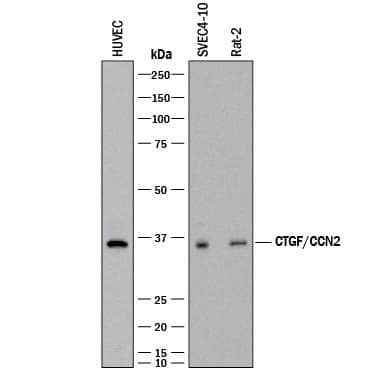
Detection of Human, Mouse, and Rat CTGF/CCN2 by Western Blot.
Western blot shows lysates of HUVEC human umbilical vein endothelial cells, SVEC4-10 mouse vascular endothelial cell line, and Rat-2 rat embryonic fibroblast cell line. PVDF membrane was probed with 2 µg/mL of Rabbit Anti-Human/Mouse/Rat CTGF/CCN2 Monoclonal Antibody (Catalog # MAB91901) followed by HRP-conjugated Anti-Rabbit IgG Secondary Antibody (Catalog # HAF008). A specific band was detected for CTGF/CCN2 at approximately 36 kDa (as indicated). This experiment was conducted under reducing conditions and using Immunoblot Buffer Group 1.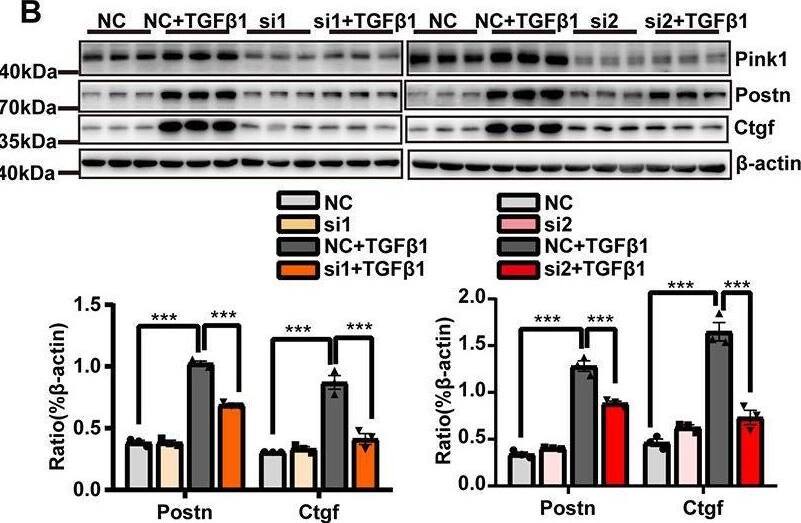
Detection of CTGF/CCN2 by Western Blot
The suppression of mitophagy inhibited cardiac fibroblasts (CF) activation. CF were transfected with either Pink1 siRNA or negative control (NC) and then stimulated with TGF-beta 1. (A) alpha-SMA immunofluorescence staining and semi-quantitative analysis. (B) Immunoblot analyses and quantitative analyses of the markers of CF activation, Postn and Ctgf, among the different groups. EdU and vimentin staining (C) and the MTS cell proliferation assay (D) were used to evaluate CF proliferation. (E) A wound healing assay was performed to evaluate CF migratory capacity following the different treatments. (F) Measurement of lysyl oxidase (LOX) activity. (G) The relative expression levels of extracellular matrix (ECM)-related proteins normalized to that of beta-actin. (H) Cell apoptosis was compared among the different groups by flow cytometry. Data are shown as mean ± standard error of the mean (n = 3 independent cell isolations per group). Means were compared by one-way ANOVA, followed by the Student–Newman–Keuls (SNK) post hoc test. *P < 0.05; **P < 0.01; ***P < 0.001. Image collected and cropped by CiteAb from the following open publication (https://pubmed.ncbi.nlm.nih.gov/33585469), licensed under a CC-BY license. Not internally tested by R&D Systems.
Detection of CTGF/CCN2 by Western Blot
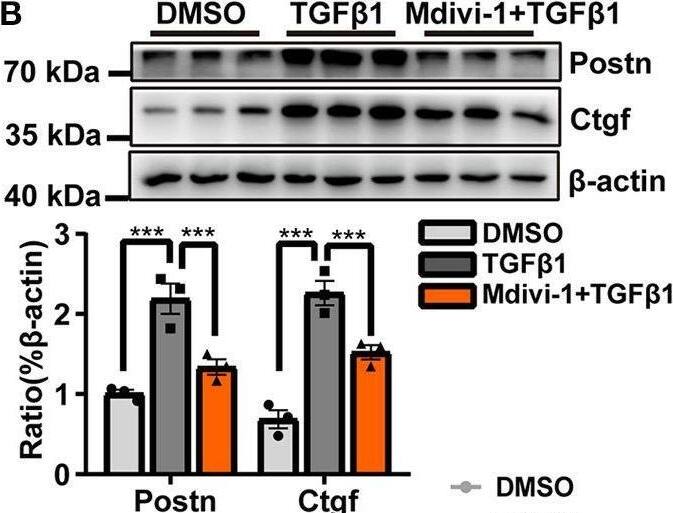
Reducing the cardiac fibroblasts (CF) glycolytic flux may be important for mitochondrial fission inhibition-induced suppression of CF activation. (A) Measurements of the extracellular acidification rate (ECAR) metabolic profile by Seahorse XF glycolytic rate assay kit and analyses of CF Proton Efflux Rate (PER) in basal glycolysis and glycolysis capacity. (B) The oxygen consumption rate (OCR) as measured using a Seahorse XF Cell Mito Stress Test Kit and analyses of the OCR under basal and maximum respiration. (C) Western blot analyses and quantification of key glycolytic enzymes under TGF-beta 1 plus mdivi-1 cotreatment. (D) The expression of CF activation-related markers was measured by immunoblotting following TGF-beta 1 plus mdivi-1 cotreatment and in the presence or absence of 2-DG. Data are shown as mean ± standard error of the mean (n = 3 independent cell isolations per group). Means were compared by one-way ANOVA, followed by the Student–Newman–Keuls (SNK) post hoc test. ns, not significant; *P < 0.05; **P < 0.01; ***P < 0.001. Image collected and cropped by CiteAb from the following open publication (https://pubmed.ncbi.nlm.nih.gov/33585469), licensed under a CC-BY license. Not internally tested by R&D Systems.Applications for Human/Mouse/Rat CTGF/CCN2 Antibody
Application
Recommended Usage
Western Blot
2 µg/mL
Sample: HUVEC human umbilical vein endothelial cells, SVEC4‑10 mouse vascular endothelial cell line, and Rat‑2 rat embryonic fibroblast cell line
Sample: HUVEC human umbilical vein endothelial cells, SVEC4‑10 mouse vascular endothelial cell line, and Rat‑2 rat embryonic fibroblast cell line
Formulation, Preparation, and Storage
Purification
Protein A or G purified from hybridoma culture supernatant
Reconstitution
Reconstitute at 0.5 mg/mL in sterile PBS. For liquid material, refer to CoA for concentration.
Formulation
Lyophilized from a 0.2 μm filtered solution in PBS with Trehalose. *Small pack size (SP) is supplied either lyophilized or as a 0.2 µm filtered solution in PBS.
Shipping
Lyophilized product is shipped at ambient temperature. Liquid small pack size (-SP) is shipped with polar packs. Upon receipt, store immediately at the temperature recommended below.
Stability & Storage
Use a manual defrost freezer and avoid repeated freeze-thaw cycles.
- 12 months from date of receipt, -20 to -70 °C as supplied.
- 1 month, 2 to 8 °C under sterile conditions after reconstitution.
- 6 months, -20 to -70 °C under sterile conditions after reconstitution.
Background: CTGF/CCN2
Long Name
Connective Tissue Growth Factor
Alternate Names
CCN2, CTGRP, Fisp12, HCS24, IGFBP-8, NOV2
Gene Symbol
CCN2
UniProt
Additional CTGF/CCN2 Products
Product Documents for Human/Mouse/Rat CTGF/CCN2 Antibody
Product Specific Notices for Human/Mouse/Rat CTGF/CCN2 Antibody
For research use only
Loading...
Loading...
Loading...
Loading...
Loading...