
Human/Mouse 14-3-3 zeta Antibody
R&D Systems, part of Bio-Techne | Catalog # AF2669

Scientific images may be resized, cropped, or adjusted for brightness or contrast for presentation purposes. These updates are limited to presentation and do not affect the underlying scientific interpretation of the data. Where available, additional source data may be provided upon request.
Conjugate
Catalog #
Key Product Details
Species Reactivity
Validated:
Human, Mouse
Cited:
Human, Mouse
Applications
Validated:
Western Blot
Cited:
Immunohistochemistry, Western Blot
Label
Unconjugated
Antibody Source
Polyclonal Goat IgG
Product Specifications
Immunogen
E. coli-derived recombinant human 14-3-3 zeta
Met1-Asn245
Accession # P63104
Met1-Asn245
Accession # P63104
Specificity
Detects human, mouse, and rat 14-3-3 zeta in Western blots. In Western blots, less than 1% cross-reactivity with recombinant human 14‑3‑3 beta, epsilon, eta, gamma, or sigma is observed.
Clonality
Polyclonal
Host
Goat
Isotype
IgG
Scientific Data Images for Human/Mouse 14-3-3 zeta Antibody
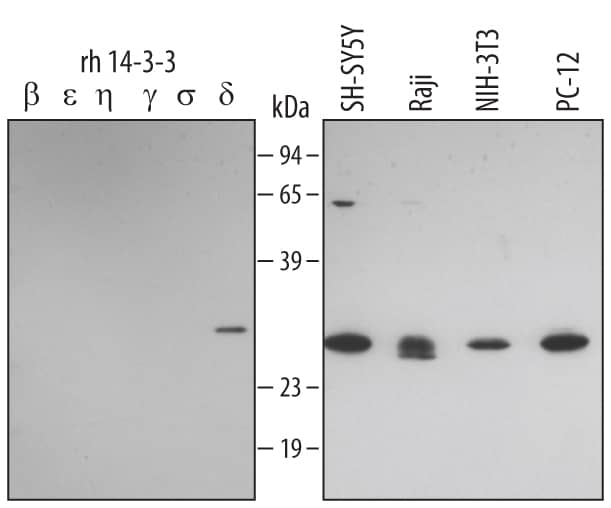
Detection of Human/Mouse 14‑3‑3 zeta by Western Blot.
Western blot shows lysates of SH-SY5Y human neuroblastoma cell line, Raji human Burkitt's lymphoma cell line, NIH-3T3 mouse embryonic fibroblast cell line, and PC-12 rat adrenal pheo-chromocytoma cell line. PVDF membrane was probed with 0.25 µg/mL Goat Anti-Human/ Mouse 14-3-3 zeta Antigen Affinity-purified Polyclonal Antibody (Catalog # AF2669) followed by HRP-conjugated Anti-Goat IgG Secondary Antibody (Catalog # HAF017). For additional reference, recombinant human 14-3-3 beta, epsilon, eta, gamma, sigma, and zeta (2 ng/lane) were included. A specific band for 14-3-3 zeta was detected at approximately 27 kDa (as indicated). This experiment was conducted under reducing conditions and using Immunoblot Buffer Group 2.Applications for Human/Mouse 14-3-3 zeta Antibody
Application
Recommended Usage
Western Blot
0.25 µg/mL
Sample: SH-SY5Y human neuroblastoma cell line, Raji human Burkitt's lymphoma cell line, NIH-3T3 mouse embryonic fibroblast cell line, and PC-12 rat adrenal pheochromocytoma cell line
Sample: SH-SY5Y human neuroblastoma cell line, Raji human Burkitt's lymphoma cell line, NIH-3T3 mouse embryonic fibroblast cell line, and PC-12 rat adrenal pheochromocytoma cell line
Reviewed Applications
Read 1 review rated 4 using AF2669 in the following applications:
Formulation, Preparation, and Storage
Purification
Antigen Affinity-purified
Reconstitution
Reconstitute at 0.2 mg/mL in sterile PBS. For liquid material, refer to CoA for concentration.
Formulation
Lyophilized from a 0.2 μm filtered solution in PBS with Trehalose. *Small pack size (SP) is supplied either lyophilized or as a 0.2 µm filtered solution in PBS.
Shipping
Lyophilized product is shipped at ambient temperature. Liquid small pack size (-SP) is shipped with polar packs. Upon receipt, store immediately at the temperature recommended below.
Stability & Storage
Use a manual defrost freezer and avoid repeated freeze-thaw cycles.
- 12 months from date of receipt, -20 to -70 °C as supplied.
- 1 month, 2 to 8 °C under sterile conditions after reconstitution.
- 6 months, -20 to -70 °C under sterile conditions after reconstitution.
Background: 14-3-3 zeta
14-3-3 proteins are a highly conserved family of homo- and heterodimeric phosphoserine/threonine-binding proteins present in high abundance in all eukaryotic cells. 14-3-3 proteins were the first polypeptides shown to have pSer/Thr binding properties, generally recognizing the consensus sequences RSXpSXP and RXY/FXpSXP (where X is any amino acid). 14-3-3 proteins act as key regulators of intracellular signal transduction through their ability to bind specific motifs phosphorylated on serine or threonine. For example, the binding of 14-3-3 to phosphorylated BAD blocks its proapoptotic association with Bcl-XL. There are at least seven distinct 14-3-3 genes in vertebrates, alpha/beta, epsilon, eta, gamma, theta, sigma and zeta ( alpha/ beta, epsilon, eta, gamma, tau/ theta, sigma, and zeta/ delta). 14-3-3 zeta, also known as Tyrosine 3-Monooxygenase/Tryptophan 5-Monooxygenase Activation Protein, zeta isoform (YWHAZ) is a 245 amino acid, 27 kDa protein.
Additional 14-3-3 zeta Products
Product Documents for Human/Mouse 14-3-3 zeta Antibody
Product Specific Notices for Human/Mouse 14-3-3 zeta Antibody
For research use only
Loading...
Loading...
Loading...
Loading...
Loading...