
Human IL-17C Antibody
R&D Systems, part of Bio-Techne | Catalog # AF1234


Scientific images may be resized, cropped, or adjusted for brightness or contrast for presentation purposes. These updates are limited to presentation and do not affect the underlying scientific interpretation of the data. Where available, additional source data may be provided upon request.
Conjugate
Catalog #
Key Product Details
Species Reactivity
Validated:
Human
Cited:
Human
Applications
Validated:
Western Blot
Cited:
Immunohistochemistry
Label
Unconjugated
Antibody Source
Polyclonal Goat IgG
Product Specifications
Immunogen
E. coli-derived recombinant human IL-17C
His19-Val197
Accession # Q9P0M4
His19-Val197
Accession # Q9P0M4
Specificity
Detects human IL-17C in direct ELISAs and Western blots. In direct ELISAs, less than 5% cross-reactivity with recombinant human(rh) IL‑17D and rhIL‑17E is observed.
Clonality
Polyclonal
Host
Goat
Isotype
IgG
Scientific Data Images for Human IL-17C Antibody
Human IL-17C ELISA Standard Curve
Recombinant Human IL-17C (Catalog # 1234-IL) was serially diluted and captured by Mouse Anti-Human IL-17C Monoclonal Antibody (Catalog # MAB1234) coated on a Clear Polystyrene Microplate (Catalog # DY990). Goat Anti-Human IL-17C Antigen Affinity-purified Polyclonal Antibody (Catalog # AF1234) was biotinylated and incubated with the protein captured on the plate. Detection of the standard curve was achieved by incubating Streptavidin-HRP (Catalog # DY998)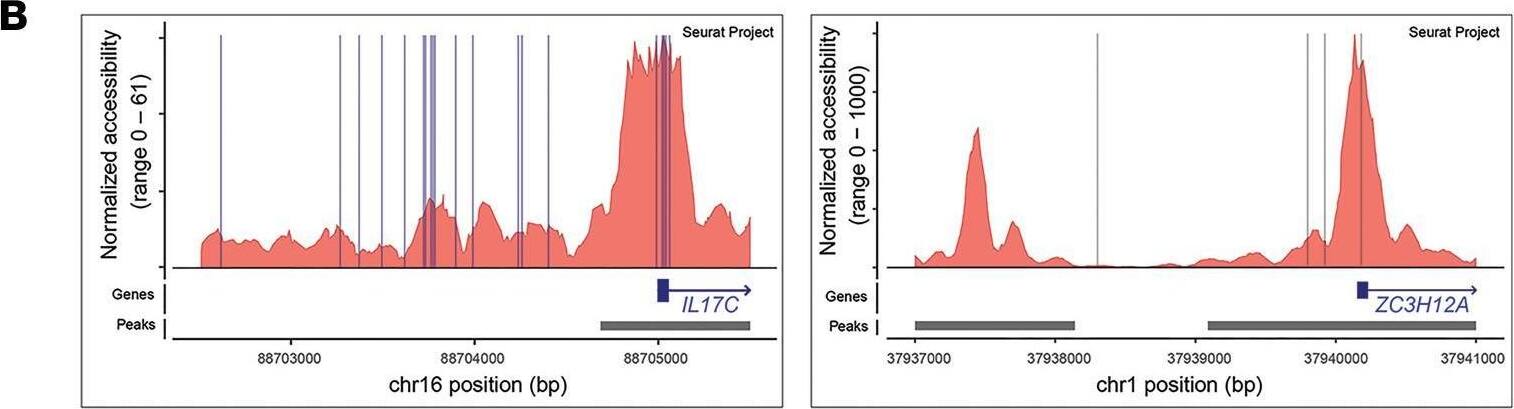
Detection of IL-17C by Flow Cytometry
TCF4 negatively regulates IL-17C in keratinocytes.(A) Silencing TCF4 (siRNA-mediated) in N/TERT keratinocytes, but not NFKB1, JUN, or CEBPG, increases IL17C mRNA expression, which is further increased in the presence of TNF-alpha stimulation (10 ng/mL; n = 3, mean ± SEM, 2-way ANOVA with post hoc Tukey test. *P < 0.01; **P < 0.005, ***P < 0.001, ****P < 0.0001; dashed line and the diamond demarcate P < 0.05 between 2 indicated groups via Student’s t test (Supplemental Figure 3). (B) ATAC-Seq of human KCs isolated from fresh tissue biopsies identifies TCF4 binding sites in open chromatin regions of IL17C and ZC3H12A promoters. (C) Representative images of healthy normal and of lesional and nonlesional Ps skin demonstrates decreases in TCF4 (nuclear localization) and increases in IL-17C and ZC3H12A staining (using IHC; stained protein appears brown in color). Insets represent higher-magnification image. Scale bar: 100 μm; 20 μm (insets). (D) IL17C expression negatively correlates with TCF4 and positively correlates with ZC3H12A in lesional Ps and AD skin. Image collected and cropped by CiteAb from the following open publication (https://pubmed.ncbi.nlm.nih.gov/38470486), licensed under a CC-BY license. Not internally tested by R&D Systems.Applications for Human IL-17C Antibody
Application
Recommended Usage
Western Blot
0.1 µg/mL
Sample: Recombinant Human IL-17C (Catalog # 1234-IL)
Sample: Recombinant Human IL-17C (Catalog # 1234-IL)
Formulation, Preparation, and Storage
Purification
Antigen Affinity-purified
Reconstitution
Reconstitute at 0.2 mg/mL in sterile PBS. For liquid material, refer to CoA for concentration.
Formulation
Lyophilized from a 0.2 μm filtered solution in PBS with Trehalose. *Small pack size (SP) is supplied either lyophilized or as a 0.2 µm filtered solution in PBS.
Shipping
Lyophilized product is shipped at ambient temperature. Liquid small pack size (-SP) is shipped with polar packs. Upon receipt, store immediately at the temperature recommended below.
Stability & Storage
Use a manual defrost freezer and avoid repeated freeze-thaw cycles.
- 12 months from date of receipt, -20 to -70 °C as supplied.
- 1 month, 2 to 8 °C under sterile conditions after reconstitution.
- 6 months, -20 to -70 °C under sterile conditions after reconstitution.
Background: IL-17C
The Interleukin-17 (IL-17) family proteins, comprising six members (IL-17 and IL-17B through IL-17F), are secreted, structurally related proteins that share a conserved cysteine-knot fold near the C-terminus, but have considerable sequence divergence at the N-terminus (1, 2). With the exception of IL-17B, which exists as a
non-covalently linked dimer, all IL-17 family members are disulfide-linked dimers (3). IL-17 family proteins are pro-inflammatory cytokines that induce local cytokine production and are involved in the regulation of immune functions (1, 2). Two receptors (IL-17 R, and IL-17B R), which are activated by IL-17 family members, have been identified. In addition, at least three additional orphan type I transmembrane receptors with homology to IL-17 R, including IL-17 RL (IL-17 RC), IL-17 RD, and
IL‑17 RE, have also been reported (1-4). The functions of IL-17 RC, D, and E are not known.
Human IL-17C cDNA encodes a 197 amino acid (aa) residues protein with a putative 18 aa signal peptide (5). IL-17C shares from 15-30% aa sequence identity with other IL-17 family members. Human and mouse IL-17C also share 83% aa sequence identity. IL-17C has a very restricted expression pattern and was detected as a rare expressed sequence tag (EST) sequence in an adult prostate and fetal kidney libraries (2). IL-17C has been shown to stimulate the release of TNF-alpha and IL-1 beta from the monocytic cell line THP-1, a property it shares with IL-17B (5, 6). The receptor of IL-17C has not yet been identified. The IL-17C preparations from R&D Systems have been found to bind immobilized recombinant IL-17B R/Fc in a functional ELISA.
References
- Aggarwal, S. and A.L. Gurney (2002) J. Leukoc. Biol. 71:1.
- Moseley, T.A. et al. (2003) Cytokine & Growth Factor Rev. 14:155.
- Hymowitz, S.G. et al. (2001) EMBO J. 20:5332.
- Haudenschild, D. et al. (2002) J. Biol. Chem. 277:4309.
- Li, H. et al. (2000) Proc. Natl. Acad. Sci. USA 97:773.
- Shi, Y. et al. (2000) J. Biol. Chem. 275:19167.
Long Name
Interleukin 17C
Alternate Names
Cytokine CX2, IL17C
Gene Symbol
IL17C
UniProt
Additional IL-17C Products
Product Documents for Human IL-17C Antibody
Product Specific Notices for Human IL-17C Antibody
For research use only
Loading...
Loading...
Loading...
Loading...
Loading...