
Human HTRA2/Omi Antibody
R&D Systems, part of Bio-Techne | Catalog # MAB1458


Scientific images may be resized, cropped, or adjusted for brightness or contrast for presentation purposes. These updates are limited to presentation and do not affect the underlying scientific interpretation of the data. Where available, additional source data may be provided upon request.
Conjugate
Catalog #
Key Product Details
Species Reactivity
Validated:
Human
Cited:
Human, Mouse
Applications
Validated:
Western Blot, Immunocytochemistry
Cited:
Western Blot, Immunocytochemistry, ELISA Detection
Label
Unconjugated
Antibody Source
Monoclonal Mouse IgG2B Clone # 229926
Product Specifications
Immunogen
E. coli-derived recombinant human HTRA2/Omi
Ala134-Glu458
Accession # O43464
Ala134-Glu458
Accession # O43464
Specificity
Detects the mitochondria-processed form of human HTRA2/Omi.
Clonality
Monoclonal
Host
Mouse
Isotype
IgG2B
Scientific Data Images for Human HTRA2/Omi Antibody
Detection of Human HTRA2/Omi by Western Blot.
Western blot shows lysates of SK-Mel-28 human malignant melanoma cell line, MCF-7 human breast cancer cell line, HEK293 human embryonic kidney cell line, and HeLa human cervical epithelial carcinoma cell line. PVDF membrane was probed with 1 µg/mL of Mouse Anti-Human HTRA2/Omi Monoclonal Antibody (Catalog # MAB1458) followed by HRP-conjugated Anti-Mouse IgG Secondary Antibody (Catalog # HAF007). A specific band was detected for HTRA2/Omi at approximately 35 kDa (as indicated). This experiment was conducted under reducing conditions and using Immunoblot Buffer Group 4.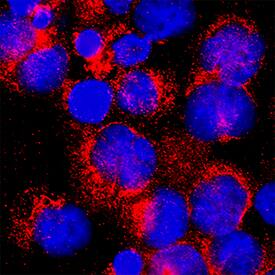
HTRA2/Omi in K562 Human Cell Line.
HTRA2/Omi was detected in immersion fixed K562 human chronic myelogenous leukemia cell line using Mouse Anti-Human HTRA2/Omi Monoclonal Antibody (Catalog # MAB1458) at 25 µg/mL for 3 hours at room temperature. Cells were stained using the NorthernLights™ 557-conjugated Anti-Mouse IgG Secondary Antibody (red; NL007) and counterstained with DAPI (blue). Specific staining was localized to cytoplasm. Staining was performed using our protocol for Fluorescent ICC Staining of Non-adherent Cells.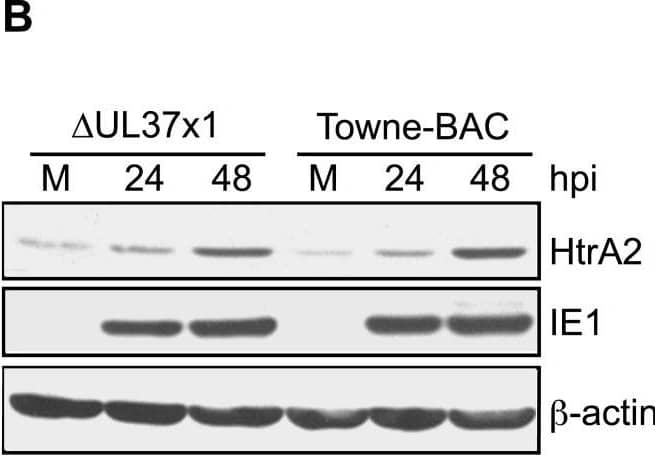
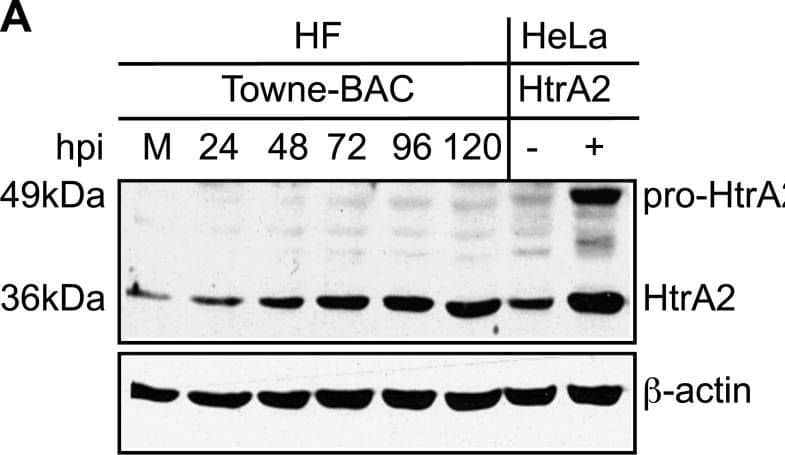
Detection of HTRA2/Omi by Western Blot
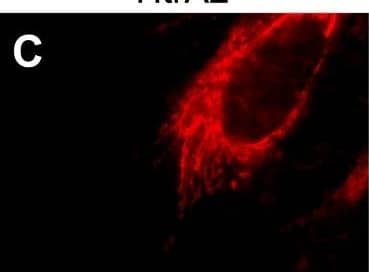
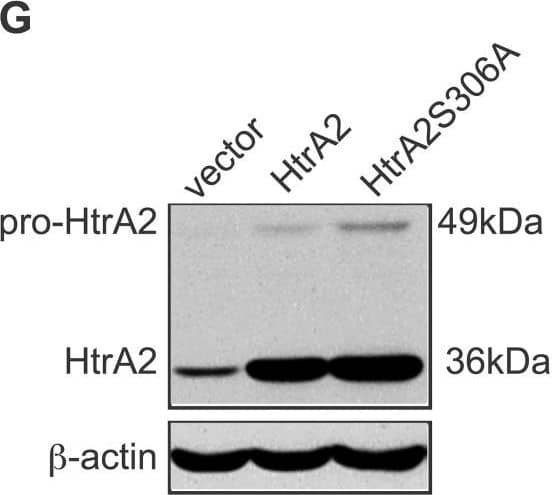
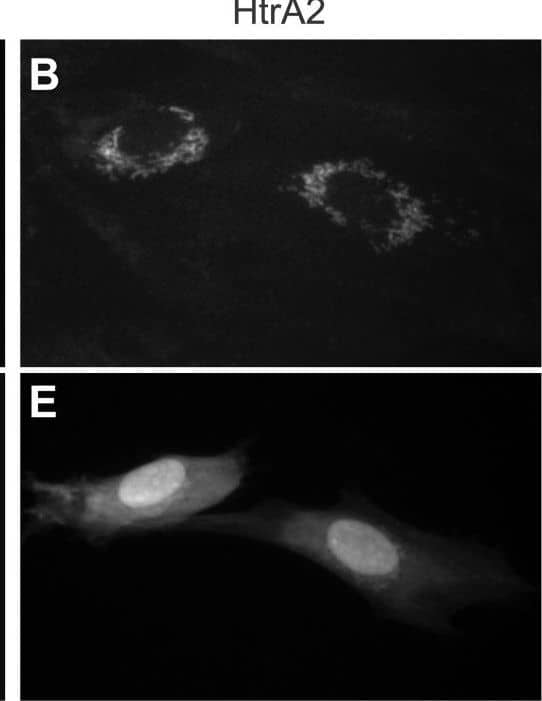
HtrA2/Omi expression increases following CMV infection.(A–B) Immunoblot analyses of HtrA2/Omi in lysates of mock-infected HF (M) or HF infected (MOI of 3) with Towne-BAC or deltaUL37x1 for 24, 48, 72, 96, or 120 h and control cell lysates from HeLa cells transfected with HtrA2/Omi expression plasmid (+) or control plasmid (−). The expected migration of the 49 kDa immature, pro-HtrA2/Omi and 36 kDA mature, HtrA2/Omi was calculated based on migration of molecular weight markers (not shown). Immunoblot detection of HtrA2, beta-actin and IE1 are shown. (C–N) Immunofluorescent images of HtrA2/Omi (C, F) and cytochrome c (I, L) (red), and GFP fluorescence (green) (D, G, J, M) and merged images (E, H, K, N) at 72 h (C–H) or 96 h (I–N) postinfection (MOI of 0.001) with deltaUL37x1 (C–E, I–K) or Towne-BAC (F–H, L–N). Original magnification ×1000. Image collected and cropped by CiteAb from the following open publication (https://pubmed.ncbi.nlm.nih.gov/18769594), licensed under a CC-BY license. Not internally tested by R&D Systems.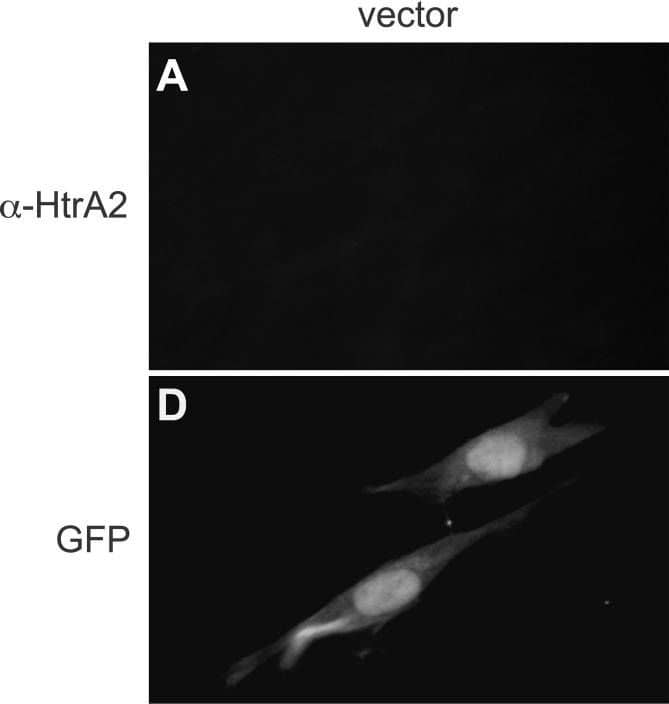
Applications for Human HTRA2/Omi Antibody
Application
Recommended Usage
Immunocytochemistry
8-25 µg/mL
Sample: Immersion fixed K562 human chronic myelogenous leukemia cell line
Sample: Immersion fixed K562 human chronic myelogenous leukemia cell line
Western Blot
1 µg/mL
Sample: SK-Mel-28 human malignant melanoma cell line, MCF-7 human breast cancer cell line, HEK293 human embryonic kidney cell line, and HeLa human cervical epithelial carcinoma cell line
Sample: SK-Mel-28 human malignant melanoma cell line, MCF-7 human breast cancer cell line, HEK293 human embryonic kidney cell line, and HeLa human cervical epithelial carcinoma cell line
Formulation, Preparation, and Storage
Purification
Protein A or G purified from hybridoma culture supernatant
Reconstitution
Reconstitute at 0.5 mg/mL in sterile PBS. For liquid material, refer to CoA for concentration.
Formulation
Lyophilized from a 0.2 μm filtered solution in PBS with Trehalose. *Small pack size (SP) is supplied either lyophilized or as a 0.2 µm filtered solution in PBS.
Shipping
Lyophilized product is shipped at ambient temperature. Liquid small pack size (-SP) is shipped with polar packs. Upon receipt, store immediately at the temperature recommended below.
Stability & Storage
Use a manual defrost freezer and avoid repeated freeze-thaw cycles.
- 12 months from date of receipt, -20 to -70 °C as supplied.
- 1 month, 2 to 8 °C under sterile conditions after reconstitution.
- 6 months, -20 to -70 °C under sterile conditions after reconstitution.
Background: HTRA2/Omi
HTRA2/Omi is the mammalian homologue of bacterial high temperature requirement protein (HtrA). HTRA2/Omi localizes to the mitochondria and is processed to expose an amino-terminal Reaper-like motif similar to SMAC/Diablo. HTRA2/Omi is released from the mitochondria in response to apoptotic insult and can interact with the BIR2 or BIR3 domains of XIAP to relieve caspase-IAP inhibition. This effect can be measured by reversing XIAP-BIR2 (R&D Systems, Catalog # 786-XB) inhibition of Caspase-7 (R&D Systems, Catalog # 823-C7) cleavage of a fluorogenic peptide (DEVD-AFC, MP Bio, Catalog # AFC-138). IC50 values for this effect are typically between 0.2 and 1.5 μM. HTRA2/Omi is trimeric and functions as a serine protease. The serine protease activity may play a more central role in apoptosis than its IAP antagonizing function. A PDZ domain regulates the serine protease activity by blocking access to the active site.
References
- Suzuki, Y. et al. (2001) Mol. Cell. 8:613.
- van Loo, G. et al. (2002) Cell Death & Diff. 9:20.
- Hedge, R. et al. (2001) J. Biol. Chem. 277:432.
- Verhagen, A. et al. (2001) J. Biol. Chem. 277:445.
- Martins, L. et al. (2002) J. Biol. Chem. 277:439.
- Silke, J., and A. Verhagen (2002) Cell Death & Diff. 9:362.
- Savopoulos, J. et al. (2000) Protein Expression & Purification 19:227.
Long Name
High Temperature Requirement Protein-2
Alternate Names
Omi, PRSS25
Gene Symbol
HTRA2
UniProt
Additional HTRA2/Omi Products
Product Documents for Human HTRA2/Omi Antibody
Product Specific Notices for Human HTRA2/Omi Antibody
For research use only
Loading...
Loading...
Loading...
Loading...
Loading...