
Human DC-SIGNR/CD299 PE-conjugated Antibody
R&D Systems, part of Bio-Techne | Catalog # FAB162P
Clone 120604 was used by HLDA to establish CD designation

Conjugate
Catalog #
Key Product Details
Species Reactivity
Validated:
Human
Cited:
Human, Primate - Macaca mulatta (Rhesus Macaque)
Applications
Validated:
Flow Cytometry
Cited:
Flow Cytometry
Label
Phycoerythrin (Excitation = 488 nm, Emission = 565-605 nm)
Antibody Source
Monoclonal Mouse IgG2B Clone # 120604
Product Specifications
Immunogen
NIH-3T3 mouse embryonic fibroblast cell line transfected with human DC‑SIGNR/CD299
Accession # Q9H2X3
Accession # Q9H2X3
Specificity
Detects human DC‑SIGNR/CD299.
Clonality
Monoclonal
Host
Mouse
Isotype
IgG2B
Scientific Data Images for Human DC-SIGNR/CD299 PE-conjugated Antibody
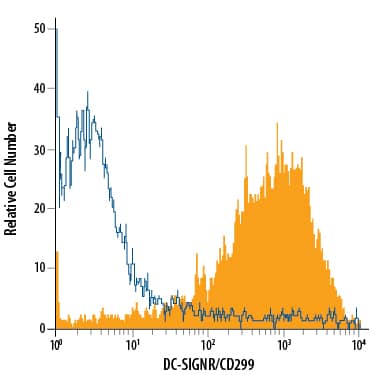
Detection of DC-SIGNR/CD299 in 3T3 Mouse Cell Line Transfected with Human DC-SIGNR/CD299 by Flow Cytometry.
3T3 mouse embryonic fibroblast cell line transfected with human DC-SIGNR/CD299 was stained with Mouse Anti-Human DC-SIGNR/CD299 PE-conjugated Monoclonal Antibody (Catalog # FAB162P, filled histogram) or isotype control antibody (Catalog # IC0041P, open histogram). View our protocol for Staining Membrane-associated Proteins.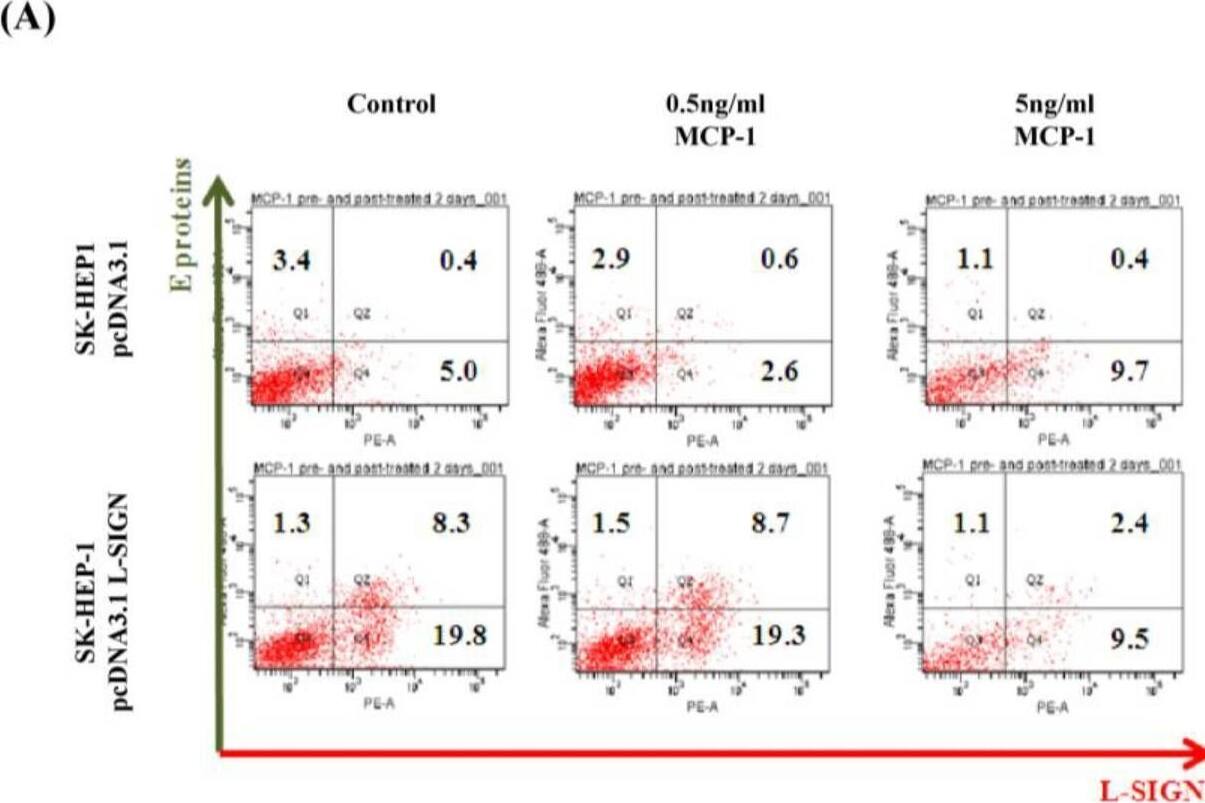
Detection of DC-SIGNR/CD299 by Flow Cytometry
Recombinant MCP-1 protein in DENV replication. (A) Flow cytometry was used to detect the dengue virus envelope protein (E) and L-SIGN expression on the cell surface in DENV-infected SK-HEP-1 pcDNA3.1 and SK-HEP-1 pcDNA3.1 L-SIGN with 0, 0.5, and 5 ng/mL MCP-1. (B) DENV copy numbers were counted by fluorescence intensity in DENV-infected SK-HEP-1 pcDNA3.1 and SK-HEP-1 pcDNA3.1 L-SIGN with 0, 0.5, and 5 ng/mL MCP-1. Image collected and cropped by CiteAb from the following open publication (https://pubmed.ncbi.nlm.nih.gov/40143272), licensed under a CC-BY license. Not internally tested by R&D Systems.Applications for Human DC-SIGNR/CD299 PE-conjugated Antibody
Application
Recommended Usage
Flow Cytometry
10 µL/106 cells
Sample: 3T3 mouse embryonic fibroblast cell line transfected with human DC-SIGNR/CD299
Sample: 3T3 mouse embryonic fibroblast cell line transfected with human DC-SIGNR/CD299
Reviewed Applications
Read 1 review rated 5 using FAB162P in the following applications:
Spectra Viewer
Plan Your Experiments
Use our spectra viewer to interactively plan your experiments, assessing multiplexing options. View the excitation and emission spectra for our fluorescent dye range and other commonly used dyes.
Spectra Viewer
Formulation, Preparation, and Storage
Purification
Protein A or G purified from hybridoma culture supernatant
Formulation
Supplied in a saline solution containing BSA and Sodium Azide.
Shipping
The product is shipped with polar packs. Upon receipt, store it immediately at the temperature recommended below.
Stability & Storage
Protect from light. Do not freeze.
- 12 months from date of receipt, 2 to 8 °C as supplied.
Background: DC-SIGNR/CD299
Dendritic cell-specific ICAM-3 grabbing non-integrin (DC-SIGN or CD299) and DC-SIGN related protein (DC-SIGNR, DC-SIGN2, L-SIGN or CD209L) are type II membrane proteins that are mannose-specific calcium-dependent (C-type) lectins. The two proteins share 77% amino acid identity. DC-SIGN mediates interactions between dendritic cells (DCs) and T cells. Both DC-SIGN and DC-SIGNR have been shown to bind HIV, hepatitis C glycoproteins, Ebola virus glycoproteins and the cellular adhesion protein ICAM-3 (1-4). DC-SIGN and DC-SIGNR appear to selectively recognize and bind viral proteins containing a large portion of high-mannose oligosaccharides (5). Though DC-SIGN and DC-SIGNR are found on the same chromosome, they are not expressed in the same tissue. DC-SIGN is expressed solely on Dendritic cells while DC-SIGNR is found on endothelial cells in the liver and lymph node sinuses and in a significant portion of capillary endothelial cells in term placenta (1, 4).
References
- Pohlmann, S. et al. (2001) Proc. Natl. Acad. Sci. USA 98:2670.
- Pohlmann, S. et al. (2003) J. Virol. 77:4070.
- Simmons, L.G. et al. (2003) J. Virol. 77:1337.
- Bahirova, A.A. et al. (2001) J. Exp. Med. 193:671.
- Feinberg, H. et al. (2001) Science 294:2163.
Long Name
Dendritic Cell-specific ICAM-3-grabbing Non-integrin 2
Alternate Names
CD209L, CD299, CLEC4M, DC-SIGN2, DCSIGNR, LSIGN
Entrez Gene IDs
10332 (Human)
Gene Symbol
CLEC4M
UniProt
Additional DC-SIGNR/CD299 Products
Product Documents for Human DC-SIGNR/CD299 PE-conjugated Antibody
Product Specific Notices for Human DC-SIGNR/CD299 PE-conjugated Antibody
For research use only
Loading...
Loading...
Loading...
Loading...
Loading...