
Human CCL3/MIP-1 alpha Antibody
R&D Systems, part of Bio-Techne | Catalog # AB-270-NA

Scientific images may be resized, cropped, or adjusted for brightness or contrast for presentation purposes. These updates are limited to presentation and do not affect the underlying scientific interpretation of the data. Where available, additional source data may be provided upon request.
Key Product Details
Species Reactivity
Validated:
Human
Cited:
Human
Applications
Validated:
Western Blot, Neutralization
Cited:
Neutralization
Label
Unconjugated
Antibody Source
Polyclonal Goat IgG
Product Specifications
Immunogen
E. coli-derived recombinant human CCL3/MIP-1 alpha
Ala27-Ala92
Accession # P10147
Ala27-Ala92
Accession # P10147
Specificity
Detects human CCL3/MIP-1 alpha in direct ELISAs and Western blots. In direct ELISAs, less than 20% cross-reactivity with recombinant human (rh) MIP-1 beta is observed, less than 15% cross-reactivity with recombinant mouse MIP-1 alpha is observed and less than 1% cross-reactivity with rhMIP-1 delta and rhMPIF-1 is observed.
Clonality
Polyclonal
Host
Goat
Isotype
IgG
Endotoxin Level
<0.10 EU per 1 μg of the antibody by the LAL method.
Scientific Data Images for Human CCL3/MIP-1 alpha Antibody
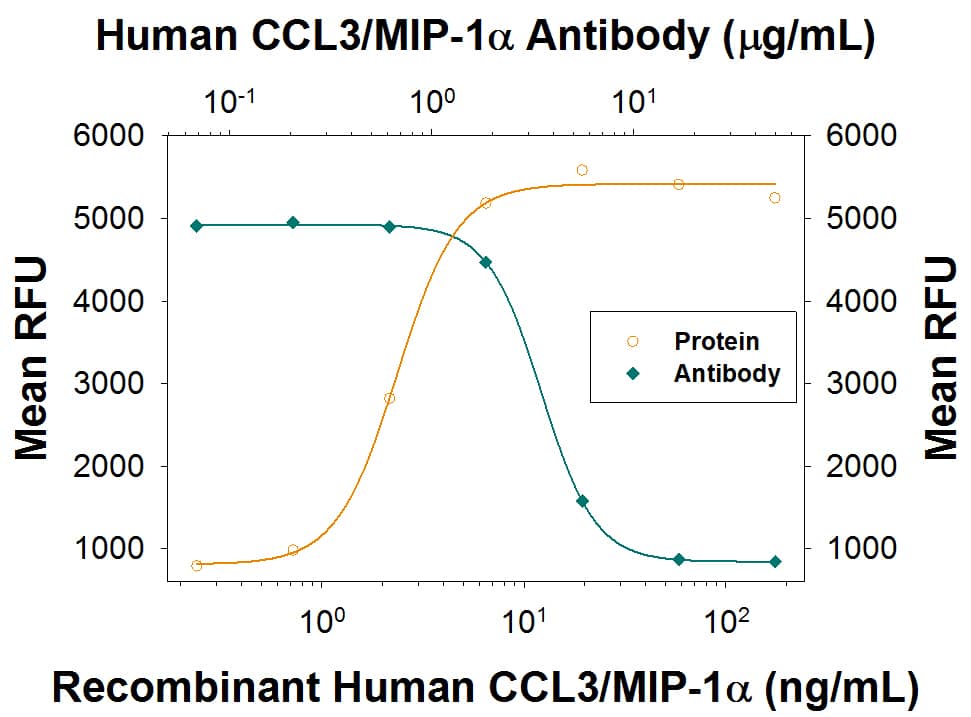
Chemotaxis Induced by CCL3/MIP-1 alpha and Neutralization by Human CCL3/MIP-1 alpha Antibody.
Recombinant Human CCL3/MIP-1a (Catalog # 270-LD) chemoattracts the BaF3 mouse pro-B cell line transfected with human CCR5 in a dose-dependent manner (orange line). The amount of cells that migrated through to the lower chemotaxis chamber was measured by Resazurin (Catalog # AR002). Chemotaxis elicited by Recombinant HumanCCL3/MIP-1a (5 ng/mL) is neutralized (green line) by increasing concentrations of Goat Anti-Human CCL3/MIP-1a Polyclonal Antibody (Catalog # AB-270-NA). The ND50 is typically ≤ 6 µg/mL.
Detection of CCL3/MIP-1 alpha by Immunohistochemistry
Citrulline protected mice against primary CDI with MIP-1 alpha inhibition. (A) Experimental plan of primary CDI in regular mice. Mice were infected with C. difficile VPI10463. Some mice were intraperitoneally injected with 100mg/mouse control IgG (AB-108-C, R&D Systems), 10 mg/mouse MIP-1 alpha (250-09, PeproTech), and 100 mg/mouse anti-IL-10 neutralizing antibody (AB-417-NA, R&D Systems) once. n = 12 regular mice per group. (B) Survival rate. CDI reduced survival rate, which was prevented by citrulline treatment. n = 6 regular mice per group. (C, left panel) Images of H&E-stained colonic tissues in infected mice. 200 mm scale bars are shown in the upper left corners. (C, right panel) Histology scores. Citrulline reduced CDI-dependent colonic injury, which was reversed by MIP-1 alpha but not anti-IL-10 neutralizing antibody injection. n = 6 regular mice per group (mean ± SD). One-way ANOVAs were used. (D) Colonic tissues were collected on day 3 post-infection. Total RNA was extracted and processed for real-time RT-PCR, as described in the Materials and Methods section. Colonic Ccl3 and Il10 mRNA expression were determined by real-time RT-PCR. n = 6 regular mice per group (mean ± SD). One-way ANOVAs were used. (E–F) Fecal samples were collected on day 3 post-infection and suspended in ice-cold PBS. After centrifugation at 2000 g for 5 minutes to remove debris, the clear supernatants were used for citrulline assay and C. difficile toxin ELISAs. Fecal citrulline and C. difficile toxin levels. Oral citrulline treatment increased fecal citrulline but not toxin levels in the infected regular mice. n = 6 regular mice per group (mean ± SD). One-way ANOVAs were used. Image collected and cropped by CiteAb from the following open publication (https://pubmed.ncbi.nlm.nih.gov/39923847), licensed under a CC-BY license. Not internally tested by R&D Systems.Applications for Human CCL3/MIP-1 alpha Antibody
Application
Recommended Usage
Western Blot
1 µg/mL
Sample: Recombinant Human CCL3/MIP-1 alpha isoform LD78a (Catalog # 270-LD)
Sample: Recombinant Human CCL3/MIP-1 alpha isoform LD78a (Catalog # 270-LD)
Neutralization
Measured by its ability to neutralize CCL3/MIP‑1 alpha-induced chemotaxis in the BaF3 mouse pro‑B cell line transfected with human CCR5. The Neutralization Dose (ND50) is typically ≤6 µg/mL in the presence of 5 ng/mL Recombinant Human CCL3/MIP‑1 alpha isoform LD78a.
Formulation, Preparation, and Storage
Purification
Protein A or G purified
Reconstitution
Reconstitute at 1 mg/mL in sterile PBS.
Formulation
Lyophilized from a 0.2 μm filtered solution in PBS with Trehalose.
Shipping
The product is shipped at ambient temperature. Upon receipt, store it immediately at the temperature recommended below.
Stability & Storage
Use a manual defrost freezer and avoid repeated freeze-thaw cycles.
- 12 months from date of receipt, -20 to -70 °C as supplied.
- 1 month, 2 to 8 °C under sterile conditions after reconstitution.
- 6 months, -20 to -70 °C under sterile conditions after reconstitution.
Background: CCL3/MIP-1 alpha
The macrophage inflammatory proteins -1 alpha and -1 beta were originally co-purified from medium conditioned by an LPS-stimulated murine macrophage cell line. Human MIP-1 alpha refers to the products of several independently cloned cDNAs, including LD78, pL78, pAT464, and GOS19. These cDNAs all code for the same human protein that is a homologue of the murine MIP-1 alpha. Mature MIP-1 alpha and MIP-1 beta in both human and mouse share approximately 70% homology at the amino acid level.
The MIP‑1 proteins are members of the beta (C-C) subfamily of chemokines.
Both MIP-1 alpha and MIP-1 beta are monocyte chemoattractants in vitro. Additionally, the MIP-1 proteins have been reported to have chemoattractant and adhesive effects on lymphocytes, with MIP-1 alpha and MIP-1 beta preferentially attracting CD8+ and CD4+ T cells, respectively. MIP-1 alpha has also been shown to attract B cells as well as eosinophils. MIP-1 proteins have been reported to have multiple effects on hematopoietic precursor cells and MIP-1 alpha has been identified as a stem cell inhibitory factor that can inhibit the proliferation of hematopoietic stem cells in vitro as well as in vivo. The functional receptor for MIP-1 alpha has been identified as CCR1 and CCR5.
References
- Menten, P. et al. (2002) Cytokine Growth Factor Rev. 13:455.
Alternate Names
G0S19-1, LD78a, MIP-1 alpha, MIP1 alpha, MIP1A, PAT 464.1, SCYA3, SIS-beta
Entrez Gene IDs
Gene Symbol
CCL3
UniProt
Additional CCL3/MIP-1 alpha Products
Product Documents for Human CCL3/MIP-1 alpha Antibody
Product Specific Notices for Human CCL3/MIP-1 alpha Antibody
For research use only
Loading...
Loading...
Loading...
Loading...
Loading...