
HCoV-229E Spike RBD Antibody
R&D Systems, part of Bio-Techne | Catalog # MAB11039
Recombinant Monoclonal Antibody.

Conjugate
Catalog #
Key Product Details
Species Reactivity
HCoV-229E
Applications
Western Blot, Immunocytochemistry
Label
Unconjugated
Antibody Source
Recombinant Monoclonal Rabbit IgG Clone # 2840H
Product Specifications
Immunogen
Human embryonic kidney cell, HEK293-derived HCoV-229E Spike RBD
Ser292-Asp453
Accession # P15423.1
Ser292-Asp453
Accession # P15423.1
Specificity
Detects both HCoV-229E and HCoV-NL63 in ELISA.
Clonality
Monoclonal
Host
Rabbit
Isotype
IgG
Scientific Data Images for HCoV-229E Spike RBD Antibody
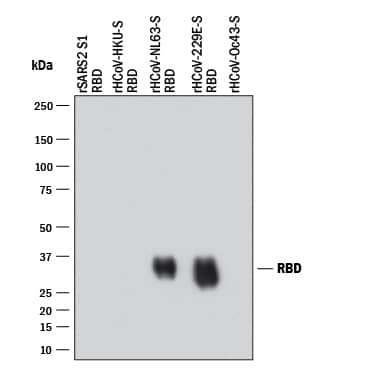
Detection of Spike RBD by Western Blot.
Western blot shows recombinant SARS-CoV-2 Spike S1 RBD, recombinant HCoV-HKU1 S1 RBD, recombinant HCoV-NL63 S1 RBD, recombinant HCoV-229E S1 RBD, and recombinant HCoV-OC43 S. PVDF membrane was probed with 0.1 µg/mL of Rabbit Anti-HCoV-229E Spike RBD Monoclonal Antibody (Catalog # MAB11039) followed by HRP-conjugated Anti-Rabbit IgG Secondary Antibody (HAF008). Specific bands were detected for Spike RBD at approximately 30 and 35 kDa (as indicated). This experiment was conducted under reducing conditions and using Western Blot Buffer Group 1.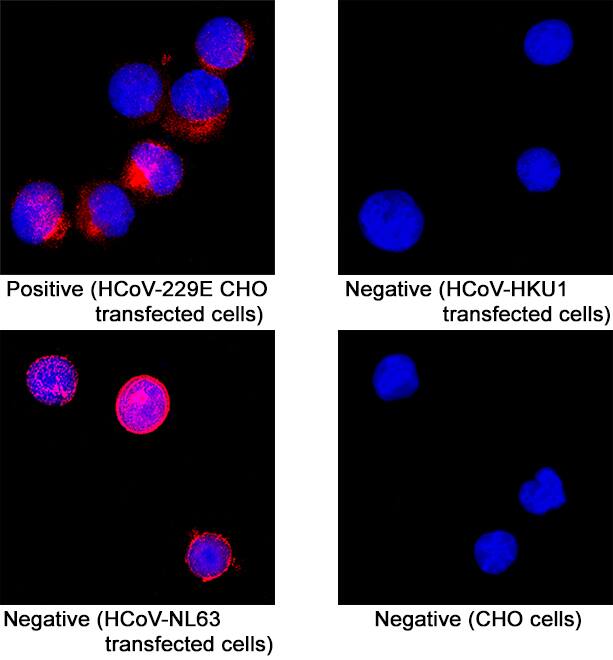
Spike RBD in CHO Chinese hamster ovary cell line transfected with HCoV-229E.
Spike RBD was detected in immersion fixed Transfected HCoV-229E CHO cells (positive), Transfected HCoV-NL63 CHO cells (negative), Transfected HCoV-HKU1 CHO cells (negative), Wild Type CHO cells (negative) using Rabbit Anti-HCoV-229E Spike RBD Monoclonal Antibody (Catalog # MAB11039) at 8 µg/mL for 3 hours at room temperature. Cells were stained using the NorthernLights™ 557-conjugated Anti-Rabbit IgG Secondary Antibody (red; Catalog # NL004) and counterstained with DAPI (blue). Specific staining was localized to cytoplasm. View our protocol for Fluorescent ICC Staining of Cells on Coverslips.Applications for HCoV-229E Spike RBD Antibody
Application
Recommended Usage
Immunocytochemistry
3-25 µg/mL
Sample: Immersion fixed CHO Chinese hamster ovary cell line transfected with HCoV-229E and HCoV-NL63 S1 RBD
Sample: Immersion fixed CHO Chinese hamster ovary cell line transfected with HCoV-229E and HCoV-NL63 S1 RBD
Western Blot
0.1 µg/mL
Sample: Recombinant HCoV-NL63 S1 RBD and recombinant HCoV-229E S1 RBD
Sample: Recombinant HCoV-NL63 S1 RBD and recombinant HCoV-229E S1 RBD
Formulation, Preparation, and Storage
Purification
Protein A or G purified from hybridoma culture supernatant
Reconstitution
Reconstitute at 0.5 mg/mL in sterile PBS. For liquid material, refer to CoA for concentration.
Formulation
Lyophilized from a 0.2 μm filtered solution in PBS with Trehalose. *Small pack size (SP) is supplied either lyophilized or as a 0.2 µm filtered solution in PBS.
Shipping
Lyophilized product is shipped at ambient temperature. Liquid small pack size (-SP) is shipped with polar packs. Upon receipt, store immediately at the temperature recommended below.
Stability & Storage
Use a manual defrost freezer and avoid repeated freeze-thaw cycles.
- 12 months from date of receipt, -20 to -70 °C as supplied.
- 1 month, 2 to 8 °C under sterile conditions after reconstitution.
- 6 months, -20 to -70 °C under sterile conditions after reconstitution.
Background: Spike RBD
References
- Hamre, D. and J.J. Procknow (1966) Proc. Soc. Exp. Biol. Med. 121:190.
- Van der Hoek, L. et al. (2004) Nat. Med. 10:368.
- Yeager, C.L. et al. (1992) Nature 357:420.
- Wong, A.H.M. et al. (2017) Nat. Commun. 8:1735.
Long Name
Spike Receptor Binding Domain
Gene Symbol
S
UniProt
Additional Spike RBD Products
Product Documents for HCoV-229E Spike RBD Antibody
Product Specific Notices for HCoV-229E Spike RBD Antibody
For research use only
Loading...
Loading...
Loading...
Loading...
Loading...