
EpCAM/TROP1 Antibody (MT201 (HD69)) - Chimeric, (Research Grade adecatumumab Biosimilar) - BSA Free
Novus Biologicals, part of Bio-Techne | Catalog # NBP3-45124
Recombinant Monoclonal Antibody

Conjugate
Catalog #
Key Product Details
Species Reactivity
Human
Applications
Immunohistochemistry, Western Blot, ELISA, Flow Cytometry
Label
Unconjugated
Antibody Source
Recombinant Monoclonal Rabbit IgG Kappa Clone # MT201 (HD69)
Format
BSA Free
Concentration
1 mg/ml
Product Specifications
Immunogen
Panned against a naturally expressed human library.
Clonality
Monoclonal
Host
Rabbit
Isotype
IgG Kappa
Description
This chimeric rabbit antibody was made using the variable domain sequences of the original Human IgG1 format, for improved compatibility with existing reagents, assays and techniques.
Scientific Data Images
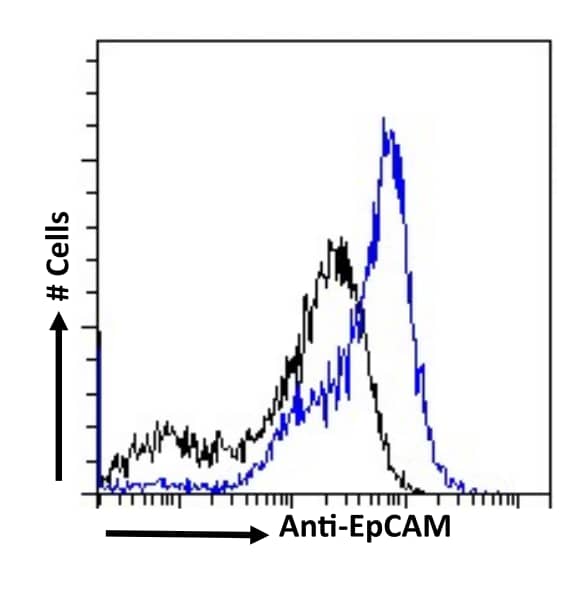
Flow Cytometry: EpCAM/TROP1 Antibody (MT201 (HD69)) - Chimeric, (Research Grade adecatumumab Biosimilar) - BSA Free [NBP3-45124] -
Flow Cytometry: EpCAM/TROP1 Antibody (MT201 (HD69)) - Chimeric, (Research Grade adecatumumab Biosimilar) - BSA Free [NBP3-45124] - Paraformaldehyde-fixed A431 cells permeabilized with 0.5% Triton were stained with the anti-unknown specificity antibody (isotype control, black line) or NBP3-45124 (blue line) at a dilution of 1:100 for 1 h at RT. After washing, the bound antibody was detected using a goat anti-rabbit IgG AlexaFluor® 488 antibody at a dilution of 1:1000, and the cells were analyzed using a FACSCanto flow-cytometer.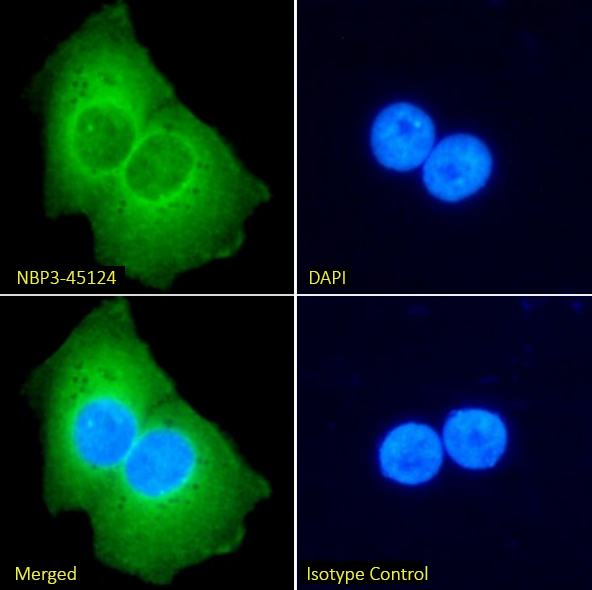
Immunocytochemistry/ Immunofluorescence: EpCAM/TROP1 Antibody (MT201 (HD69)) - Chimeric, (Research Grade adecatumumab Biosimilar) - BSA Free [NBP3-45124] -
Immunocytochemistry/ Immunofluorescence: EpCAM/TROP1 Antibody (MT201 (HD69)) - Chimeric, (Research Grade adecatumumab Biosimilar) - BSA Free [NBP3-45124] - Immunofluorescence analysis of paraformaldehyde-fixed A431 cells on coverslips stained with NBP3-45124 (1:100 dilution) for 1h followed by Alexa Fluor® 488 secondary antibody (1:1000 dilution), showing cytoplasmic and membrane staining. The nuclear stain is DAPI (blue). Panels show, from left-right, top-bottom, NBP3-45124, DAPI, merged channels and an isotype control. The isotype control was an unknown specificity antibody followed by staining with Alexa Fluor® 488 secondary antibody.Applications
Application
Recommended Usage
ELISA
Optimal dilutions of this antibody should be experimentally determined.
Flow Cytometry
Optimal dilutions of this antibody should be experimentally determined.
Immunohistochemistry
Optimal dilutions of this antibody should be experimentally determined.
Western Blot
Optimal dilutions of this antibody should be experimentally determined.
Formulation, Preparation, and Storage
Purification
Protein A purified
Formulation
PBS
Format
BSA Free
Preservative
0.02% Proclin 300
Concentration
1 mg/ml
Shipping
The product is shipped with polar packs. Upon receipt, store it immediately at the temperature recommended below.
Stability & Storage
Store at 4C short term. Aliquot and store at -20C long term. Avoid freeze-thaw cycles.
Background: EpCAM/TROP1
EpCAM functions as an intracellular signaling molecule and contributes to regulation of epithelial-to-mesenchymal (EMT) transition (4,5). EpCAM is cleaved during the process of regulated intramembrane proteolysis (RIP) (4,5). Initial cleavage occurs at the membrane via a disintegrin and metalloprotease 17 (ADAM17) which releases EpCAM's extracellular domain (EpEx) (4,5). A secondary cleavage is mediated by presenilin 2 (PSEN2) which releases EpCAM's cytoplasmic trail (EpICD) (4,5). EpICD translocates to the nucleus where it associates with beta-catenin, FHL-2, and LEF-1 and induces transcription of genes related to EMT and tumor growth (4,5). EpCAM has also been shown to regulate structure and functionality of the apical junction complex of cells through direct interaction with claudin-7 and association with E-cadherin (2,5). Loss of EpCAM disrupts adherins junction and tight junction structure and function (2).
References
1. Mohtar MA, Syafruddin SE, Nasir SN, Low TY. Revisiting the Roles of Pro-Metastatic EpCAM in Cancer. Biomolecules. 2020; 10(2):255. https://doi.org/10.3390/biom10020255
2. Huang L, Yang Y, Yang F, et al. Functions of EpCAM in physiological processes and diseases (Review). Int J Mol Med. 2018; 42(4):1771-1785. https://doi.org/10.3892/ijmm.2018.3764
3. Brown TC, Sankpal NV, Gillanders WE. Functional Implications of the Dynamic Regulation of EpCAM during Epithelial-to-Mesenchymal Transition. Biomolecules. 2021; 11(7):956. https://doi.org/10.3390/biom11070956
4. Uniprot (P16422)
5. Schnell U, Cirulli V, Giepmans BN. EpCAM: structure and function in health and disease. Biochim Biophys Acta. 2013; 1828(8):1989-2001. https://doi.org/10.1016/j.bbamem.2013.04.018
Long Name
Epithelial Cell Adhesion Molecule
Alternate Names
17-1A, CD326, GA733-2, gp40, KS1/4, M4S1, TACSTD1, TROP1
Gene Symbol
EPCAM
Additional EpCAM/TROP1 Products
Product Specific Notices
This product is for research use only and is not approved for use in humans or in clinical diagnosis. Primary Antibodies are guaranteed for 1 year from date of receipt.
Loading...
Loading...
Loading...
Loading...
Loading...
Loading...