
DNA/RNA Damage Antibody (15A3) - BSA Free
Novus Biologicals, part of Bio-Techne | Catalog # NB110-96878

![Immunocytochemistry/ Immunofluorescence: DNA/RNA Damage Antibody (15A3) [NB110-96878]](https://resources.bio-techne.com/images/products/DNA-RNA-Damage-Antibody-15A3-Immunocytochemistry-Immunofluorescence-NB110-96878-img0004.jpg "Immunocytochemistry/ Immunofluorescence: DNA/RNA Damage Antibody (15A3) [NB110-96878]")
Conjugate
Catalog #
Key Product Details
Species Reactivity
Validated:
Human, Mouse, Non-species specific
Cited:
Human, Mouse, Rabbit
Applications
Validated:
Immunohistochemistry, Immunohistochemistry-Paraffin, ELISA, Immunoassay, Flow Cytometry, Immunocytochemistry/ Immunofluorescence, Immunoprecipitation, Dot Blot, Functional Assay
Cited:
Immunohistochemistry, Immunohistochemistry-Paraffin, Immunoassay, Flow Cytometry, Immunocytochemistry/ Immunofluorescence, Immunoprecipitation, IF/IHC
Label
Unconjugated
Antibody Source
Monoclonal Mouse IgG2B Clone # 15A3
Format
BSA Free
Concentration
1 mg/ml
Product Specifications
Immunogen
8-hydroxy-guanosine-BSA and-casein conjugates
Reactivity Notes
Use in Human reported in scientific literature (PMID:33482333) Mouse reactivity reported in scientific literature (PMID: 31226694).
Specificity
Recognizes markers of oxidative damage to DNA (8-hydroxy-2'-deoxyguanosine, 8-hydroxyguanine and 8-hydroxyguanosine).
Clonality
Monoclonal
Host
Mouse
Isotype
IgG2B
Scientific Data Images for DNA/RNA Damage Antibody (15A3) - BSA Free
Immunocytochemistry/ Immunofluorescence: DNA/RNA Damage Antibody (15A3) [NB110-96878]
Immunocytochemistry/Immunofluorescence: DNA/RNA Damage Antibody (15A3) [NB110-96878] - visualized on a retinal injury![Immunohistochemistry: DNA/RNA Damage Antibody (15A3) [NB110-96878]](https://resources.bio-techne.com/images/products/DNA-RNA-Damage-Antibody-15A3-Immunohistochemistry-NB110-96878-img0013.jpg "Immunohistochemistry: DNA/RNA Damage Antibody (15A3) [NB110-96878]")
Immunohistochemistry: DNA/RNA Damage Antibody (15A3) [NB110-96878]
Immunohistochemistry: DNA/RNA Damage Antibody (15A3) [NB110-96878] - Immunohistochemistry analysis using Mouse Anti-DNA/RNA DamageMonoclonal Antibody, Clone 15A3 (NB110-96878). Tissue: inflamed colon. Species: Mouse. Fixation: Formalin. Primary Antibody: Mouse Anti-DNA/RNA DamageMonoclonal Antibody (NB110-96878) at 1:1000000 for 12 hours at 4C. Secondary Antibody: Biotin Goat Anti-Mouse at 1:2000 for 1 hour at RT. Counterstain: Mayer Hematoxylin (purple/blue) nuclear stain at 200 l for 2 minutes at RT. Magnification: 40x. With anti-microbial.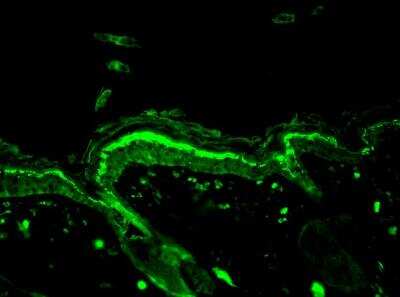
DNA/RNA Damage Antibody (15A3) [NB110-96878] - Immunohistochemistry analysis using Mouse Anti-DNA/RNA DamageMonoclonal Antibody, Clone 15A3 (NB110-96878). Tissue: backskin. Species: Mouse. Fixation: Bouin's Fixative and paraffin-embedded. Primary Antibody: Mouse Anti-DNA/RNA DamageMonoclonal Antibody (NB110-96878) at 1:100 for 1 hour at RT. Secondary Antibody: FITC Goat Anti-Mouse (green) at 1:50 for 1 hour at RT.
Applications for DNA/RNA Damage Antibody (15A3) - BSA Free
Application
Recommended Usage
Immunohistochemistry
1:1000
Immunohistochemistry-Paraffin
1:1000
Application Notes
Use in immoprecipitation reported in scientific literature (PMID 26510519). Use in Immunoassay reported in scientific literature (PMID:31625228).
Formulation, Preparation, and Storage
Purification
Protein G purified
Formulation
PBS, 50% Glycerol
Format
BSA Free
Preservative
0.09% Sodium Azide
Concentration
1 mg/ml
Shipping
The product is shipped with polar packs. Upon receipt, store it immediately at the temperature recommended below.
Stability & Storage
Store at 4C short term. Aliquot and store at -20C long term. Avoid freeze-thaw cycles.
Background: DNA/RNA Damage
Alternate Names
DNA/RNA Oxidative Damage Markers Monoclonal Antibody
Additional DNA/RNA Damage Products
Product Documents for DNA/RNA Damage Antibody (15A3) - BSA Free
Product Specific Notices for DNA/RNA Damage Antibody (15A3) - BSA Free
This product is for research use only and is not approved for use in humans or in clinical diagnosis. Primary Antibodies are guaranteed for 1 year from date of receipt.
Loading...
Loading...
Loading...
Loading...
Loading...
Loading...