
What is BaseScope™?
Many diseases are driven by sequence-specific changes in RNA—an exon that's skipped, an alternative isoform that's expressed, or a cryptic exon that appears in disease. While these changes may differ by only a few bases, they can dramatically alter protein function and therapeutic response.
The challenge is that many conventional RNA assays detect all transcripts from a gene, making it difficult to determine which RNA variant is present or which cells are expressing it.
The BaseScope assay leverages our proven and established RNAscope™ RNA ISH technology, but expands the detection capabilities, enabling the highly precise detection of sequence-specific RNA differences in intact tissue.
Product Line Features
- BaseScope enables detecting biological events in cells and in situ using a single Z pair
- Highly specific and sensitive detection of RNA targets with down to ONE nucleotide differences
- Detection of alternative splice isoforms, exon-skipping events, cryptic exons, transgene-derived RNA, gene editing products, microexons or short indels
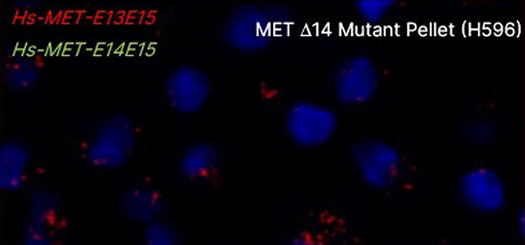
Splice Variant
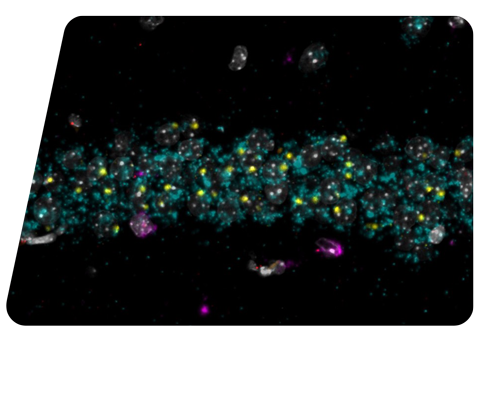
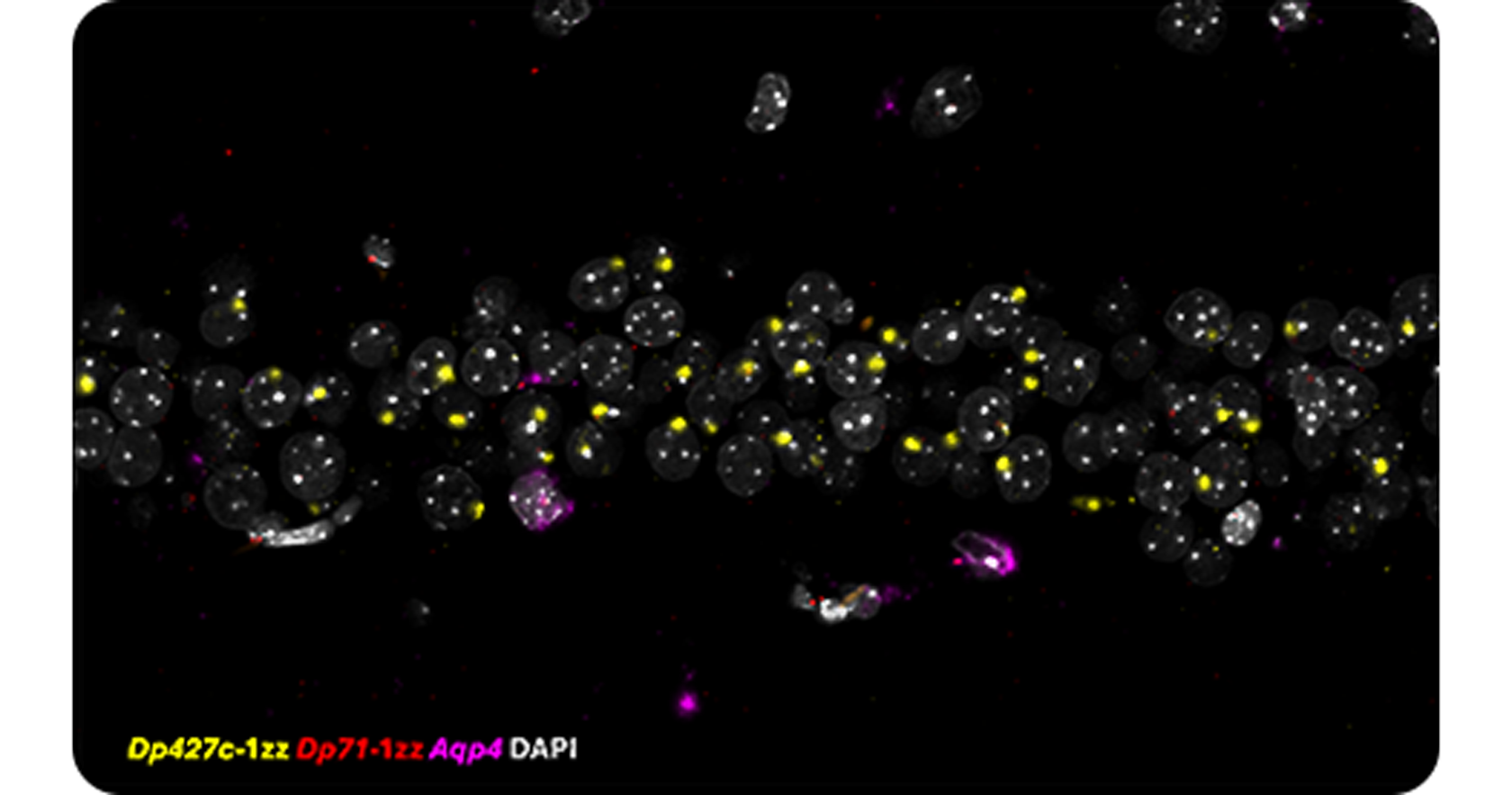
Simultaneous visualization of splice variants using BaseScope LS Duplex Fluorescent Assay
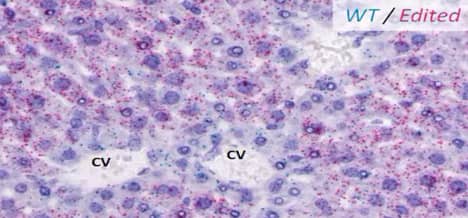
Gene Editing
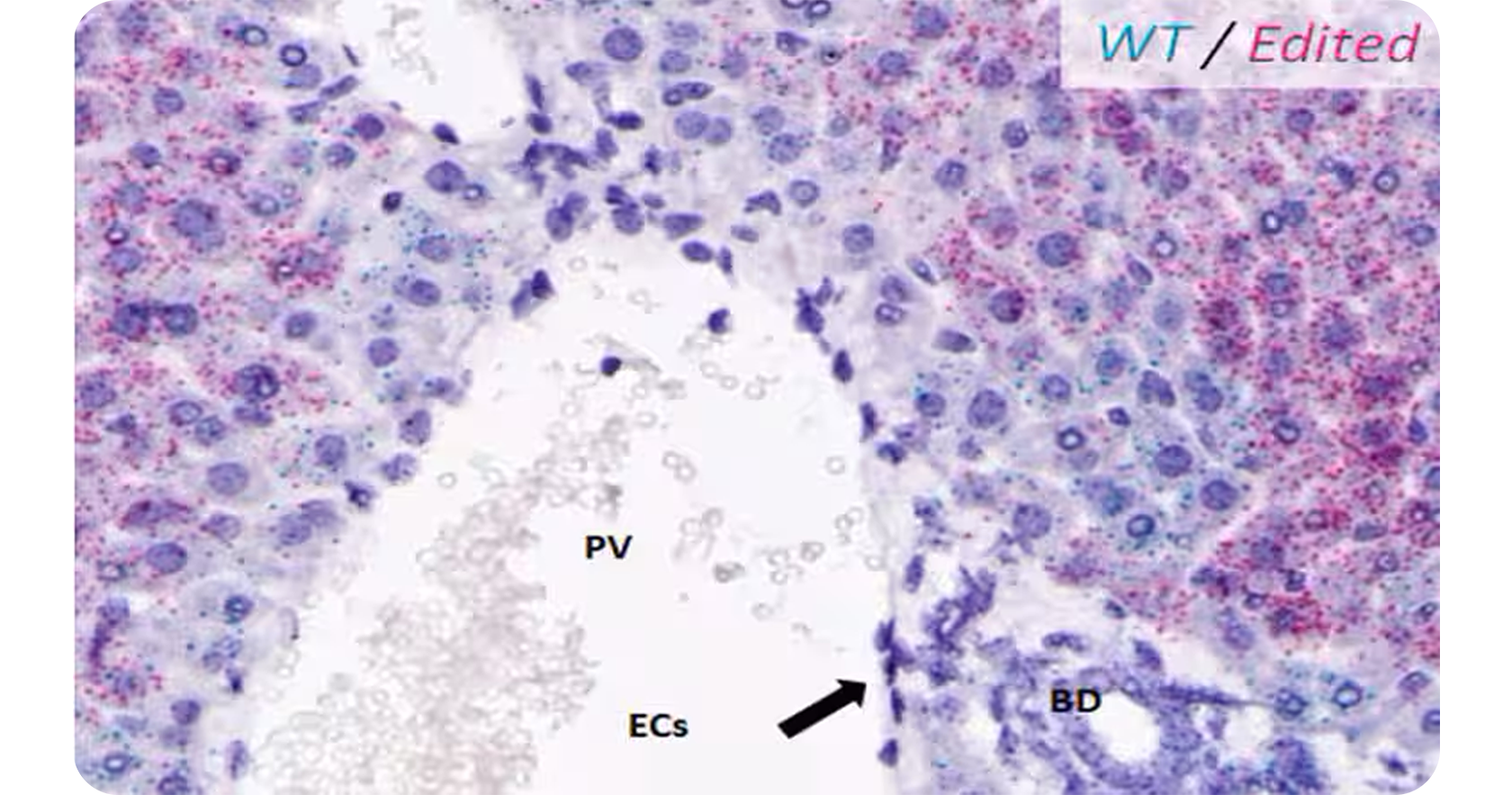
Discern cell type-specific gene editing with the BaseScope Duplex Assay
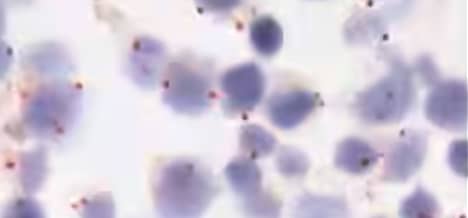
Point Mutation
Detection of KRAS G12D in KRAS mutation cell line with the BaseScope v2 Assay
BaseScope Chromogenic Assays
- BaseScope RED Assay assay enables manual detection of short RNA sequences like exon junctions
- BaseScope Duplex Assay enables manual detection of sequence-specific RNA targets at single cell resolution
- BaseScope VS Reagent Kit assay is our automated solution which enables customers with high throughput single RNA detection on the Roche DISCOVERY ULTRA
- BaseScope LS Reagent Kit - RED assay is our automated solution which enables customers with high throughput detection of RNA targets using the BOND RX by Leica Biosystems
Figure 1 (left): Discern cell type-specific gene editing with the BaseScope Duplex Assay. CRISPR-mediated gene editing was detected in hepatocytes but not in the bile duct (BD) or endothelial cells (ECs) of the portal vein (PV) using BaseScope Duplex probes for the WT (green) or Edited (red) sequences.
BaseScope Fluorescent Assay
BaseScope LS Duplex Fluorescent Assay is our automated solution which enables customers with high throughput visualization highly-homologous RNA targets using the BOND RX by Leica Biosystems.
Applications of the BaseScope Duplex Assay include:
- Distinguishing transgene-derived RNA from endogenous RNA
- Mapping alternative splicing isoforms
- Visualizing aberrant RNA (exon-skipping events, cryptic exons) vs wildtype RNA
- Co-detection of circRNAs and linear RNAs
- Discerning bi-allelic vs mono-allelic CRISPR-mediated mutations
Figure 2 (left): Cell type specific expression of dystrophin isoforms dp427c and dp71 with astrocyte marker in mouse hippocampus using BaseScope LS Duplex Fluorescent Assay on BOND RX by Leica Biosystems.
Customer Success Stories

Sanford Burnham Prebys Medical Discovery Institute


Mater Research Institute-University of Queensland