
Recombinant Human His6-Pro-SUMO1 Protein, CF
R&D Systems, part of Bio-Techne | Catalog # UL-705

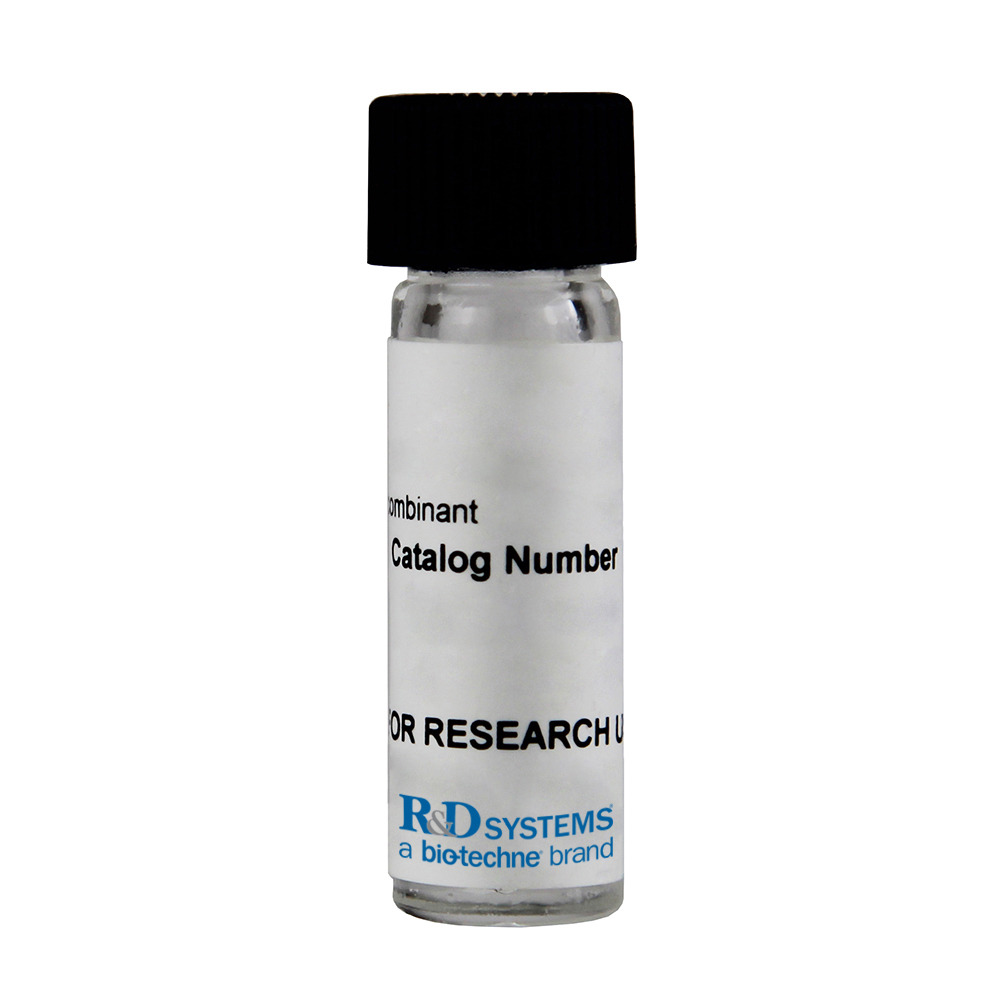
Discontinued Product
UL-705 has been discontinued.
View all SUMO1 products.
Key Product Details
Product Specifications
Source
E. coli-derived human SUMO1 protein
Contains an N-terminal 6-His tag
Contains an N-terminal 6-His tag
Purity
>95%, by SDS-PAGE under reducing conditions and visualized by Colloidal Coomassie® Blue stain.
Predicted Molecular Mass
14 kDa
Activity
Recombinant Human His6-Pro-SUMO1 can be used as a negative control for SUMOylation reactions or as a substrate for Sentrin Proteases (SENPs). Protein concentration for use in vitro will need to be optimized for each specific application.
Formulation, Preparation and Storage
UL-705
| Formulation | Supplied as a solution in HEPES, NaCl and DTT. |
| Shipping | The product is shipped with dry ice or equivalent. Upon receipt, store it immediately at the temperature recommended below. |
| Stability & Storage | Use a manual defrost freezer and avoid repeated freeze-thaw cycles.
|
Background: SUMO1
Human Small Ubiquitin-like Modifier 1 (SUMO1), also known as Sentrin, UBL1, and SMT3C, is synthesized as a 101 amino acid (aa) propeptide with a predicted molecular weight of 11.5 kDa. Human SUMO1 is the most unique of the four identified SUMO proteins and shares only 44%, 47%, and 41% aa sequence identity with SUMO2, SUMO3, and SUMO4, respectively. In contrast, human SUMO1 shares 100% aa sequence identity with the mouse ortholog. SUMOs are a family of small, related proteins that can be enzymatically attached to a target protein by a post-translational modification process termed SUMOylation (1-3). All SUMO proteins share a conserved Ubiquitin domain and a C-terminal diglycine cleavage/attachment site. Following cleavage of a four aa C-terminal prosegment, the C-terminal glycine residue of SUMO1 is enzymatically attached to a lysine residue on a target protein. In humans, SUMO1 is conjugated to a variety of molecules in the presence of the SAE1/UBA2 SUMO-activating (E1) enzyme and the UBE2I/Ubc9 SUMO-conjugating (E2) enzyme (4,5). In yeast, the SUMO-activating (E1) enzyme is Aos1/Uba2p (6). SUMOylation can occur without the requirement of a specific SUMO ligase (E3), where SUMO1 is transferred directly from UBE2I/Ubc9 to specific substrates. In Alzheimer's disease models SUMO1 has been shown to influence the generation of Amyloid-beta peptide by promoting the accumulation of BACE-1 (7). Covalent modification of Phosphatase and Tensin Homolog Deleted on Chromosome (PTEN) by SUMO1 is thought to regulate tumorigenesis by retaining PTEN at the plasma membrane, an effect that suppresses PI 3-Kinase/Akt-dependent tumor growth (8).
All SUMO isoforms are translated with additional C-terminal residues that have to be removed to generate the active protein. Pro-SUMO1 (101 amino acids) is the inactive precursor of SUMO1 (97 aa) and is processed at the C-terminus by SUMO1 specific proteases (SENPs).The resulting SUMO1 protein has the conserved C-terminal Gly-Gly residues that function in activation and conjugation reactions. This protein can be used as a negative control in SUMOlyation reactions or as a substrate for SENPs. This His-6 tag is at the N-terminus. NCBIaccession # NM_003352.
References
- Desterro, J.M. et al. (1997) FEBS. Lett. 417:297.
- Bettermann, K. et al. (2012) Cancer Lett. 316:113.
- Praefcke, G.J. et al. (2012) Trends Biochem. Sci. 37:23.
- Okuma, T. et al. (1999) Biochem. Biophys. Res. Commun. 254:693.
- Tatham, M.H. et al. (2001) J. Biol. Chem. 276:35368.
- Johnson, E.S. et al. (1997) EMBO J. 16:5509.
- Yun, S.M. et al. (2012) Neurobiol Aging. [Epub ahead of print].
- Huang, J. et al. (2012) Nat. Commun. 3:911.
Long Name
Small Ubiquitin-like Modifier 1
Alternate Names
PIC1, Sentrin, SMT3C, SMT3H3, UBL1
Gene Symbol
SUMO1
UniProt
Additional SUMO1 Products
Product Documents for Recombinant Human His6-Pro-SUMO1 Protein, CF
Product Specific Notices for Recombinant Human His6-Pro-SUMO1 Protein, CF
For research use only
Loading...
Loading...