
Recombinant Human Fatty Acid Synthase/FASN His-tag, CF

R&D Systems, part of Bio-Techne | Catalog # 11788-FS

R&D Systems, part of Bio-Techne
Catalog #
Availability
Size / Price
Qty
Loading...
11788-FS-020

Key Product Details

Source

HEK293

Accession #

Conjugate

Unconjugated

Applications

Enzyme Activity

Product Specifications

Source

Human embryonic kidney cell, HEK293-derived human Fatty Acid Synthase/FASN protein
Met1-Gly2511, with a C-terminal 6-His tag

Purity

>90%, by SDS-PAGE visualized with Silver Staining and quantitative densitometry by Coomassie® Blue Staining.

Endotoxin Level

<0.10 EU per 1 μg of the protein by the LAL method.

N-terminal Sequence Analysis

Protein identity confirmed by mass spectrometry.

Predicted Molecular Mass

274 kDa

Activity

Measured by its ability to hydrolyze 4-methylumbelliferyl heptanoate.

Scientific Data Images for Recombinant Human Fatty Acid Synthase/FASN His-tag, CF
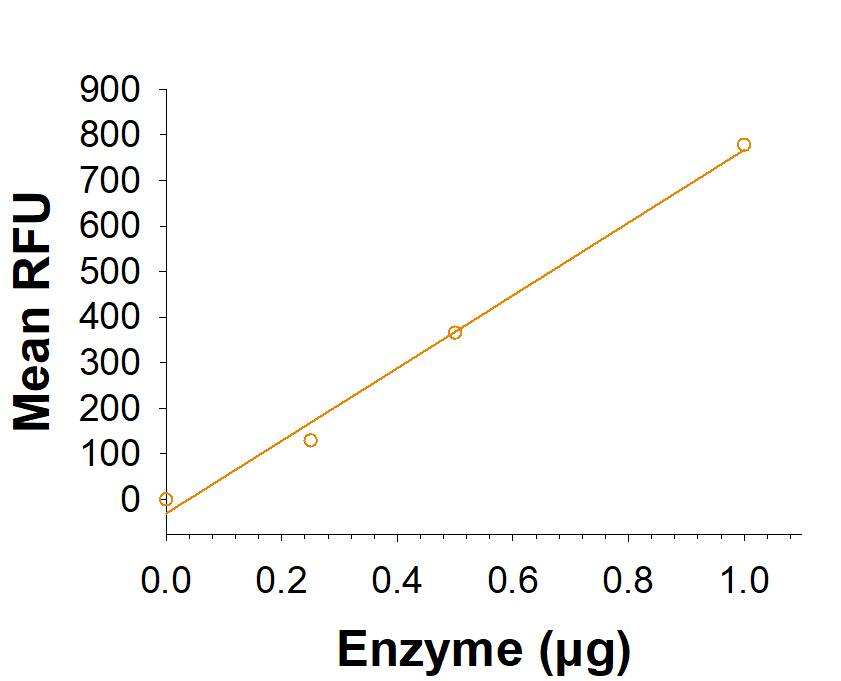
Recombinant Human Fatty Acid Synthase/FASN His-tag Enzyme Activity.

Recombinant Human Fatty Acid Synthase/FASN His-tag (Catalog # 11788-FS) is measured by its ability to hydrolyze 4-methylumbelliferyl heptanoate.
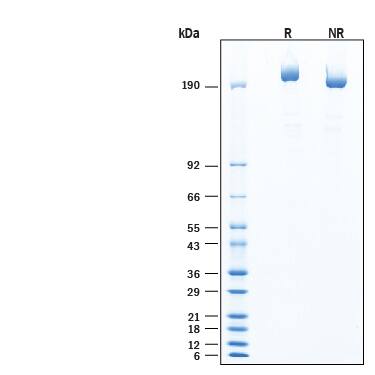
Recombinant Human Fatty Acid Synthase/FASN His-tag SDS-PAGE.

2 μg/lane of Recombinant Human Fatty Acid Synthase/FASN His-tag (Catalog # 11788-FS) was resolved with SDS-PAGE under reducing (R) and non-reducing (NR) conditions and visualized by Coomassie® Blue staining, showing bands at 234-258 kDa, under reducing conditions.

Formulation, Preparation and Storage

11788-FS
Formulation Supplied as a 0.2 μm filtered solution in Tris, NaCl, Glycerol and TCEP.
Shipping The product is shipped with polar packs. Upon receipt, store it immediately at the temperature recommended below.
Stability & Storage Use a manual defrost freezer and avoid repeated freeze-thaw cycles.
  • 6 months from date of receipt, -20 to -70 °C as supplied.
  • 3 months, -20 to -70 °C under sterile conditions after opening.

Background: Fatty Acid Synthase/FASN

Recombinant human fatty acid synthase (FASN) is a large cytosolic, homodimeric, multifunctional protein that functionally completes the entire pathway of palmitate synthesis from malonyl-CoA in mammals. Each FASN monomer contains three N-terminal domains, the b-ketoacyl synthase (KS), malonyl/acetyl transferase (MAT) and dehydratase (DH) separated by a structural core from four C-terminal domains, the enoyl reductase (ER), b-ketoacyl reductase (KR), acyl carrier protein (ACP) and thiosterase (TE) (1-2). The highly coordinated assembly of these domains in a homodimeric structure allows FASN to catalyze the sequential condensation of acetyl-CoA and malonyl-CoA, utilizing NADPH to produce palmitate as the final product (3). In contrast to normal adult tissues, where exogenous dietary lipids are generally sufficient to support metabolic demands, tumor cells display a marked dependency on fatty acid (FA) synthesis (3-5). FASN has two key dynamic post-translational modifications that impact its stability, subcellular localization, and enzymatic activity: S-palmitoylation that results in protein stabilization and elevated expression (6-7) and acetylation that prevents its degradation via the ubiquitin-mediated proteasomal degradation pathway (8).  FASN is broadly expressed but overexpression and hyperactivation of FASN is reported in solid and hematologic malignancies, including but not limited to breast, liver, prostate, cervical, and lymphoid cancers (6,7,9-13), as elevated FASN increases the biosynthesis of membrane phospholipids and lipid rafts that facilitate sustained oncogenic signaling and its downstream lipid products support enhanced migratory and metastatic behavior (3). FASN expression is prominently regulated by sterol regulatory element-binding protein 1 (SREBP1) (13) and tumor-suppressive miRNAs that target FASN, such as miR-497–5p or miR-449 (11). Through its roles in metabolic adaptability and modulation of immune checkpoint inhibition through MHC-I downregulation, CD8⁺ T-cell exhaustion, and induction of tumor-associated macrophage M2 polarization, FASN is implicated in resistance to chemotherapy, radiotherapy, and emerging therapies in cancer (3,7,12,14). Therapeutic approaches to modulate FASN initially focused on direct enzymatic inhibitors that target the TE domain (such as cerulenin, C75, and orlistat) with some success (9) while subsequent KS-domain inhibitors (such as denifanstat and GSK2194069) had potent, on-target suppression and broad antitumor activity in preclinical models (2). Next-wave inhibitors seek to exploit tumor-specific enzymatic activation (15). In addition, strategies for indirect modulation via targeted perturbation of upstream or post-translational regulators of FASN are actively being explored (16-17) as well as rational combinatorial strategies that yield more durable anti-tumor responses based on biomarker-guided deployment (3, 14, 18).  

References

  1. Smith, S. et al. (2003) Prog Lipid Res 42:289.
  2. Nuzzo, P.V. et al. (2025) Crit. Rev. Oncol. Hematol. 214:104910.
  3. Jiang, X. et al. (2026) Crit. Rev. Oncol. Hematol. 220:105155. 
  4. Menendez, J.A. and R. Lupu. (2007) Nat. Rev. Cancer. 7:763.
  5. Fhu, C.W. and A. Ali. (2020) Molecules. 25:3935.
  6. Mo, Y. et al. (2024) Mol. Cancer. 23:274.
  7. Liu, B. et al. (2024) Leukemia. 38:351.
  8. Gu, L. et al. (2020) Oncogene. 39: 2437.
  9. Mansour, M. et al. (2011) Int. J. Oncol. 38:537.
  10. Menendez, J.A. and R. Lupu. (2017) Expert Opin. Ther. Targets. 21:1001.
  11. Zhang, H. et al (2022) Nutr. Cancer. 74:3026.
  12. Cheng, H. et al. (2023) Drug Discov. Ther. 17:328.
  13. Li, B. et al. (2024) Int. J. Biol. Sci. 20:4635.
  14. Huang, J. et al. (2024) Cancer Res. 84:855.
  15. Amrutha, N.A. et al. (2019) J. Cell. Biochem. 120:16643.
  16. Balasubramanian, A. et al. (2024) Sci. Immunol. 9:eadn1452.
  17. Liu, J. et al. (2025) Nat. Commun. 16:1762.
  18. Li, G. et al. (2025) Ann. Med. 57:2447403.

Alternate Names

FASN, OA-519, SDR27X1

Entrez Gene IDs

2194 (Human); 14104 (Mouse)

Gene Symbol

FASN

UniProt

Additional Fatty Acid Synthase/FASN Products

Product Documents for Recombinant Human Fatty Acid Synthase/FASN His-tag, CF

Certificate of Analysis

To download a Certificate of Analysis, please enter a lot number in the search box below.

Note: Certificate of Analysis not available for kit components.

Product Specific Notices for Recombinant Human Fatty Acid Synthase/FASN His-tag, CF

For research use only

Loading...
Loading...
Loading...