
Recombinant Human FAT10 Biotin Protein, CF
R&D Systems, part of Bio-Techne | Catalog # UL-912

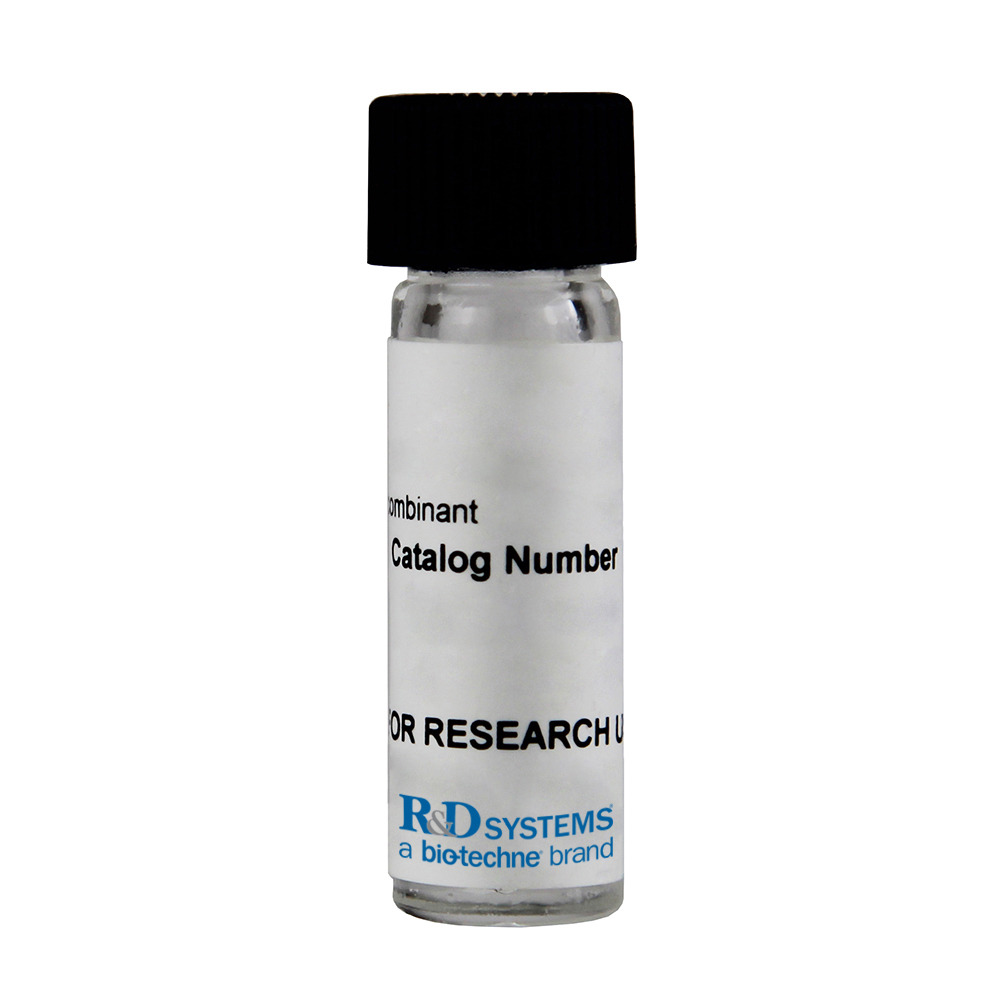
Discontinued Product
UL-912 has been discontinued.
View all FAT10 products.
Key Product Details
Product Specifications
Source
E. coli-derived human FAT10 protein
Purity
>95%, by PAGE.
Activity
Biotin-FAT10 can be conjugated to substrate proteins via the subsequent actions of a FAT10-activating (E1) enzyme, a FAT10-conjugating (E2) enzyme, and a FAT10 ligase (E3). Biotin-FAT10 is ideal for the visualization or quantification of thioester formation with avidin-linked reagents. Reaction conditions will need to be optimized for each specific application. We recommend an initial Biotin-FAT10 concentration of 5-20 μM.
Formulation, Preparation and Storage
UL-912
| Formulation | Supplied as a solution in HEPES, NaCl, DTT and Glycerol. |
| Shipping | The product is shipped with dry ice or equivalent. Upon receipt, store it immediately at the temperature recommended below. |
| Stability & Storage | Use a manual defrost freezer and avoid repeated freeze-thaw cycles.
|
Background: FAT10
Human Leukocyte Antigen-F Associated Transcript 10 (FAT10), also known as Ubiquitin D (UBD), is a 165 amino acid (aa) member of the Ubiquitin-like family of proteins. Human FAT10 has a predicted molecular weight of 18.5 kDa and shares 69% aa sequence identity with mouse FAT10 (1). Human FAT10 mRNA is expressed as a single transcript in lymphoblastoid lines and dendritic cells, but more than one mRNA transcript has been identified for murine FAT10 (1,2). FAT10 can also be induced by IFN-gamma and TNF-alpha in some cell lines (1). Structurally, FAT10 consists of two Ubiquitin-like domains that are connected by a short linker. Like Ubiquitin, FAT10 has a C-terminal glycine residue that can be used to form isopeptide bonds with target proteins. FAT10-conjugated proteins are targeted to the proteasome where the 26S Proteasome subunit S5a/Angiocidin binds to FAT10 and enables subsequent degradation of the conjugated protein (3). In addition to S5a/Angiocidin, FAT10 has been shown to interact with Huntingtin, Ataxin-1, MAD2, and NUB1L (4,5). FAT10 has been implicated in a number of biological processes such as cell cycle control, antigen presentation, and cytokine response (1,6-8).This protein is modified with biotin via primary amine coupling resulting in the modification of lysine residues as well as the N-terminus. Biotinylated FAT10 can be detected using avidin-linked reagents for higher efficiency and detection sensitivity than with antibodies.
References
- Liu, Y.-C. et al. (1999) Proc. Natl. Acad. Sci. USA 96:4313.
- Canaan, A. et al. (2006) Mol. Cell. Biol. 26:5180.
- Rani, N. et al. (2012) Nat. Commun. 3:749.
- Hipp, M.S. et al. (2004) J. Biol. Chem. 279:16503.
- Nagashima, Y. et al. (2011) J. Biol. Chem. 286:29594.
- Ebstein, F. et al. (2012) Cell. Mol. Life Sci. 69:2443.
- Lukasiak, S. et al. (2008) Oncogene 27:6068.
- Ren, J. et al. (2011) J. Cell Sci. 124:3665.
Alternate Names
UBD
Gene Symbol
UBD
Additional FAT10 Products
Product Documents for Recombinant Human FAT10 Biotin Protein, CF
Product Specific Notices for Recombinant Human FAT10 Biotin Protein, CF
For research use only
Loading...
Loading...