
Recombinant Cyno/Rhesus APRIL/TNFSF13 HA Tag Protein, CF New
R&D Systems, part of Bio-Techne | Catalog # 11778-AP

Key Product Details
Source
HEK293
Conjugate
Unconjugated
Applications
Bioactivity
Product Specifications
Source
Human embryonic kidney cell, HEK293-derived cynomolgus monkey APRIL/TNFSF13 protein
| HA (YPYDVPDYA) |
GCN4-IZ | GS Linker | Cyno/Rhesus APRIL (Ala105 - Leu250) Accession # XP_005582818.1 |
| N-terminus | C-terminus | ||
Purity
>90%, by SDS-PAGE visualized with Silver Staining and quantitative densitometry by Coomassie® Blue Staining.
Endotoxin Level
<0.10 EU per 1 μg of the protein by the LAL method.
N-terminal Sequence Analysis
Tyr of HA tag
Predicted Molecular Mass
22 kDa
SDS-PAGE
24-28 kDa, under reducing conditions.
Activity
Measured in a cell proliferation assay using anti-IgM stimulated mouse B cells.
The ED50 for this effect is 2.50-30.0 ng/mL in the presence of goat anti-mouse IgM.
The ED50 for this effect is 2.50-30.0 ng/mL in the presence of goat anti-mouse IgM.
Scientific Data Images for Recombinant Cyno/Rhesus APRIL/TNFSF13 HA Tag Protein, CF
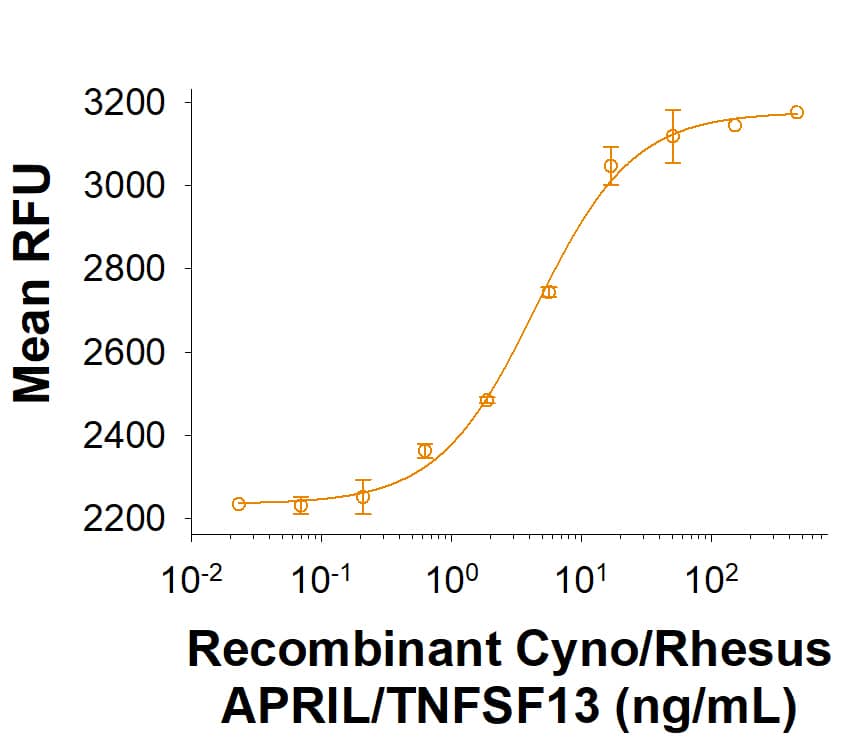
Recombinant Cyno/Rhesus APRIL/TNFSF13 HA Tag Protein Bioactivity.
Measured in a cell proliferation assay using anti-IgM stimulated mouse B cells. The ED50 for this effect is 2.50-30.0 ng/mL in the presence of goat anti-mouse IgM.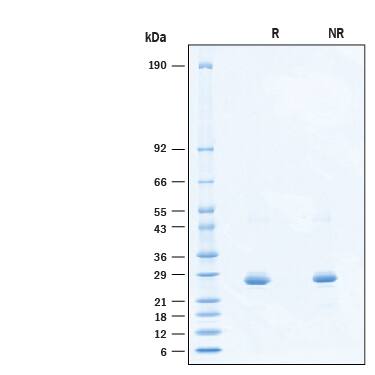
Recombinant Cyno/Rhesus APRIL/TNFSF13 HA Tag Protein SDS-PAGE.
2 μg/lane of Recombinant Cyno/Rhesus APRIL/TNFSF13 HA Tag Protein (Catalog # 11778-AP) was resolved with SDS-PAGE under reducing (R) and non-reducing (NR) conditions and visualized by Coomassie® Blue staining, showing bands at 24-28 kDa, under reducing conditions.Formulation, Preparation and Storage
11778-AP
| Formulation | Lyophilized from a 0.2 μm filtered solution in Tris and NaCl with Trehalose. |
| Reconstitution | Reconstitute at 200 μg/mL in water. |
| Shipping | The product is shipped at ambient temperature. Upon receipt, store it immediately at the temperature recommended below. |
| Stability & Storage | Use a manual defrost freezer and avoid repeated freeze-thaw cycles.
|
Background: APRIL/TNFSF13
References
- Planelles, L. et al. (2008) Curr. Mol. Med. 8:829.
- Yu, G. et al. (2000) Nat. Immunol. 1:252.
- Lopez-Fraga, M. et al. (2001) EMBO Reports 2:945.
- Kelly, K. et al. (2000) Cancer Res. 60:1021.
- Day, E.S. et al. (2005) Biochemistry 44:1919.
- Bossen, C. et al. (2006) J. Biol. Chem. 281:13964.
- Hendriks, J. et al. (2005) Cell Death Differ. 12:637.
- Schwaller, J. et al. (2007) Blood 109:331.
- Ingold, K. et al. (2005) J. Exp. Med. 201:1375.
- Roschke, V. et al. (2002) J. Immunol. 169:4314.
- Pradet-Balade, B. et al. (2002) EMBO J. 21:5711.
- Benson, M.J. et al. (2008) J. Immunol. 180:3655.
- He, B. et al. (2004) J. Immunol. 172:3268.
- Fernandez, L. et al. (2012) Ann. Rheum. Dis. 72:1367.
- Xiao, Y. et al. (2011) Eur. J. Immunol. 41:164.
- Sandberg, W.J. et al. (2009) Thromb. Haemost. 102:704.
- Mhawech-Fauceglia, P. et al. (2008) Eur. J. Cancer 44:2097.
Long Name
A Proliferation-inducing Ligand
Alternate Names
CD256, TALL2, TNFSF13, TRDL1, ZTNF2
Gene Symbol
TNFSF13
Additional APRIL/TNFSF13 Products
Product Documents for Recombinant Cyno/Rhesus APRIL/TNFSF13 HA Tag Protein, CF
Product Specific Notices for Recombinant Cyno/Rhesus APRIL/TNFSF13 HA Tag Protein, CF
For research use only
Loading...
Loading...
Loading...
Loading...