
ProDots Recombinant Human Flt-3 Ligand/FLT3L Protein
R&D Systems, part of Bio-Techne | Catalog # PRD308
Supplied as ready-to-use 5 ug protein balls

Discontinued Product
PRD308 has been discontinued.
View all Flt-3 Ligand/FLT3L products.
Key Product Details
Pre-aliquoted, lyophilized protein dots for use in cell culture medium
Features and Benefits- Rolls out of bottle for easy cell culture medium preparation
- Eliminates time spent aliquoting
- One protein dot can be used to make 500 mL of 10 ng/mL cell culture medium
Product Specifications
Source
Spodoptera frugiperda, Sf 21 (baculovirus)-derived human Flt-3 Ligand/FLT3L protein
Thr27-Pro185
Thr27-Pro185
Purity
>97%, by SDS-PAGE under reducing conditions and visualized by silver stain.
Endotoxin Level
<0.10 EU per 1 μg of the protein by the LAL method.
N-terminal Sequence Analysis
Thr27
Predicted Molecular Mass
17.5 kDa
SDS-PAGE
17-30 kDa, reducing conditions
Activity
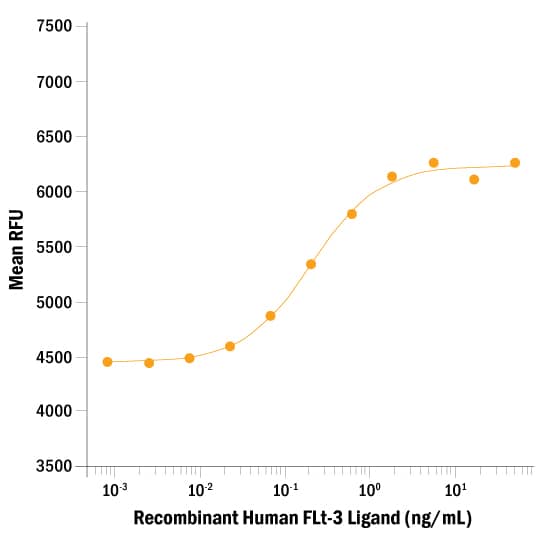
Measured in a cell proliferation assay using BaF3 mouse pro-B cells transfected with mouse Flt-3.
The ED50 for this effect is 0.2-1 ng/mL.
The ED50 for this effect is 0.2-1 ng/mL.
Scientific Data Images for ProDots Recombinant Human Flt-3 Ligand/FLT3L Protein
ProDots Recombinant Human Flt-3 Ligand/FLT3L Protein Bioactivity
ProDots®Recombinant Human Flt-3 Ligand stimulates cell proliferation in the BaF3 mouse Pro-B cell line transfected with mouse Flt-3. The ED50 for this effect is 0.2-1 ng/mL.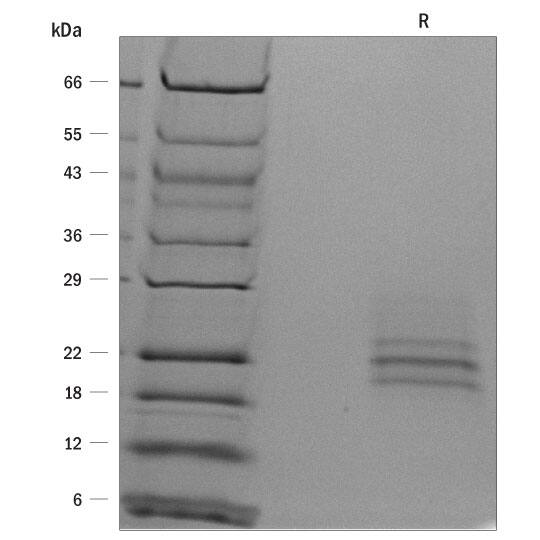
ProDots Recombinant Human Flt-3 Ligand/FLT3L Protein SDS-PAGE
1 μg/lane of ProDots®Recombinant Human Flt-3 Ligand was resolved with SDS-PAGE under reducing (R) conditions and visualized with silver staining, showing major bands at 20-24 kDa. The multiple bands are due to variable glycosylation of the protein.Formulation, Preparation and Storage
PRD308
| Reconstitution | For a stock solution, reconstitute at 100 μg/mL in sterile PBS, or simply roll ProDot® directly into cell culture medium for immediate use. |
| Shipping | The product is shipped at ambient temperature. Upon receipt, store it immediately at the temperature recommended below. |
| Stability & Storage | Use a manual defrost freezer and avoid repeated freeze-thaw cycles.
• 6 months from date of receipt at room temperature as supplied. • 12 months from date of receipt at 2-8 °C as supplied. • 1 month at 2-8 °C under sterile conditions after reconstitution. • 3 months at -20 to -80 °C under sterile conditions after reconstitution. |
Background: Flt-3 Ligand/FLT3L
References
- Wodnar-Filipowicz, A. (2003) News Physiol. Sci. 18:247.
- Dong, J. et al. (2002) Cancer Biol. Ther. 1:486.
- Gilliland, D.G. and J.D. Griffin (2002) Blood 100:1532.
- Hannum, C. et al. (1994) Nature 368:643.
- Lyman, S.D. et al. (1994) Blood 83:2795.
- Lyman, S.D. et al. (1993) Cell 75:1157.
- Savvides, S.N. et al. (2000) Nat. Struct. Biol. 7:486.
- McClanahan, T. et al. (1996) Blood 88:3371.
- Diener, K.R. et al. (2008) Exp. Hematol. 36:51.
- Farag, S.S. and M.A. Caligiuri (2006) Blood Rev. 20:123.
- Edwan, J.H. et al. (2004) J. Immunol. 172:5016.
Long Name
fms-like Tyrosine Kinase 3 Ligand
Alternate Names
FLG3L, Flt3L, FLT3LG
Gene Symbol
FLT3LG
UniProt
Additional Flt-3 Ligand/FLT3L Products
Product Documents for ProDots Recombinant Human Flt-3 Ligand/FLT3L Protein
Product Specific Notices for ProDots Recombinant Human Flt-3 Ligand/FLT3L Protein
726223.1
For research use only
Loading...
Loading...
Loading...