
Recombinant Human alpha-Synuclein Active, Pre-formed Fibrils, (Type 1), A53T Mutant Protein
Novus Biologicals, part of Bio-Techne | Catalog # NBP3-14767

Key Product Details
Conjugate
Unconjugated
Applications
Western Blot, Functional Assay, SDS-PAGE, SEC-MALS
Product Specifications
Description
A full length recombinant protein of Human alpha-Synuclein
Source: E. coli
Uniprot ID: P37840
Amino Acid Sequence: MDVFMKGLSK AKEGVVAAAE KTKQGVAEAA GKTKEGVLYV GSKTKEGVVH GVTTVAEKTK EQVTNVGGAV VTGVTAVAQK TVEGAGSIAA ATGFVKKDQL GKNEEGAPQE GILEDMPVDP DNEAYEMPSE EGYQDYEPEA
Purity
>95%, by SDS-PAGE
Activity
100 uM A53T alpha-Synuclein protein monomer seeded with 10 uM A53T alpha-Synuclein protein pre-formed fibrils in 25 uM Thioflavin T (PBS pH 7.4, 100 ul reaction volume) generated a fluorescence intensity of 28 000 RFU after incubation at 37C with shaking at 600 rpm for 56 hours. Fluorescence measured by excitation at 450 nm and emission at 485 nm on a microplate reader.
Localization
Cytoplasm, Membrane, Nucleus
Protein / Peptide Type
Recombinant Protein
Scientific Data Images
![In vitro assay: Recombinant Human alpha-Synuclein Active, Pre-formed Fibrils, (Type 1), A53T Mutant Protein [NBP3-14767]](https://resources.bio-techne.com/images/products/Recombinant-Human-alpha-Synuclein-Active-Pre-formed-Fibrils-Type-1-A53T-Mutant-Protein-In-vitro-assay-NBP3-14767-img0001.jpg "In vitro assay: Recombinant Human alpha-Synuclein Active, Pre-formed Fibrils, (Type 1), A53T Mutant Protein [NBP3-14767]")
In vitro assay: Recombinant Human alpha-Synuclein Active, Pre-formed Fibrils, (Type 1), A53T Mutant Protein [NBP3-14767]
In vitro assay: Recombinant Human alpha-Synuclein Active, Pre-formed Fibrils, (Type 1), A53T Mutant Protein [NBP3-14767] - Thioflavin T is a fluorescent dye that binds to beta sheet-rich structures such as those in alpha synuclein fibrils. Upon binding, the emission spectrum of the dye experiences a red-shift and increased fluorescence intensity. Thioflavin T emission curves show a limited increase in fluorescence (correlated to alpha synuclein aggregation) over time in A53T alpha synuclein monomers . A much greater increase in fluorescence is seen when 100 uM monomer is combined with 10 uM of fibrils (NBP3-14767) as the fibrils seed the formation of new fibrils from the pool of active monomers. Thioflavin T ex = 450 nm, em = 485 nm.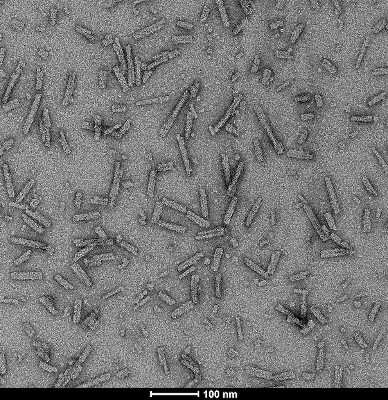
Electron Microscopy: Recombinant Human alpha-Synuclein Active, Pre-formed Fibrils, (Type 1), A53T Mutant Protein [NBP3-14767] - TEM of A53T alpha synuclein Pre-formed Fibrils (NBP3-14767)
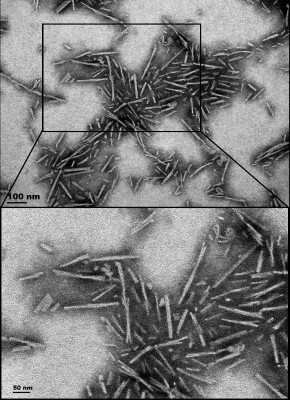
Electron Microscopy: Recombinant Human alpha-Synuclein Active, Pre-formed Fibrils, (Type 1), A53T Mutant Protein [NBP3-14767] - TEM of A53T alpha synuclein Pre-formed Fibrils (NBP3-14767)
Formulation, Preparation and Storage
NBP3-14767
| Preparation Method | Ion-exchange Purified |
| Formulation | PBS pH 7.4 |
| Preservative | No Preservative |
| Concentration | Please see the vial label for concentration. If unlisted please contact technical services. |
| Shipping | The product is shipped with dry ice or equivalent. Upon receipt, store it immediately at the temperature recommended below. |
| Stability & Storage | Store at -80C. Avoid freeze-thaw cycles. |
Background: alpha-Synuclein
A number of studies have revealed that alpha-synuclein aggregation is a hallmark feature in a number of neurodegenerative diseases, referred to as synucleinopathies (2-4). Alpha-synuclein protein aggregates are a large component of Lewy bodies that are present in Parkinson's disease (PD), Lewy body dementia (LBD), and multiple system atrophy (1-6). Research has shown phosphorylation of alpha-synuclein at Ser129 moves the protein from the nucleus to the cytoplasm and promotes fibril formation associated with synucleinopathies (1,2,5). Recent studies also suggest that alpha-synuclein accumulation can prevent mitochondrial import machinery causing mitochondrial dysfunction that is often observed in neurodegeneration (5). It is thought that preventing alpha-synuclein aggregation may prevent PD, thus alpha-synuclein is a target for many potential therapeutic interventions aimed at decreasing aggregate formation or increasing clearance (1,2,4-6).
References
1. Villar-Pique, A., Lopes da Fonseca, T., & Outeiro, T. F. (2016). Structure, function and toxicity of alpha-synuclein: the Bermuda triangle in synucleinopathies. Journal of neurochemistry. https://doi.org/10.1111/jnc.13249
2. Emamzadeh F. N. (2016). Alpha-synuclein structure, functions, and interactions. Journal of research in medical sciences : the official journal of Isfahan University of Medical Sciences. https://doi.org/10.4103/1735-1995.181989
3. Burre J. (2015). The Synaptic Function of alpha-Synuclein. Journal of Parkinson's disease. https://doi.org/10.3233/JPD-150642
4. Lashuel, H. A., Overk, C. R., Oueslati, A., & Masliah, E. (2013). The many faces of alpha-synuclein: from structure and toxicity to therapeutic target. Nature reviews. Neuroscience. https://doi.org/10.1038/nrn3406
5. Rocha, E. M., De Miranda, B., & Sanders, L. H. (2018). Alpha-synuclein: Pathology, mitochondrial dysfunction and neuroinflammation in Parkinson's disease. Neurobiology of disease. https://doi.org/10.1016/j.nbd.2017.04.004
6. O'Leary, E. I., & Lee, J. C. (2019). Interplay between alpha-synuclein amyloid formation and membrane structure. Biochimica et biophysica acta. Proteins and proteomics. https://doi.org/10.1016/j.bbapap.2018.09.012
Alternate Names
NACP, PARK1, PARK4, SNCA, Synuclein-alpha
Gene Symbol
SNCA
Additional alpha-Synuclein Products
Product Specific Notices
Please note that the 200ug and 500ug sizes are sent in 2x100ug and 5x100ug vials, respectively
This product is for research use only and is not approved for use in humans or in clinical diagnosis. This product is guaranteed for 1 year from date of receipt.
Loading...
Loading...
Loading...
Loading...
Loading...