
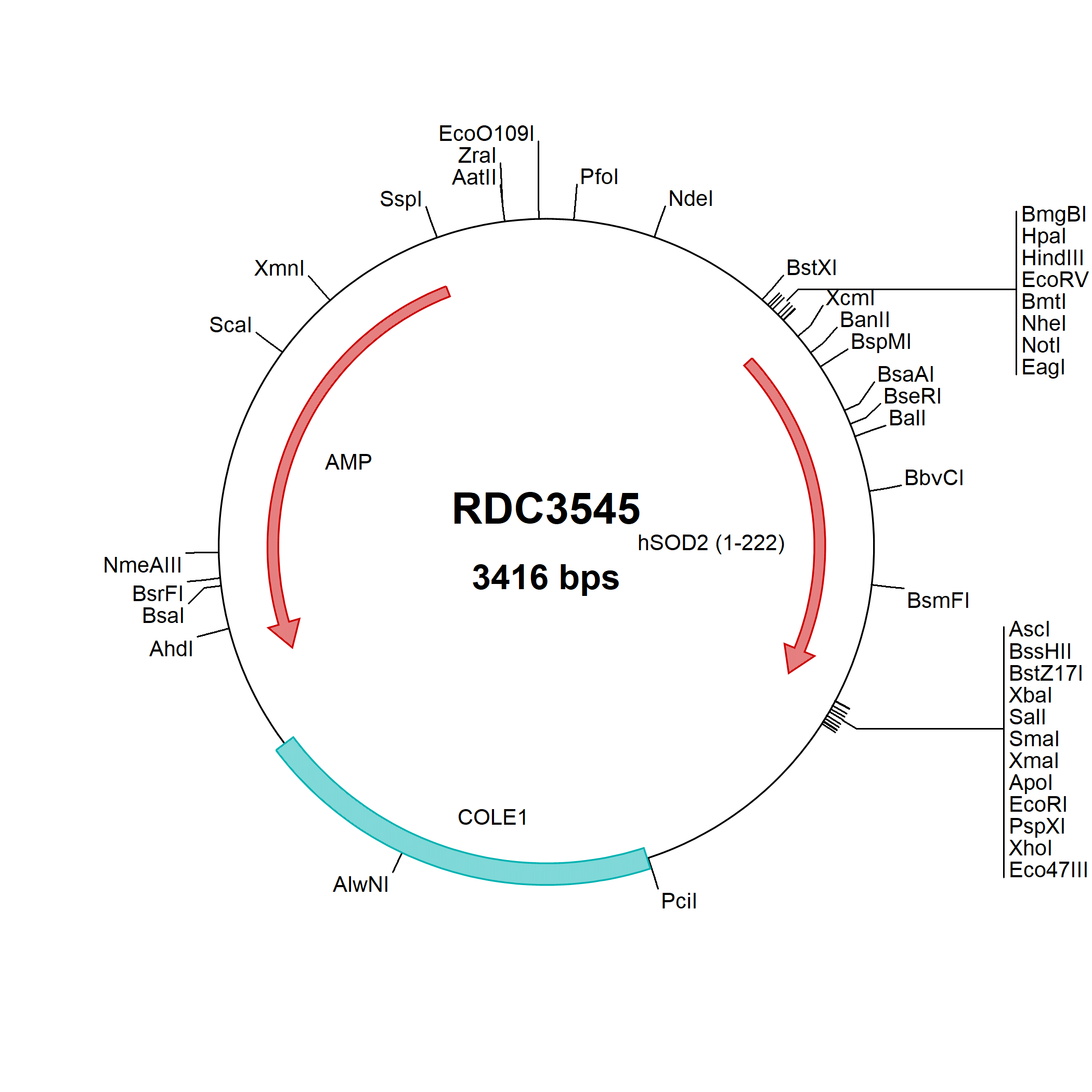
Human SOD2/Mn-SOD (NP_000627.2) VersaClone cDNA
R&D Systems, part of Bio-Techne | Catalog # RDC3545

Key Product Details
Species
Human
Accession Number
Formulation, Preparation, and Storage
Shipping
The product is shipped at ambient temperature. Upon receipt, store it immediately at the temperature recommended below.
Storage
Store the unopened product at -20 to -70 °C. Use a manual defrost freezer and avoid repeated freeze-thaw cycles. Do not use past expiration date.
Background: SOD2/Mn-SOD
Superoxide Dismutases, originally identified as Indophenoloxidases (IPOs), are enzymes that catalyze the conversion of naturally-occuring but harmful superoxide radicals into molecular oxygen and hydrogen peroxide. Three mammalian isozymes of SOD have been identified and are functionally related but have very modest sequence homology. SODs are typically soluble secreted or cytosolic proteins, but are also found in the mitochondria and extracellular matrix.
Any of three metals, manganese, iron, or copper, may be used in the active site of SOD and are indicative of cellular localization.MnSOD (SOD2) is found in the mitochondria of both prokaryotes and ukaryotes, whereas the cytosol of eukaryotes and prokaryotic organisms contains Cu/ZnSOD (SOD1) and FeSOD, respectively.
There have been several mutations identified in the Cu/ZnSOD (SOD1) gene in amyotrophic lateral sclerosis (ALS) patients, possibly suggesting a role for free radicals in this disease process. The mechanism of motor neuron degeneration that occurs in ALS, however, is unclear at this time. Several hypotheses have been explored for the role of mutant SOD1 and convincing evidence for the involvement of apoptosis has been presented, as well.
Long Name
Superoxide Dismutase-2
Alternate Names
IPO-B, Mn SOD, MnSOD, SOD, Mitochodrial
Gene Symbol
SOD2
UniProt
Additional SOD2/Mn-SOD Products
Product Documents for Human SOD2/Mn-SOD (NP_000627.2) VersaClone cDNA
Product Specific Notices for Human SOD2/Mn-SOD (NP_000627.2) VersaClone cDNA
For research use only
Loading...
Loading...
Loading...