
Rat TIM-1/KIM-1/HAVCR Antibody
R&D Systems, part of Bio-Techne | Catalog # AF3689


Scientific images may be resized, cropped, or adjusted for brightness or contrast for presentation purposes. These updates are limited to presentation and do not affect the underlying scientific interpretation of the data. Where available, additional source data may be provided upon request.
Conjugate
Catalog #
Key Product Details
Species Reactivity
Validated:
Rat
Cited:
Human, Mouse, Rat, Transgenic Mouse
Applications
Validated:
Immunohistochemistry, Western Blot
Cited:
Immunohistochemistry, Immunohistochemistry-Paraffin, Immunohistochemistry-Frozen, Western Blot, Neutralization, ELISA Capture
Label
Unconjugated
Antibody Source
Polyclonal Goat IgG
Product Specifications
Immunogen
Mouse myeloma cell line NS0-derived recombinant rat TIM-1/KIM-1/HAVCR
Ser18-Val238
Accession # O54947
Ser18-Val238
Accession # O54947
Specificity
Detects rat TIM-1/KIM-1/HAVCR in direct ELISAs and Western blots. In direct ELISAs, approximately 5% cross-reactivity with recombinant mouse (rm) TIM-1 is observed, and less than 1% cross-reactivity with recombinant human TIM-1, recombinant rat TIM-2, rmTIM-3, rmTIM-4, rmTIM-6, and rmTIM-7 is observed.
Clonality
Polyclonal
Host
Goat
Isotype
IgG
Scientific Data Images for Rat TIM-1/KIM-1/HAVCR Antibody
TIM‑1/KIM‑1/HAVCR in Rat Kidney.
TIM-1/KIM-1/HAVCR was detected in perfusion fixed frozen sections of rat kidney using 15 µg/mL Rat TIM-1/KIM-1/HAVCR Antigen Affinity-purified Polyclonal Antibody (Catalog # AF3689) overnight at 4 °C. Tissue was stained with the Anti-Goat HRP-DAB Cell & Tissue Staining Kit (brown; Catalog # CTS008) and counterstained with hematoxylin (blue). View our protocol for Chromogenic IHC Staining of Frozen Tissue Sections.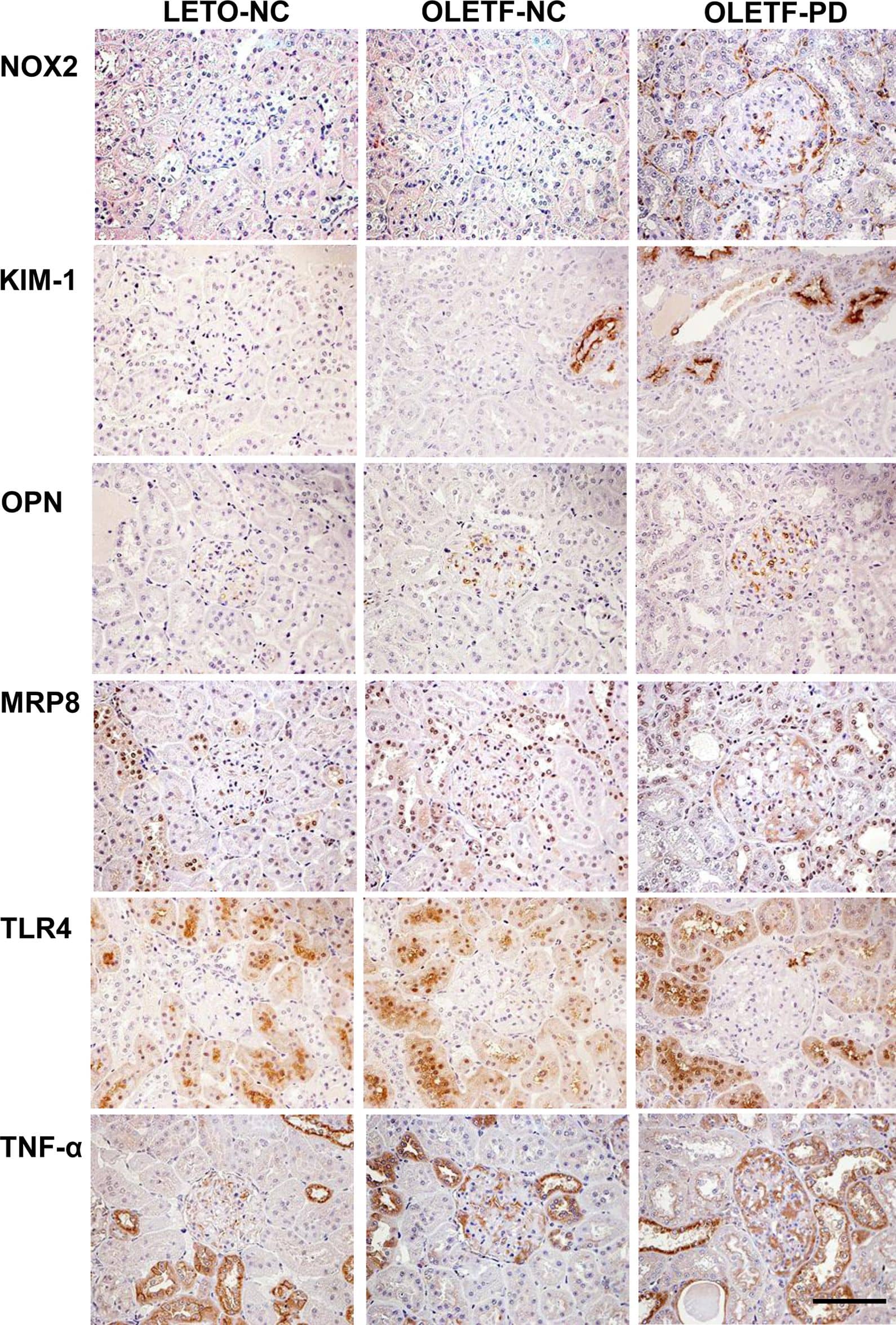
Detection of Rat TIM-1/KIM-1/HAVCR by Immunocytochemistry/Immunofluorescence
Immunohistochemical analysis of kidneys in LETO and OLETF rats.Representative immunohistochemical images of glomerular, tubular and tubulointerstitial lesions in each group, 12 weeks after starting to feed a Paigen diet. Scale bar, 100 μm. KIM-1, kidney injury molecule-1; MRP8, myeloid-related protein 8; NOX2, NADPH oxidase 2; OPN, osteopontin; TLR4, toll-like receptor 4; TNF-alpha, tumor necrosis factor-alpha. Image collected and cropped by CiteAb from the following publication (https://dx.plos.org/10.1371/journal.pone.0143979), licensed under a CC-BY license. Not internally tested by R&D Systems.
Rat TIM-1 / KIM-1 / HAVCR ELISA Standard Curve
Recombinant Rat TIM-1/KIM-1/HAVCR (Catalog # 3689-TM) was serially diluted and captured by Mouse Anti-Rat TIM-1/KIM-1/HAVCR Monoclonal Antibody (Catalog # MAB3689) coated on a Clear Polystyrene Microplate (Catalog # DY990). Goat Anti-Rat TIM-1/KIM-1/HAVCR Antigen Affinity-purified Polyclonal Antibody (Catalog # AF3689) was biotinylated and incubated with the protein captured on the plate. Detection of the standard curve was achieved by incubating Streptavidin-HRP (Catalog # DY998)Applications for Rat TIM-1/KIM-1/HAVCR Antibody
Application
Recommended Usage
Immunohistochemistry
5-15 µg/mL
Sample: Perfusion fixed frozen sections of rat kidney
Sample: Perfusion fixed frozen sections of rat kidney
Western Blot
0.1 µg/mL
Sample: Recombinant Rat TIM-1/KIM-1/HAVCR (Catalog # 3689-TM)
Sample: Recombinant Rat TIM-1/KIM-1/HAVCR (Catalog # 3689-TM)
Formulation, Preparation, and Storage
Purification
Antigen Affinity-purified
Reconstitution
Reconstitute at 0.2 mg/mL in sterile PBS. For liquid material, refer to CoA for concentration.
Formulation
Lyophilized from a 0.2 μm filtered solution in PBS with Trehalose. *Small pack size (SP) is supplied either lyophilized or as a 0.2 µm filtered solution in PBS.
Shipping
Lyophilized product is shipped at ambient temperature. Liquid small pack size (-SP) is shipped with polar packs. Upon receipt, store immediately at the temperature recommended below.
Stability & Storage
Use a manual defrost freezer and avoid repeated freeze-thaw cycles.
- 12 months from date of receipt, -20 to -70 °C as supplied.
- 1 month, 2 to 8 °C under sterile conditions after reconstitution.
- 6 months, -20 to -70 °C under sterile conditions after reconstitution.
Background: TIM-1/KIM-1/HAVCR
KIM-1 (Kidney-injury molecule-1; also TIM-1 and HAVCR) is a 50-80 kDa, variably glycosylated, type I transmembrane glycoprotein that is a member of the TIM family of immunoglobulin superfamily molecules. This gene family is involved in the regulation of Th1 and Th2-cell-mediated immunity. In mouse, there are eight known TIM/KIM genes (# 1-8) vs. only three genes in human (# 1, 3, 4). It is unknown if the rat genome exactly parallels that of mouse. Rat KIM-1 is synthesized as a 307 amino acid (aa) precursor that contains a 21 aa signal sequence, a 214 aa extracellular domain (ECD), a 21 aa transmembrane segment and a 51 aa cytoplasmic domain. The ECD contains one V-type Ig-like domain and a mucin region characterized by multiple Thr-Ser-Pro motifs. The mucin region may undergo extensive O-linked glycosylation. The mouse KIM-1 gene is highly polymorphic and this may be reflected in rat. In human, TIM-1 is known to circulate as a soluble form. It undergoes constitutive cleavage by an undefined MMP, releasing an 85 kDa soluble molecule. A similar process has now been described in rat. The ECD of rat KIM-1 is 50% and 81% aa identical to human and mouse KIM-1 ECD, respectively. The only two reported ligands for KIM-1 are TIM-4 and the hepatitis A virus. However, others are believed to exist, and based on the ligand for TIM-3, one might be an S-type lectin. KIM-1 is found on CD4+ T cells and proximal renal tubular cells. KIM-1 ligation induces T cell proliferation and promotes cytokine production. In particular, it induces IL-4 production, and requires the KIM-1 cytoplasmic tyrosine phosphorylation motif. Alternatively, KIM-1 activation of TIM-4 induces cell cycle arrest.
Long Name
T Cell Immunoglobulin Mucin-1
Alternate Names
CD365, HAVCR1, KIM-1, TIM1
Gene Symbol
HAVCR1
UniProt
Additional TIM-1/KIM-1/HAVCR Products
Product Documents for Rat TIM-1/KIM-1/HAVCR Antibody
Product Specific Notices for Rat TIM-1/KIM-1/HAVCR Antibody
This product is covered by one or more of the following US Patents 7,300,652; 7,041,290; 6,664,385 and other US and foreign patents pending or issued.
For research use only
Loading...
Loading...
Loading...
Loading...
Loading...