
Mouse VEGFR2/KDR/Flk-1 Antibody
R&D Systems, part of Bio-Techne | Catalog # MAB11749
Recombinant Monoclonal Antibody.

Conjugate
Catalog #
Key Product Details
Species Reactivity
Mouse
Applications
Multiplex Immunofluorescence, Immunohistochemistry, COMET
Label
Unconjugated
Antibody Source
Recombinant Monoclonal Rabbit IgG Clone # 3319C
Product Specifications
Immunogen
Synthetic Peptide
Accession # P35918
Accession # P35918
Specificity
Detects a synthetic peptide specific for mouse VEGFR2 around amino acid 1300 in Direct ELISA.
Clonality
Monoclonal
Host
Rabbit
Isotype
IgG
Scientific Data Images for Mouse VEGFR2/KDR/Flk-1 Antibody
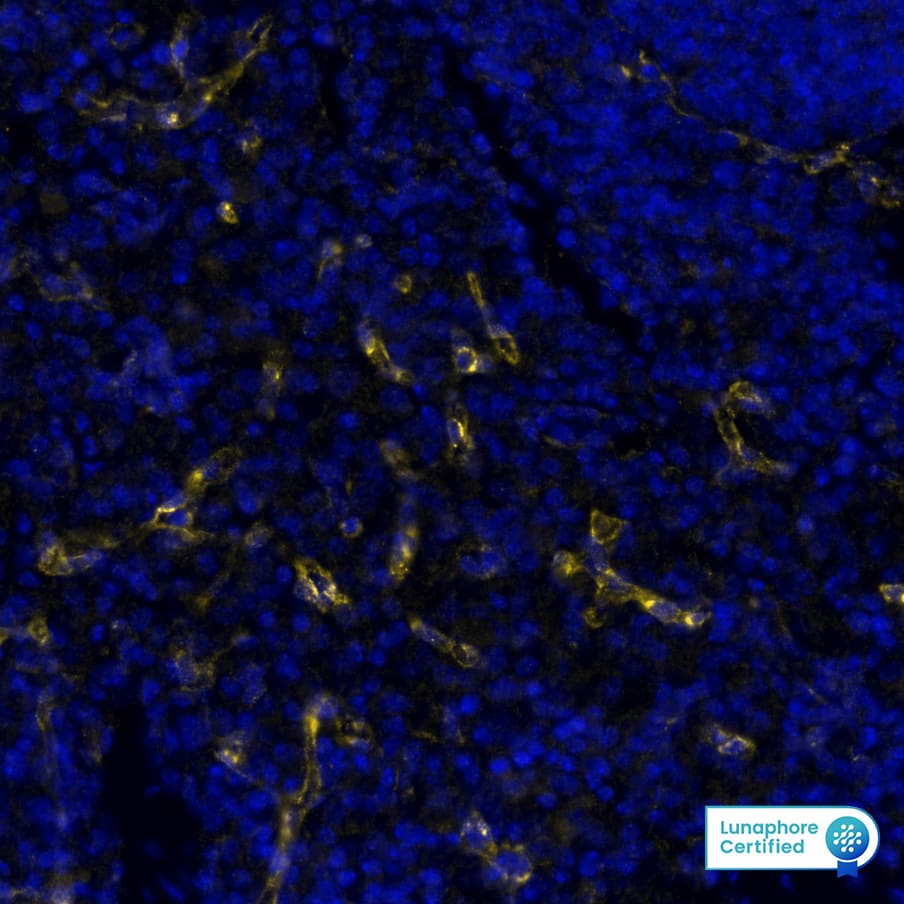
Detection of VEGFR2/KDR/Flk-1 in Mouse Spleen via seqIF™ staining on COMET™
VEGFR2/KDR/Flk-1 was detected in immersion fixed paraffin-embedded sections of mouse spleen using Rabbit Anti-Mouse VEGFR2/KDR/Flk-1 , Monoclonal Antibody (Catalog #MAB11749) at 10ug/mL at 37° Celsius for 8 minutes. Before incubation with the primary antibody, tissue underwent an all-in-one dewaxing and antigen retrieval preprocessing using PreTreatment Module (PT Module) and Dewax and HIER Buffer H (pH 9; Epredia Catalog # TA-999-DHBH). Tissue was stained using the Alexa Fluor™ Plus 647 Goat anti-Rabbit IgG Secondary Antibody at 1:200 at 37 ° Celsius for 2 minutes. (Yellow; Lunaphore Catalog # DR647RB) and counterstained with DAPI (blue; Lunaphore Catalog # DR100). Specific staining was localized to the endothelial cells. Protocol available in COMET™ Panel Builder.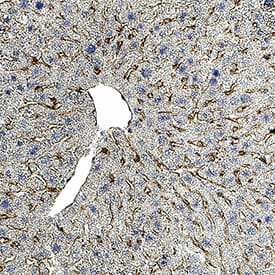
Detection of VEGFR2/KDR/Flk-1 in Mouse Liver.
VEGFR2/KDR/Flk-1 was detected in perfusion fixed paraffin-embedded sections of mouse liver using Rabbit Anti-Mouse VEGFR2/KDR/Flk-1 Monoclonal Antibody (Catalog # MAB11749) at 0.5 µg/ml overnight at 4 °C. Before incubation with the primary antibody, tissue was subjected to heat-induced epitope retrieval using VisUCyte Antigen Retrieval Reagent-Basic (Catalog # VCTS021). Tissue was stained using the HRP-conjugated Anti-Rabbit IgG Secondary Antibody (Catalog # HAF008) and counterstained with hematoxylin (blue). Specific staining was localized to the cell surface of endothelial cells. View our protocol for Chromogenic IHC Staining of Paraffin-embedded Tissue Sections.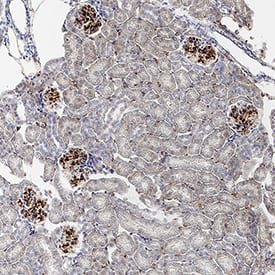
Detection of VEGFR2/KDR/Flk-1 in Mouse Kidney.
VEGFR2/KDR/Flk-1 was detected in perfusion fixed paraffin-embedded sections of mouse kidney using Rabbit Anti-Mouse VEGFR2/KDR/Flk-1 Monoclonal Antibody (Catalog # MAB11749) at 0.5 µg/ml overnight at 4 °C. Before incubation with the primary antibody, tissue was subjected to heat-induced epitope retrieval using VisUCyte Antigen Retrieval Reagent-Basic (Catalog # VCTS021). Tissue was stained using the HRP-conjugated Anti-Rabbit IgG Secondary Antibody (Catalog # HAF008) and counterstained with hematoxylin (blue). Specific staining was localized to the cell surface of endothelial cells. View our protocol for Chromogenic IHC Staining of Paraffin-embedded Tissue Sections.Applications for Mouse VEGFR2/KDR/Flk-1 Antibody
Application
Recommended Usage
COMET
Immunohistochemistry
0.5-10 µg/mL
Sample: Perfusion fixed paraffin-embedded sections of mouse liver and mouse kidney
Sample: Perfusion fixed paraffin-embedded sections of mouse liver and mouse kidney
Multiplex Immunofluorescence
10 µg/mL
Sample: Immersion fixed paraffin-embedded sections of mouse spleen
Sample: Immersion fixed paraffin-embedded sections of mouse spleen
Formulation, Preparation, and Storage
Purification
Protein A or G purified from hybridoma culture supernatant
Reconstitution
Reconstitute lyophilized material at 0.2 mg/ml in sterile PBS. For liquid material, refer to CoA for concentration.
Formulation
Lyophilized from a 0.2 μm filtered solution in PBS with Trehalose.
Shipping
Lyophilized product is shipped at ambient temperature. Liquid small pack size (-SP) is shipped with polar packs. Upon receipt, store immediately at the temperature recommended below.
Stability & Storage
Use a manual defrost freezer and avoid repeated freeze-thaw cycles.
- 12 months from date of receipt, -20 to -70 °C as supplied.
- 1 month, 2 to 8 °C under sterile conditions after reconstitution.
- 6 months, -20 to -70 °C under sterile conditions after reconstitution.
Background: VEGFR2/KDR/Flk-1
VEGFR2 (KDR/Flk-1), VEGFR1 (Flt-1) and VEGFR3 (Flt-4) belong to the class III subfamily of receptor tyrosine kinases (RTKs). All three receptors contain seven immunoglobulin-like repeats in their extracellular domains and kinase insert domains in their intracellular regions. The expression of VEGFR1, 2, and 3 is almost exclusively restricted to endothelial cells. These receptors are likely to play essential roles in vasculogenesis and angiogenesis. Mature mouse VEGFR2 is composed of a 743 amino acid (aa) extracellular domain, a 22 aa transmembrane domain, and a 583 aa cytoplasmic domain. In contrast to VEGFR1 which binds both PlGF and VEGF with high affinity, VEGFR2 binds VEGF but not PlGF with high affinity.
References
- Ferra, N. and R. Davis-Smyth (1997) Endocrine Reviews 18:4.
- Achen, M.G. et al. (1998) Proc. Natl. Acad. Sci. USA 95:548.
Long Name
Vascular Endothelial Growth Factor Receptor 2
Alternate Names
CD309, Flk-1, Flk1, KDR, KRD1, Ly73, VEGF R2
Gene Symbol
KDR
UniProt
Additional VEGFR2/KDR/Flk-1 Products
Product Documents for Mouse VEGFR2/KDR/Flk-1 Antibody
Product Specific Notices for Mouse VEGFR2/KDR/Flk-1 Antibody
For research use only
Loading...
Loading...
Loading...
Loading...
Loading...