
Mouse OX40 Ligand/TNFSF4 Antibody
R&D Systems, part of Bio-Techne | Catalog # AF1236

Scientific images may be resized, cropped, or adjusted for brightness or contrast for presentation purposes. These updates are limited to presentation and do not affect the underlying scientific interpretation of the data. Where available, additional source data may be provided upon request.
Conjugate
Catalog #
Key Product Details
Species Reactivity
Validated:
Mouse
Cited:
Mouse
Applications
Validated:
Western Blot, Neutralization, Immunocytochemistry
Cited:
Neutralization
Label
Unconjugated
Antibody Source
Polyclonal Goat IgG
Product Specifications
Immunogen
Mouse myeloma cell line NS0-derived recombinant mouse OX40 Ligand/TNFSF4
Gln49-Leu198
Accession # P43488
Gln49-Leu198
Accession # P43488
Specificity
Detects mouse OX40 Ligand/TNFSF4 in direct ELISAs and Western blots. In direct ELISAs, approximately 5% cross-reactivity with recombinant human OX40 Ligand is observed.
Clonality
Polyclonal
Host
Goat
Isotype
IgG
Endotoxin Level
<0.10 EU per 1 μg of the antibody by the LAL method.
Scientific Data Images for Mouse OX40 Ligand/TNFSF4 Antibody
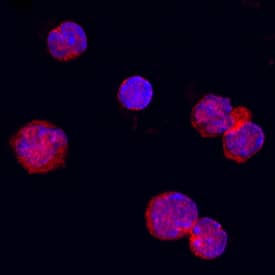
OX40 Ligand/TNFSF4 in Mouse Splenocytes.
OX40 Ligand/TNFSF4 was detected in immersion fixed mouse splenocytes using Goat Anti-Mouse OX40 Ligand/TNFSF4 Antigen Affinity-purified Polyclonal Antibody (Catalog # AF1236) at 15 µg/mL for 3 hours at room temperature. Cells were stained using the NorthernLights™ 557-conjugated Anti-Goat IgG Secondary Antibody (red; Catalog # NL001) and counterstained with DAPI (blue). Specific staining was localized to the plasma membrane and cytoplasm. View our protocol for Fluorescent ICC Staining of Non-adherent Cells.
IL-2 Secretion Induced by OX40 Ligand/TNFSF4 and Neutralization by Mouse OX40 Ligand/TNFSF4 Antibody.
In the presence of a cross-linking antibody, Mouse polyHistidine Monoclonal Antibody (10 µg/mL, Catalog # MAB050) and sub-optimal amounts of Mouse CD3e Monoclonal Antibody (Catalog # MAB484), Recombinant Mouse OX40 Ligand/TNFSF4 (Catalog # 1236-OX) stimulates IL-2 secretion in mouse T cells in a dose-dependent manner (orange line), as measured by the Mouse IL-2 Quantikine ELISA Kit (Catalog # M2000). Under these conditions, IL-2 secretion elicited by Recombinant Mouse OX40 Ligand/TNFSF4 (100 ng/mL) is neutralized (green line) by increasing concentrations of Goat Anti-Mouse OX40 Ligand/TNFSF4 Antigen Affinity-purified Polyclonal Antibody (Catalog # AF1236). The ND50 is typically 0.2-0.6 µg/mL.Applications for Mouse OX40 Ligand/TNFSF4 Antibody
Application
Recommended Usage
Immunocytochemistry
5-15 µg/mL
Sample: Immersion fixed mouse splenocytes
Sample: Immersion fixed mouse splenocytes
Western Blot
0.1 µg/mL
Sample: Recombinant Mouse OX40 Ligand/TNFSF4 (Catalog # 1236-OX)
Sample: Recombinant Mouse OX40 Ligand/TNFSF4 (Catalog # 1236-OX)
Neutralization
Measured by its ability to neutralize OX40 Ligand/TNFSF4-induced IL‑2 secretion in mouse T cells. The Neutralization Dose (ND50) is typically 0.2-0.6 µg/mL in the presence of 100 ng/mL Recombinant Mouse OX40 Ligand/TNFSF4, 10 µg/mL a cross-linking antibody, Mouse polyHistidine Monoclonal Antibody, and sub-optimal amounts of Mouse CD3 epsilon Monoclonal Antibody.
Formulation, Preparation, and Storage
Purification
Antigen Affinity-purified
Reconstitution
Reconstitute at 0.2 mg/mL in sterile PBS. For liquid material, refer to CoA for concentration.
Formulation
Lyophilized from a 0.2 μm filtered solution in PBS with Trehalose. *Small pack size (SP) is supplied either lyophilized or as a 0.2 µm filtered solution in PBS.
Shipping
Lyophilized product is shipped at ambient temperature. Liquid small pack size (-SP) is shipped with polar packs. Upon receipt, store immediately at the temperature recommended below.
Stability & Storage
Use a manual defrost freezer and avoid repeated freeze-thaw cycles.
- 12 months from date of receipt, -20 to -70 °C as supplied.
- 1 month, 2 to 8 °C under sterile conditions after reconstitution.
- 6 months, -20 to -70 °C under sterile conditions after reconstitution.
Background: OX40 Ligand/TNFSF4
OX40 Ligand (OX40L), also known as gp34, is a type II transmembrane glycoprotein belonging to the TNF superfamily. Murine OX40L cDNA encodes a 198 amino acid (aa) residue protein comprised of a 28 aa N-terminal cytoplasmic domain, a 20 aa transmembrane segment, and a 150 aa C-terminal extracellular domain (1). Human and murine OX40L share 46% sequence identity at the amino acid level (1). The OX40L is expressed on activated antigen presenting cells such as B cells, macrophages, dendritic cells, and on endothelial cells at the site of inflammation. The receptor for OX40L is OX40 (CD134) that is expressed predominantly on activated CD4+ T cells. Expression of OX40 is transient following engagement of T cell receptors (2). Ligation of OX40L by OX40 stimulates proliferation and differentiation of activated B cells, and increases immunoglobulin secretion (3, 4). The expression of OX40L on B cells is up-regulated by CD40 ligation (3). Engagement of the OX40-OX40L system has co-stimulatory effects on T cells by stimulating the production of cytokines by T helper cells and increasing the survival of memory T cells (2, 5). Blocking of the OX40-OX40L interaction in vitro inhibits co-stimulation resulting in decreased T cell proliferation and adhesion of T cells to endothelial cells. Inhibition of the OX40-OX40L interaction in disease models has beneficial effects in acute graft-versus-host disease, inflammatory bowel disease, and decreases the development of collagen-induced arthritis and experimental leishmaniasis (6).
References
- Baum, P.R. et al. (1994) EMBO J. 13:3992.
- Gramaglia, I. et al. (1999) J. Immunol. 161:6510.
- Stuber, E. et al. (1995) Immunity 2:507.
- Malstrom, V. et al. (2001) J. Immunol. 166:6972.
- Maxwell, J.R. et al. (2000) J. Immunol. 164:107.
- Weinberg, A.D. (2002) Trends Immunol. 23:102.
Alternate Names
CD252, gp34, TNFSF4
Gene Symbol
TNFSF4
UniProt
Additional OX40 Ligand/TNFSF4 Products
Product Documents for Mouse OX40 Ligand/TNFSF4 Antibody
Product Specific Notices for Mouse OX40 Ligand/TNFSF4 Antibody
For research use only
Loading...
Loading...
Loading...
Loading...
Loading...