
Mouse IL-7 Antibody
R&D Systems, part of Bio-Techne | Catalog # MAB4071
Recombinant Monoclonal Antibody.

Scientific images may be resized, cropped, or adjusted for brightness or contrast for presentation purposes. These updates are limited to presentation and do not affect the underlying scientific interpretation of the data. Where available, additional source data may be provided upon request.
Conjugate
Catalog #
Key Product Details
Species Reactivity
Mouse
Applications
Neutralization
Label
Unconjugated
Antibody Source
Recombinant Monoclonal Rabbit IgG Clone # 2304B
Product Specifications
Immunogen
E. coli-derived recombinant mouse IL-7
Glu26-Ile154
Accession # P10168
Glu26-Ile154
Accession # P10168
Specificity
Detects mouse IL-7 in direct ELISAs.
Clonality
Monoclonal
Host
Rabbit
Isotype
IgG
Endotoxin Level
<0.10 EU per 1 μg of the antibody by the LAL method.
Scientific Data Images for Mouse IL-7 Antibody
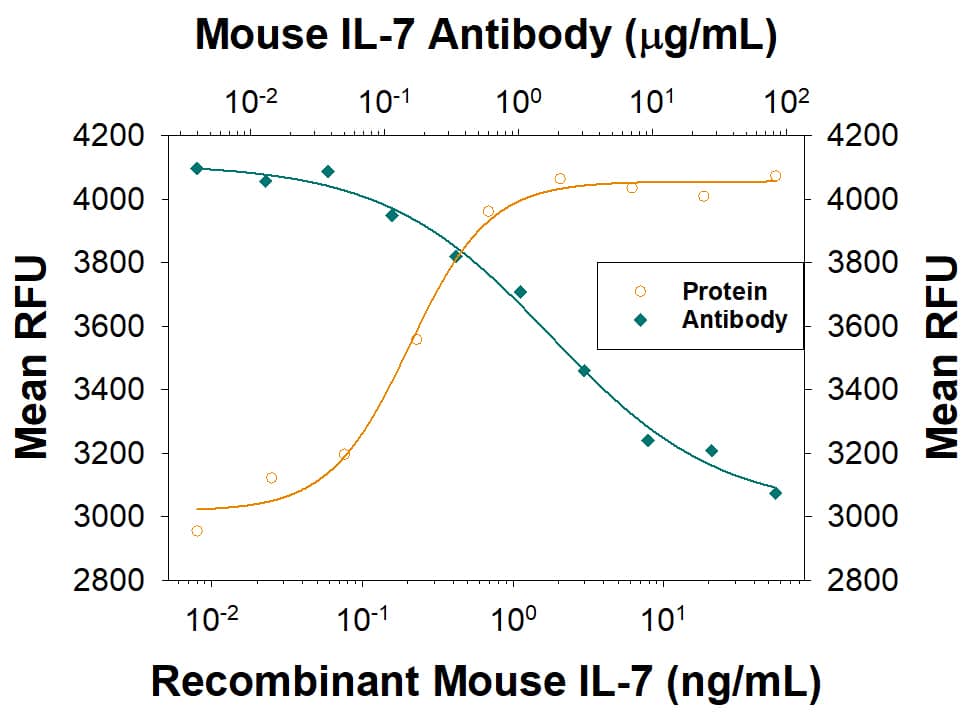
Cell Proliferation Induced by IL-7 and Neutralization by Mouse IL-7 Antibody.
Recombinant Mouse IL-7 (Catalog # 407-ML) stimulates proliferation in PHA-activated human peripheral blood mononuclear cells (PBMC) in a dose-dependent manner (orange line) as measured by Resazurin (Catalog # AR002). Proliferation elicited by Recombinant Mouse IL-7 (1.5 ng/mL) is neutralized (green line) by increasing concentrations of Rabbit Anti-Mouse IL-7 Monoclonal Antibody (Catalog # MAB4071). The ND50 is typically 0.5-3 µg/mL.Applications for Mouse IL-7 Antibody
Application
Recommended Usage
Neutralization
Measured by its ability to neutralize IL‑7-induced proliferation in PHA-activated human peripheral blood mononuclear cells (PBMC). The Neutralization Dose (ND50) is typically 0.5-3 μg/mL in the presence of 1.5 ng/mL Recombinant Mouse IL‑7.
Formulation, Preparation, and Storage
Purification
Protein A or G purified from cell culture supernatant
Reconstitution
Reconstitute at 0.5 mg/mL in sterile PBS. For liquid material, refer to CoA for concentration.
Formulation
Lyophilized from a 0.2 μm filtered solution in PBS with Trehalose. *Small pack size (SP) is supplied either lyophilized or as a 0.2 µm filtered solution in PBS.
Shipping
Lyophilized product is shipped at ambient temperature. Liquid small pack size (-SP) is shipped with polar packs. Upon receipt, store immediately at the temperature recommended below.
Stability & Storage
Use a manual defrost freezer and avoid repeated freeze-thaw cycles.
- 12 months from date of receipt, -20 to -70 °C as supplied.
- 1 month, 2 to 8 °C under sterile conditions after reconstitution.
- 6 months, -20 to -70 °C under sterile conditions after reconstitution.
Background: IL-7
IL-7, previously known as pre-B-cell growth factor and lymphopoietin-1, was originally purified on the basis of its ability to promote the proliferation of precursor B‑cells. It has now been shown that IL-7 can also stimulate the proliferation of thymocytes, T cell progenitors and mature CD4 + and CD8+ T cells. IL-7 can induce the formation of lymphokine-activated killer (LAK) cells as well as the development of cytotoxic T lymphocytes (CTL). IL-7 was also shown to induce the V(D)J rearrangement of the T cell receptor beta gene in mouse fetal thymocytes. Among myeloid lineage cells, IL-7 can up-regulate the production of pro-inflammatory cytokines and stimulate the tumorocidal activity of monocytes/macrophages. IL-7 is expressed by adherent stromal cells from various tissues.
Mouse IL-7 cDNA encodes a precursor protein of 154 amino residues containing a 25 amino acid residue signal peptide. Human IL-7 has approximately 65% amino acid sequence identity with mouse IL-7 and both proteins exhibit cross-species activity.
IL-7 bioactivities are mediated by the binding of IL-7 to functional high-affinity receptor complexes. The ligand binding subunit (IL-7 R) of the IL-7 receptor complex has been cloned from human and mouse sources. In addition to the membrane-anchored form of the IL-7 receptor, a human cDNA clone that encodes a soluble form of the IL-7 R has also been isolated. The gamma chain of the IL-2 receptor complex has been shown to be an essential component for IL-7 signal transduction. Both IL-7 R and IL-2 R gamma are members of the hematopoietin receptor superfamily. Cells known to express IL-7 receptors include pre-B cells, T cells and bone marrow cells.
Long Name
Interleukin 7
Alternate Names
IL7, Lymphopoietin-1, PBGF
Gene Symbol
IL7
UniProt
Additional IL-7 Products
Product Documents for Mouse IL-7 Antibody
Product Specific Notices for Mouse IL-7 Antibody
For research use only
Loading...
Loading...
Loading...
Loading...