
Mouse Clusterin alpha Chain Antibody
R&D Systems, part of Bio-Techne | Catalog # MAB2747

Discontinued Product
MAB2747 has been discontinued.
View all Clusterin products.
Key Product Details
Species Reactivity
Mouse
Applications
Western Blot, Immunoprecipitation
Label
Unconjugated
Antibody Source
Monoclonal Rat IgG2A Clone # 327020
Product Specifications
Immunogen
Mouse myeloma cell line NS0-derived recombinant mouse Clusterin
Glu22-Glu448
Accession # Q06890
Glu22-Glu448
Accession # Q06890
Specificity
Detects mouse Clusterin alpha Chain in direct ELISAs and Western blots. In Western blots, approximately 25% cross-reactivity with recombinant human Clusterin is observed.
Clonality
Monoclonal
Host
Rat
Isotype
IgG2A
Scientific Data Images for Mouse Clusterin alpha Chain Antibody
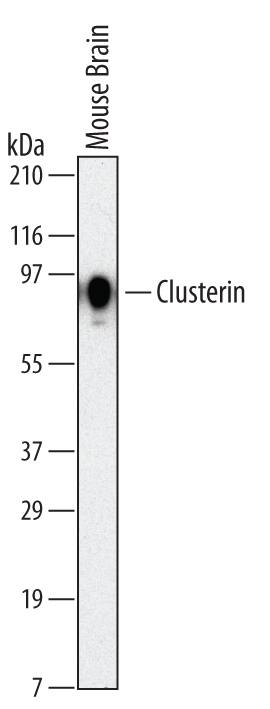
Detection of Mouse Clusterin by Western Blot.
Western blot shows lysates of mouse brain tissue. PVDF membrane was probed with 2 µg/mL of Rat Anti-Mouse Clusterin a Chain Monoclonal Antibody (Catalog # MAB2747) followed by HRP-conjugated Anti-Rat IgG Secondary Antibody (Catalog # HAF005). A specific band was detected for Clusterin at approximately 80 kDa (as indicated). This experiment was conducted under non-reducing conditions and using Immunoblot Buffer Group 1.Applications for Mouse Clusterin alpha Chain Antibody
Application
Recommended Usage
Immunoprecipitation
25 µg/mL
Sample: Conditioned cell culture medium spiked with Recombinant Mouse Clusterin (Catalog # 2747‑HS), see our available Western blot detection antibodies
Sample: Conditioned cell culture medium spiked with Recombinant Mouse Clusterin (Catalog # 2747‑HS), see our available Western blot detection antibodies
Western Blot
2 µg/mL
Sample: Mouse brain tissue
Sample: Mouse brain tissue
Formulation, Preparation, and Storage
Purification
Protein A or G purified from hybridoma culture supernatant
Reconstitution
Reconstitute at 0.5 mg/mL in sterile PBS. For liquid material, refer to CoA for concentration.
Formulation
Lyophilized from a 0.2 μm filtered solution in PBS with Trehalose. *Small pack size (SP) is supplied either lyophilized or as a 0.2 µm filtered solution in PBS.
Shipping
Lyophilized product is shipped at ambient temperature. Liquid small pack size (-SP) is shipped with polar packs. Upon receipt, store immediately at the temperature recommended below.
Stability & Storage
Use a manual defrost freezer and avoid repeated freeze-thaw cycles.
- 12 months from date of receipt, -20 to -70 °C as supplied.
- 1 month, 2 to 8 °C under sterile conditions after reconstitution.
- 6 months, -20 to -70 °C under sterile conditions after reconstitution.
Background: Clusterin
Clusterin, also known as Apolipoprotein J, Sulfated Glycoprotein 2 (SGP-2), TRPM-2, and SP-40,40, is a secreted multifunctional protein that was named for its ability to induce cellular clustering. It binds a wide range of molecules and may function as a chaperone of misfolded extracellular proteins. It also participates in the control of cell proliferation, apoptosis, and carcinogenesis (1, 2). Clusterin is predominantly expressed in adult testis, ovary, adrenal gland, liver, heart, and brain and in many epithelial tissues during embryonic development (3). Mouse Clusterin is synthesized as a precursor that contains two coiled coil domains, two nuclear localization signals (NLS), and one heparin binding domain (3-6). Intracellular cleavages of the precursor remove the signal peptide and generate comparably sized alpha and beta chains which are secreted as an 80 kDa N-glycosylated disulfide-linked heterodimer (7, 8). Mature mouse Clusterin shares 77% and 93% amino acid sequence identity with human and rat Clusterin, respectively. High μg/mL concentrations of Clusterin circulate predominantly as a component of high density lipoprotein particles, and these are internalized and degraded through interactions with LRP-2/Megalin (9, 10). In human, an alternately spliced 50 kDa isoform of Clusterin (nCLU) lacks the signal peptide and remains intracellular (5, 11). This molecule is neither glycosylated nor cleaved into alpha and beta chains (11). In the cytoplasm, nCLU destabilizes the actin cytoskeleton and inhibits NF kappaB activation (12, 13). Cellular exposure to ionizing radiation promotes the translocation of nCLU to the nucleus where it interacts with Ku70 and promotes apoptosis (5, 11). This function contrasts with the cytoprotective effect of secreted Clusterin (14). During colon cancer tumor progression there is a downregulation of the intracellular form and an upregulation of the glycosylated secreted form (11).
References
- Carver, J.A. et al. (2003) IUBMB Life 55:661.
- Shannan, B. et al. (2006) Cell Death Differ. 13:12.
- French, L.E. et al. (1993) J. Cell Biol. 122:1119.
- Lee, K.H. et al. (1993) Biochem. Biophys. Res. Commun. 194:1175.
- Leskov, K.S. et al. (2003) J. Biol. Chem. 278:11590.
- Pankhurst, G.J. et al. (1998) Biochemistry 37:4823.
- Burkey, B.F. et al. (1991) J. Lipid. Res. 32:1039.
- de Silva, H.V. et al. (1990) J. Biol. Chem. 265:14292.
- Jenne, D.E. et al. (1991) J. Biol. Chem. 266:11030.
- Kounnas, M.Z. et al. (1995) J. Biol. Chem. 270:13070.
- Pucci, S. et al. (2004) Oncogene 23:2298.
- Moretti, R. M. et al. (2007) Cancer Res. 67:10325.
- Santilli, G. et al. (2003) J. Biol. Chem. 278:38214.
- Trougakos, I.P. et al. (2004) Cancer Res. 64:1834.
Alternate Names
APOJ, CLI, CLU, SGP-2, SP-40, TRPM-2
Gene Symbol
CLU
UniProt
Additional Clusterin Products
Product Documents for Mouse Clusterin alpha Chain Antibody
Product Specific Notices for Mouse Clusterin alpha Chain Antibody
For research use only
Loading...
Loading...
Loading...
Loading...