
Mouse Chitinase 3-like 1/YKL-40 Antibody
R&D Systems, part of Bio-Techne | Catalog # MAB2649

Scientific images may be resized, cropped, or adjusted for brightness or contrast for presentation purposes. These updates are limited to presentation and do not affect the underlying scientific interpretation of the data. Where available, additional source data may be provided upon request.
Conjugate
Catalog #
Key Product Details
Species Reactivity
Validated:
Mouse
Cited:
Mouse
Applications
Validated:
Western Blot
Cited:
Immunohistochemistry, Western Blot
Label
Unconjugated
Antibody Source
Monoclonal Rat IgG2B Clone # 321924
Product Specifications
Immunogen
Mouse myeloma cell line NS0-derived recombinant mouse Chitinase 3-like 1/YKL-40
Tyr22-Ala381
Accession # Q61362
Tyr22-Ala381
Accession # Q61362
Specificity
Detects mouse Chitinase 3-like 1/YKL-40 in direct ELISAs and Western blots. In direct ELISAs and Western blots, this antibody does not cross‑react with recombinant human Chitinase 3-like 1/YKL-40.
Clonality
Monoclonal
Host
Rat
Isotype
IgG2B
Scientific Data Images for Mouse Chitinase 3-like 1/YKL-40 Antibody
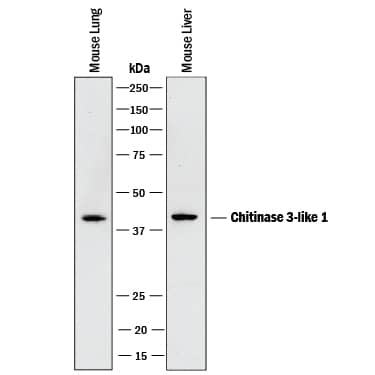
Detection of Mouse Chitinase 3‑like 1/YKL-40 by Western Blot.
Western blot shows lysates of mouse lung tissue and mouse liver tissue. PVDF membrane was probed with 1 µg/mL of Rat Anti-Mouse Chitinase 3-like 1/YKL-40 Monoclonal Antibody (Catalog # MAB2649) followed by HRP-conjugated Anti-Rat IgG Secondary Antibody (HAF005). A specific band was detected for Chitinase 3-like 1/YKL-40 at approximately 40 kDa (as indicated). This experiment was conducted under reducing conditions and using Immunoblot Buffer Group 1.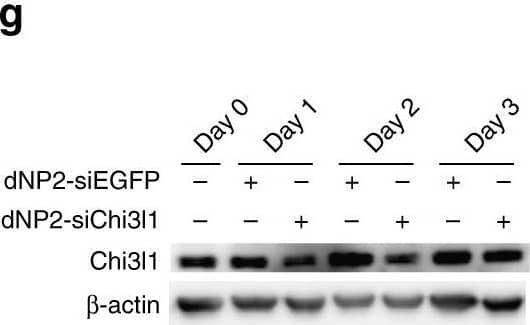
Detection of Chitinase 3-like 1/YKL-40 by Western Blot
Targeted inhibition of Chi3l1 by dNP2-siChi3l1 complex enhances effector cytokine production in Th1 & CD8 T . a Schematic diagram of the complex formation of dNP2-HA2 peptide & Chi3l1 siRNA (siChi3l1) at indicated N/P ratios. b Gel retardation assay of dNP2-siChi3l1 complex. c The size of free siRNA, free peptide, & dNP2-siRNA complexes measured by Nano particle size analyzer. d Dose dependent reduction of Chi3l1 mRNA expression by dNP2-siChi3l1 complex at 1:25 N/P ratio. e Chi3l1 protein level in culture supernatants measured by ELISA. f Chi3l1 mRNA in the lung after intranasal administration of dNP2-siEGFP or dNP2-siChi3l1 complex at 1:25 N/P ratio. Chi3l1 mRNA normalized to beta-actin, & presented as relative to expression at day 0. g Chi3l1 protein level in the lung was analyzed by WBting. Chi3l1 protein relative to expression at day 0. h Densitometric values of band intensity was calculated by normalization to the value of beta-actin, then the value was represented as relative to the value at day 0. Statistical significance of dNP2-siChi3l1 treated group was analyzed to dNP2-siEGFP treated group on each day. i FACS-sorted WT naïve CD4 T differentiated into Th1 & WT naïve CD8 T activated by plate-bound anti-CD3 & anti-CD28 antibodies with IL-2 for 5 days with indicated concentrations of dNP2-siEGFP or dNP2-siChi3l1 complexes. IFN gamma & TNF alpha expression analyzed by flow cytometry. j % of TNF alpha+IFN gamma+ represented as bar graph. k Chi3l1 & IFN gamma mRNA expression in dNP2-siChi3l1 treated Th1 . Each gene expression level was normalized to beta-actin, & represented as fold change to those of WT Th1 cell. Data are presented as mean ± SD of three sets of independent experiments (n = 6). n.s., not significant; *p < 0.05, **p < 0.01, ***p < 0.001 (two-tailed Student’s t-test) Image collected & cropped by CiteAb from the following open publication (https://pubmed.ncbi.nlm.nih.gov/29403003), licensed under a CC-BY license. Not internally tested by R&D Systems.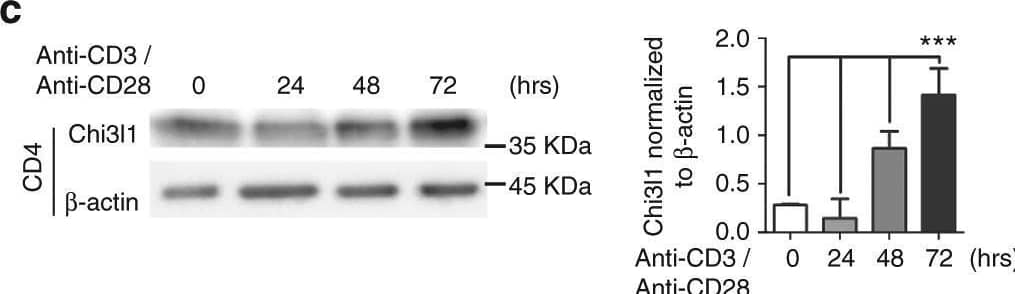
Detection of Chitinase 3-like 1/YKL-40 by Western Blot
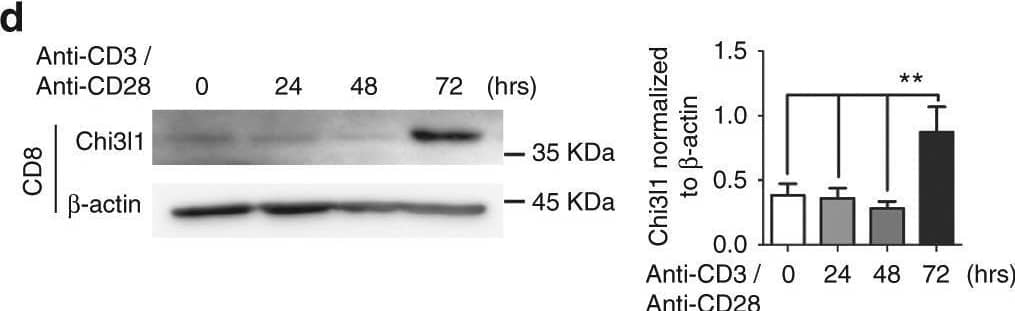
Chitinase and Chitinase-like protein expressions in T cells. a, b mRNA expression of chitinase (Chitotriosidase, AMCase) and chitinase-like protein (Chi3l1, Ym-1) in mouse CD4 and CD8 T cells upon anti-CD3 and anti-CD28 stimulation for 3 days. Each gene expression level was normalized to beta-actin, and represented as fold change to Non-activated (NA). c, d Chi3l1 protein level in CD4 and CD8 T cells stimulated by plate-bound anti-CD3 and anti-CD28 antibodies for indicated time point. Densitometric values of band intensity were calculated by normalization to the value of beta-actin. e Chi3l1 mRNA expression in naïve and effector T cell subsets. Chi3l1 mRNA expression level was normalized to beta-actin level. Data are mean ± SD of three sets of independent experiments (n = 6). n.d., not detected; **p < 0.01, ***p < 0.001 (two-tailed Student’s t-test) Image collected and cropped by CiteAb from the following open publication (https://pubmed.ncbi.nlm.nih.gov/29403003), licensed under a CC-BY license. Not internally tested by R&D Systems.Applications for Mouse Chitinase 3-like 1/YKL-40 Antibody
Application
Recommended Usage
Western Blot
1 µg/mL
Sample: Mouse lung tissue and mouse liver tissue
Sample: Mouse lung tissue and mouse liver tissue
Reviewed Applications
Read 1 review rated 5 using MAB2649 in the following applications:
Formulation, Preparation, and Storage
Purification
Protein A or G purified from hybridoma culture supernatant
Reconstitution
Reconstitute at 0.5 mg/mL in sterile PBS. For liquid material, refer to CoA for concentration.
Formulation
Lyophilized from a 0.2 μm filtered solution in PBS with Trehalose. *Small pack size (SP) is supplied either lyophilized or as a 0.2 µm filtered solution in PBS.
Shipping
Lyophilized product is shipped at ambient temperature. Liquid small pack size (-SP) is shipped with polar packs. Upon receipt, store immediately at the temperature recommended below.
Stability & Storage
Use a manual defrost freezer and avoid repeated freeze-thaw cycles.
- 12 months from date of receipt, -20 to -70 °C as supplied.
- 1 month, 2 to 8 °C under sterile conditions after reconstitution.
- 6 months, -20 to -70 °C under sterile conditions after reconstitution.
Background: Chitinase 3-like 1/YKL-40
Chitinase 3-like 1 (CHI3L1), also called breast regression protein 39 (BRP39) in mouse, or YKL-40 in humans, is a 39 kDa glycoprotein member of the glycosyl hydrolase 18 family (1-4). CHI3L1 was first identified as secreted from cultured articular chondrocytes, synovial cells, and activated monocyte-derived macrophages, but it is also secreted by neutrophils, endothelial cells, vascular smooth muscle cells, and some cancer cells (1, 2, 5-7). The mouse CHI3L1 cDNA encodes 381 amino acids (aa), including a 21 aa signal sequence and a 360 aa mature region with two intermolecular disulfides (3). Mature mouse CHI3L1 shares 73%, 75%, 72%, 71%, 70% and 69% aa sequence identity with human, rat, equine, porcine, canine and bovine CHI3L1, respectively. CHI3L1 does not show chitotriosidase activity, but binds chitin and is thus termed a chi-lectin (1-4). CHI3L1 can bind heparins, probably as heparan sulfate (3, 7). It has been found to enhance cell adhesion and promote cell signaling, proliferation and tumor angiogenesis (4, 6-9). Human elevated serum CHI3L1 levels occur in some conditions characterized by inflammation and connective tissue remodeling, such as arthritis, chronic obstructive pulmonary disease, diabetes, cardiovascular disease, inflammatory bowel disease, and liver cirrhosis (1, 9-12). Human single nucleotide polymorphisms that can increase serum CHI3L1 are associated with higher risk for asthma in childhood (13). CHI3L1 is frequently upregulated in glioblastoma, myxoid chondrosarcoma, melanoma and carcinomas of the breast, thyroid, colon, lung, kidney, and ovary (9). In asthma and cancer, serum CHI3L1 concentrations can correlate with prognosis (9, 14, 15). Mice lacking CHI3L1 have markedly diminished antigen-induced Th2 responses, which can be rescued by expression of human CHI3L1 (16).
References
- Hakala, B.E. et al. (1993) J. Biol. Chem. 268:25803.
- Renkema, G.H. et al. (1998) Eur. J. Biochem. 251:504.
- Fusetti, F. et al. (2003) J. Biol. Chem. 278:37753.
- Houston, D.R. et al. (2003) J. Biol. Chem. 278:30206.
- Volck, B. et al. (1998) Proc. Assoc. Am. Physicians 110:351.
- Nishikawa, K.C. and A.J.T. Millis (2003) Exp. Cell Res. 287:79.
- Shao, R. et al. (2009) Oncogene 28:4456.
- Recklies, A.D. et al. (2002) Biochem. J. 365:119.
- Eurich, K. et al. (2009) World J. Gastroenterol. 15:5249.
- Letuve, S. et al. (2008) J Immunol. 181:5167.
- Rathke, C.N. and H. Vestergaard (2009) Cardiovasc. Diabetol. 8:61.
- Johansen, J.S. et al. (1997) Scand. J. Gastroenterol. 32:582.
- Ober, C. et al. (2008) N. Engl. J. Med. 358:1682.
- Johansen, J.S. et al. (1999) Rheumatology 38:618.
- Chupp, G.L. et al. (2007) N. Engl. J. Med. 357:2016.
- Lee, C.G. et al. (2009) J. Exp. Med. 206:1149.
Alternate Names
CHI3L1, Chitinase 3 like 1, HCgp39, YKL-40
Gene Symbol
CHI3L1
UniProt
Additional Chitinase 3-like 1/YKL-40 Products
- All Products for Chitinase 3-like 1/YKL-40
- Chitinase 3-like 1/YKL-40 cDNA Clones
- Chitinase 3-like 1/YKL-40 ELISA Kits
- Chitinase 3-like 1/YKL-40 Luminex Assays
- Chitinase 3-like 1/YKL-40 Lysates
- Chitinase 3-like 1/YKL-40 Primary Antibodies
- Chitinase 3-like 1/YKL-40 Proteins and Enzymes
- Chitinase 3-like 1/YKL-40 Simple Plex
Product Documents for Mouse Chitinase 3-like 1/YKL-40 Antibody
Product Specific Notices for Mouse Chitinase 3-like 1/YKL-40 Antibody
For research use only
Loading...
Loading...
Loading...
Loading...
Loading...