
Mouse CCL5/RANTES Antibody
R&D Systems, part of Bio-Techne | Catalog # AF478



Scientific images may be resized, cropped, or adjusted for brightness or contrast for presentation purposes. These updates are limited to presentation and do not affect the underlying scientific interpretation of the data. Where available, additional source data may be provided upon request.
Conjugate
Catalog #
Key Product Details
Species Reactivity
Validated:
Mouse
Cited:
Human, Mouse, Rat
Applications
Validated:
Western Blot, Neutralization, Immunocytochemistry
Cited:
Immunohistochemistry, Immunohistochemistry-Paraffin, Immunohistochemistry-Frozen, Western Blot, Neutralization, Flow Cytometry, Immunocytochemistry, In vivo assay, IF/IHC
Label
Unconjugated
Antibody Source
Polyclonal Goat IgG
Product Specifications
Immunogen
E. coli-derived recombinant mouse CCL5/RANTES
Specificity
Detects mouse CCL5/RANTES in direct ELISAs and Western blots.
Clonality
Polyclonal
Host
Goat
Isotype
IgG
Endotoxin Level
<0.30 EU per 1 μg of the antibody by the LAL method.
Scientific Data Images for Mouse CCL5/RANTES Antibody
Chemotaxis Induced by CCL5/RANTES and Neutralization by Mouse CCL5/RANTES Antibody.
Recombinant Mouse CCL5/RANTES (478-MR) chemoattracts the BaF3 mouse pro-B cell line transfected with human CCR5 in a dose-dependent manner (orange line). The amount of cells that migrated through to the lower chemotaxis chamber was measured by Resazurin (AR002). Chemotaxis elicited by Recombinant Mouse CCL5/RANTES (0.025 µg/mL) is neutralized (green line) by increasing concentrations of Goat Anti-Mouse CCL5/ RANTES Antigen Affinity-purified Polyclonal Antibody (Catalog # AF478). The ND50 is typically 0.07-0.3 µg/mL.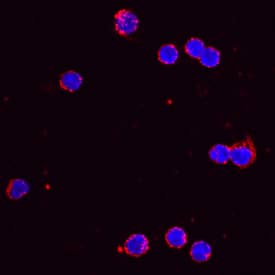
CCL5/RANTES in Mouse Splenocytes.
CCL5/RANTES was detected in immersion fixed mouse splenocytes using Goat Anti-Mouse CCL5/RANTES Antigen Affinity-purified Polyclonal Antibody (Catalog # AF478) at 10 µg/mL for 3 hours at room temperature. Cells were stained using the NorthernLights™ 557-conjugated Anti-Goat IgG Secondary Antibody (red; NL001) and counterstained with DAPI (blue). View our protocol for Fluorescent ICC Staining of Non-adherent Cells.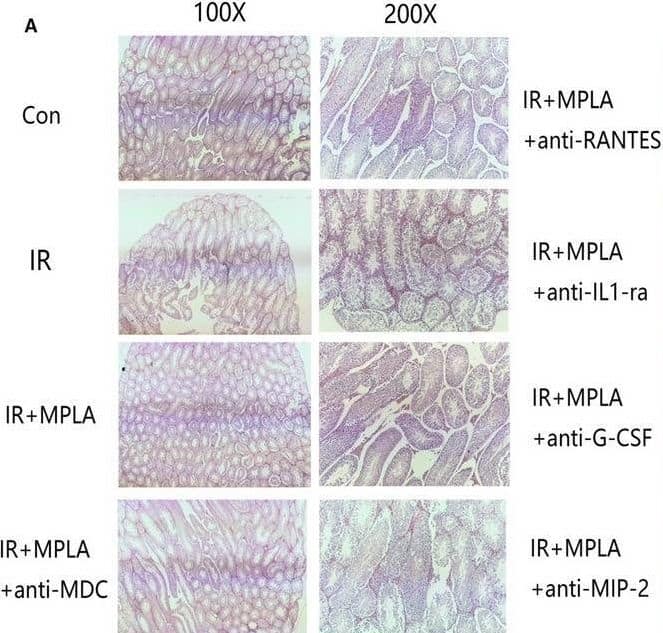
Detection of CCL5/RANTES by Immunohistochemistry
G‐CSF and MIP‐2 in exosomes were the main protection effectors in testis radiation protection. A, On day 7 after neutralizing antibody administration and 4 Gy irradiation, mice testis was isolated and subjected to H&E staining. B, Clonal formation assay was used to determine GC‐1 cell viability after exosomes treatment and irradiation exposure with or without neutralizing antibody. Data were presented as mean ± SD (n = 3). *P < .05. **P < .01, ***P < .001 Image collected and cropped by CiteAb from the following open publication (https://pubmed.ncbi.nlm.nih.gov/32135028), licensed under a CC-BY license. Not internally tested by R&D Systems.Applications for Mouse CCL5/RANTES Antibody
Application
Recommended Usage
Immunocytochemistry
5-15 µg/mL
Sample: Immersion fixed mouse splenocytes
Sample: Immersion fixed mouse splenocytes
Western Blot
0.1 µg/mL
Sample: Recombinant Mouse CCL5/RANTES (Catalog # 478-MR)
Sample: Recombinant Mouse CCL5/RANTES (Catalog # 478-MR)
Neutralization
Measured by its ability to neutralize CCL5/RANTES-induced chemotaxis in the BaF3 mouse pro‑B cell line transfected with human CCR5. The Neutralization Dose (ND50) is typically 0.07-0.3 µg/mL in the presence of 0.025 µg/mL Recombinant Mouse CCL5/RANTES.
Formulation, Preparation, and Storage
Purification
Antigen Affinity-purified
Reconstitution
Reconstitute at 0.2 mg/mL in sterile PBS. For liquid material, refer to CoA for concentration.
Formulation
Lyophilized from a 0.2 μm filtered solution in PBS with Trehalose. *Small pack size (SP) is supplied either lyophilized or as a 0.2 µm filtered solution in PBS.
Shipping
Lyophilized product is shipped at ambient temperature. Liquid small pack size (-SP) is shipped with polar packs. Upon receipt, store immediately at the temperature recommended below.
Stability & Storage
Use a manual defrost freezer and avoid repeated freeze-thaw cycles.
- 12 months from date of receipt, -20 to -70 °C as supplied.
- 1 month, 2 to 8 °C under sterile conditions after reconstitution.
- 6 months, -20 to -70 °C under sterile conditions after reconstitution.
Background: CCL5/RANTES
References
- Schall, T.J. et al. (1990) Nature 347:669.
- Bacon, K.B. et al. (1995) Science 269:1727.
- Fischer, F.R. et al. (2001) J. Immunol. 167:1637.
- Schall, T.J. et al. (1992) Eur. J. Immunol. 22:1477.
- Heeger, P. et al. (1992) Kidney Int. 41:220.
- Appay, V. and S.L. Rowland-Jones (2001) Trends Immunol. 22:83.
- Levy, J.A. (2009) J. Immunol. 182:3945.
- Randolph-Habecker, J.R. et al. (2002) Cytokine 19:37.
- DeVico, A.L. and Gallo, R.C. (2004) Nat. Rev. Microbiol. 2:401.
- Proost, P. et al. (1998) J. Biol. Chem. 273:7222.
- Appay, V. et al. (1999) J. Biol. Chem. 274:27505.
- Proudfoot, A.E.I. et al. (2003) Proc. Natl. Acad. Sci. USA 100:1885.
- von Hundelshausen, P. et al. (2005) Blood 105:924.
- von Hundelshausen, P. et al. (2001) Circulation 103:1772.
- Zernecke, A. et al. (2008) Arterioscler. Thromb. Vasc. Biol. 28:1897.
- Baltus, T. et al. (2003) Blood 102:1985.
- Soria, G. and A. Ben-Baruch (2008) Cancer Lett. 267:271.
Alternate Names
RANTES, SISd
Gene Symbol
CCL5
Additional CCL5/RANTES Products
Product Documents for Mouse CCL5/RANTES Antibody
Product Specific Notices for Mouse CCL5/RANTES Antibody
For research use only
Loading...
Loading...
Loading...
Loading...
Loading...