
Mouse Cathepsin B Antibody
R&D Systems, part of Bio-Techne | Catalog # AF965


Conjugate
Catalog #
Key Product Details
Validated by
Biological Validation
Species Reactivity
Validated:
Mouse
Cited:
Human, Mouse, Rat, Transgenic Mouse
Applications
Validated:
Immunohistochemistry, Western Blot, Neutralization
Cited:
Immunohistochemistry, Western Blot, Flow Cytometry, Immunocytochemistry, Immunoprecipitation
Label
Unconjugated
Antibody Source
Polyclonal Goat IgG
Product Specifications
Immunogen
Mouse myeloma cell line NS0-derived recombinant mouse Cathepsin B
His18-Phe339
Accession # P10605
His18-Phe339
Accession # P10605
Specificity
Detects mouse Cathepsin B in direct ELISAs and Western blots. In direct ELISAs, approximately 15% cross-reactivity with recombinant human Cathepsin B is observed and less than 5% cross-reactivity with recombinant mouse Cathepsin H is observed.
Clonality
Polyclonal
Host
Goat
Isotype
IgG
Scientific Data Images for Mouse Cathepsin B Antibody
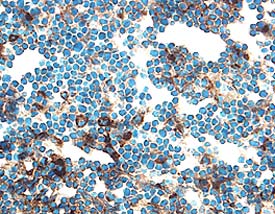
Cathepsin B in Mouse Thymus.
Cathepsin B was detected in perfusion fixed frozen sections of mouse thymus using 5 µg/mL Goat Anti-Mouse Cathepsin B Antigen Affinity-purified Polyclonal Antibody (Catalog # AF965) overnight at 4 °C. Tissue was stained with the Anti-Goat HRP-DAB Cell & Tissue Staining Kit (brown; Catalog # CTS008) and counterstained with hematoxylin (blue). View our protocol for Chromogenic IHC Staining of Frozen Tissue Sections.
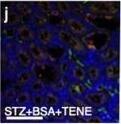
Detection of Mouse Cathepsin B by Immunocytochemistry/ Immunofluorescence
EMT in BSA-induced damaged tubule was associated with increased levels of DPP-4, integrin beta1 and CAV1; TENE treatment ameliorated these alterations. (a–e) Multiplex immunofluorescence microscopy analysis of the EMT program and association with CAV1. Formaldehyde-fixed, paraffin-embedded (FFPE) kidney samples were labeled with epithelial markers for E-cadherin, alphaSMA and CAV1. An immunofluorescence analysis was performed by confocal microscopy. (d) The enlarged image of the inset shown in (c). The alphaSMA-positive damaged tubular cells were surrounded by alphaSMA-positive interstitial cells (f–j). Multiplex immunofluorescence was performed to analyze the crosstalk among DPP-4, integrin beta1 and CAV1 in the BSA-injected diabetic mice. (i) The enlarged image of the inset shown in (h). DPP-4, integrin beta1, and CAV1 were localized at the same location (likely the luminal side of the proximal tubule). The crosstalk occurred more frequently in the damaged tubular cells. Representative images from n = 7 in each group are shown. Image collected and cropped by CiteAb from the following open publication (https://pubmed.ncbi.nlm.nih.gov/31101909), licensed under a CC-BY license. Not internally tested by R&D Systems.
Detection of Mouse Cathepsin B by Immunohistochemistry
BSA-injected diabetic mice exhibited high tubular levels of DPP-4, CAV1 and EMT program; TENE treatment ameliorated these alterations. Immunohistochemical analysis of (a–d) DPP-4, (e–h) CAV1, (i–l) snail and (m–p) AQP-1 from the BSA-injected control or diabetic mice with or without the TENE treatment. Scale bar, 50 μm. Representative images from n = 7 in each group are shown. Each group was analyzed with an unpaired two-tailed t-test. *P < 0.05, **P < 0.01. Data are presented as mean ± s.e.m (q–t). Image collected and cropped by CiteAb from the following open publication (https://pubmed.ncbi.nlm.nih.gov/31101909), licensed under a CC-BY license. Not internally tested by R&D Systems.





Applications for Mouse Cathepsin B Antibody
Application
Recommended Usage
Immunohistochemistry
5-15 µg/mL
Sample: Perfusion fixed frozen sections of mouse thymus
Sample: Perfusion fixed frozen sections of mouse thymus
Western Blot
0.1 µg/mL
Sample: Recombinant Mouse Cathepsin B (Catalog # 965-CY)
Sample: Recombinant Mouse Cathepsin B (Catalog # 965-CY)
Reviewed Applications
Read 1 review rated 5 using AF965 in the following applications:
Formulation, Preparation, and Storage
Purification
Antigen Affinity-purified
Reconstitution
Reconstitute at 0.2 mg/mL in sterile PBS. For liquid material, refer to CoA for concentration.
Formulation
Lyophilized from a 0.2 μm filtered solution in PBS with Trehalose. *Small pack size (SP) is supplied either lyophilized or as a 0.2 µm filtered solution in PBS.
Shipping
Lyophilized product is shipped at ambient temperature. Liquid small pack size (-SP) is shipped with polar packs. Upon receipt, store immediately at the temperature recommended below.
Stability & Storage
Use a manual defrost freezer and avoid repeated freeze-thaw cycles.
- 12 months from date of receipt, -20 to -70 °C as supplied.
- 1 month, 2 to 8 °C under sterile conditions after reconstitution.
- 6 months, -20 to -70 °C under sterile conditions after reconstitution.
Background: Cathepsin B
References
- Mort, J.S. (2004) in Handbook of Proteolytic Enzymes (Barrett, A.J. et al. eds.) p. 1079, Academic Press, San Diego.
- Vancompernolle, K. et al. (1998) FEBS Lett. 438:150.
- Jutras, I. and T.L. Reudelhuber (1998) FEBS Lett. 443:48.
- Taggart, C.C. et al. (2001) J. Biol. Chem. 276:33345.
- Berquin, I.M. and B.F. Sloane (1996) Adv. Exp. Med. Biol. 389:281.
Alternate Names
CTSB
Gene Symbol
CTSB
UniProt
Additional Cathepsin B Products
Product Documents for Mouse Cathepsin B Antibody
Product Specific Notices for Mouse Cathepsin B Antibody
For research use only
Loading...
Loading...
Loading...
Loading...
Loading...