
Mouse 4-1BB Ligand/TNFSF9 Antibody
R&D Systems, part of Bio-Techne | Catalog # AF1246

Scientific images may be resized, cropped, or adjusted for brightness or contrast for presentation purposes. These updates are limited to presentation and do not affect the underlying scientific interpretation of the data. Where available, additional source data may be provided upon request.
Conjugate
Catalog #
Key Product Details
Species Reactivity
Validated:
Mouse
Cited:
Human, Mouse
Applications
Validated:
Western Blot
Cited:
Western Blot, Neutralization, Immunocytochemistry, ELISA Capture, Westen Blot
Label
Unconjugated
Antibody Source
Polyclonal Goat IgG
Product Specifications
Immunogen
S. frugiperda insect ovarian cell line Sf 21-derived recombinant mouse 4‑1BB Ligand/TNFSF9
Arg104-Glu309
Accession # P41274
Arg104-Glu309
Accession # P41274
Specificity
Detects mouse 4‑1BB Ligand/TNFSF9 in direct ELISAs and Western blots. In Western blots, approximatley 5% cross‑reactivity with recombinant mouse (rm) Fas Ligand is observed and less than 1% cross-reactivity with rmOX40 Ligand, rmTWEAK, rmTRAIL, and rmTNF-alpha is observed.
Clonality
Polyclonal
Host
Goat
Isotype
IgG
Scientific Data Images for Mouse 4-1BB Ligand/TNFSF9 Antibody
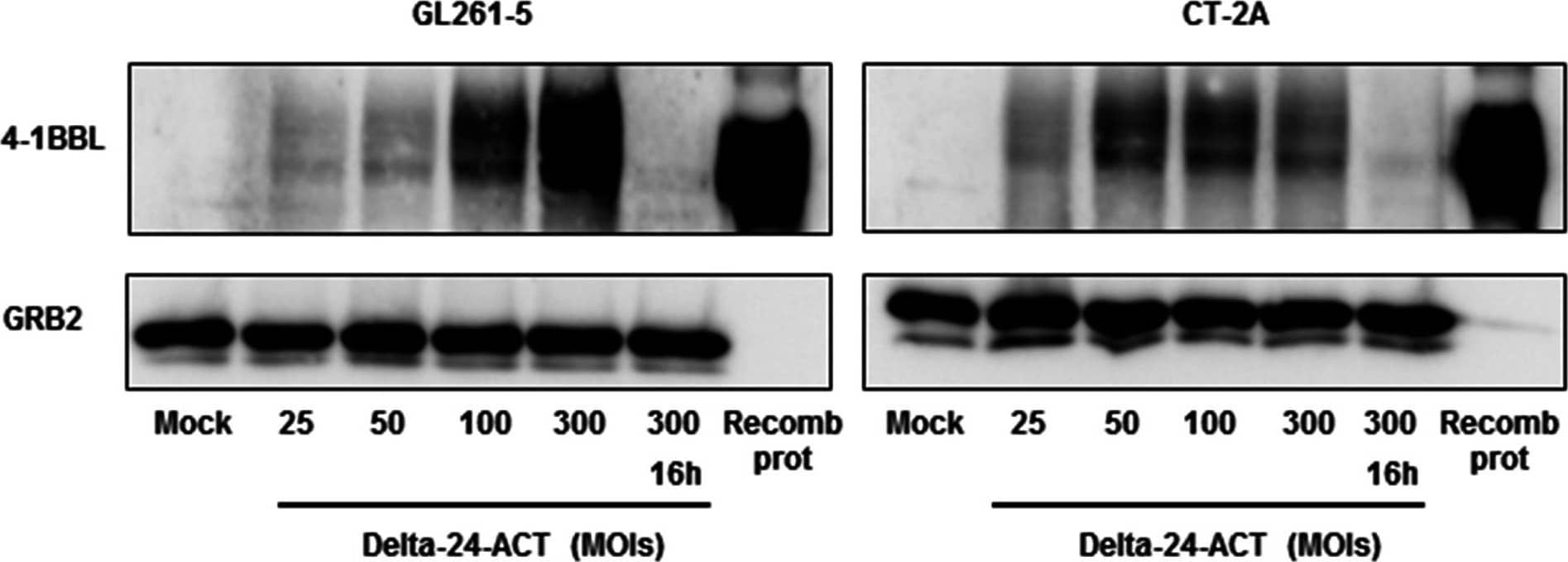
Detection of 4-1BB Ligand/TNFSF9 by Western Blot
Delta-24-ACT can be expressed in glioma cells and induces T cell activation. (A) 4-1BBL protein expression in CT-2A, GL261, GL261-5 and U87-MG cells infected with Delta-24-ACT and Delta-24-RGD at the indicated MOIs analyzed by flow cytometry (one-way ANOVA). (B) 4-1BBL protein expression in GL261-5 and CT-2A cells infected with Delta-24-ACT at the indicated MOIs analyzed by western blot analysis. A representative image is shown. (C) In vivo evaluation of 4-1BBL mRNA expression. The mRNA expression of 4-1BBL in mice bearing CT-2A tumors 3 days after treatment with Delta-24-ACT was analyzed by real-time PCR. The contralateral hemisphere was used as the negative control (Student’s t-test). (D) In vivo assessment of 4-1BBL mRNA expression in mice bearing CT-2A and U87-MG subcutaneously and treated with either Delta-24-RGD or Delta-24-ACT for 48 hours. Mice treated with PBS were used as controls. (E) IFN-gamma production by lymphocytes after Delta-24-ACT infection. CD8+ T cells from PMEL mice were cocultured with CT-2A cells infected with Delta-24-RGD or Delta-4-ACT at an MOI of 100. The secretion of IFN-gamma in the collected supernatants was quantified by ELISA. MOI, multiplicities of infection. Image collected and cropped by CiteAb from the following open publication (https://pubmed.ncbi.nlm.nih.gov/34281988), licensed under a CC-BY license. Not internally tested by R&D Systems.Applications for Mouse 4-1BB Ligand/TNFSF9 Antibody
Application
Recommended Usage
Western Blot
0.1 µg/mL
Sample: Recombinant Mouse 4-1BB Ligand/TNFSF9 (Catalog # 1246-4L)
Sample: Recombinant Mouse 4-1BB Ligand/TNFSF9 (Catalog # 1246-4L)
Formulation, Preparation, and Storage
Purification
Antigen Affinity-purified
Reconstitution
Reconstitute at 0.2 mg/mL in sterile PBS. For liquid material, refer to CoA for concentration.
Formulation
Lyophilized from a 0.2 μm filtered solution in PBS with Trehalose. *Small pack size (SP) is supplied either lyophilized or as a 0.2 µm filtered solution in PBS.
Shipping
Lyophilized product is shipped at ambient temperature. Liquid small pack size (-SP) is shipped with polar packs. Upon receipt, store immediately at the temperature recommended below.
Stability & Storage
Use a manual defrost freezer and avoid repeated freeze-thaw cycles.
- 12 months from date of receipt, -20 to -70 °C as supplied.
- 1 month, 2 to 8 °C under sterile conditions after reconstitution.
- 6 months, -20 to -70 °C under sterile conditions after reconstitution.
Background: 4-1BB Ligand/TNFSF9
4-1BB ligand (4-1BBL) is a type II transmembrane glycoprotein belonging to the TNF superfamily (TNFSF) and has been designated TNFSF9. Mouse 4-1BBL cDNA encodes a 309 amino acid residues (aa) protein with an 82 aa N-terminal cytoplasmic domain, a 21 aa transmembrane domain and a 206 aa C-terminal extracellular domain. The extracellular domain of 4-1BBL has a tertiary structure similar to that of other TNFSF members, but shares only low aa sequence homology (14‑16%). Murine 4-1BBL shares 36% aa sequence identity with its human counterpart (1, 2). 4-1BBL is predominantly expressed on activated antigen presenting cells (APCs) such as B cells, macrophages and dendritic cells (DCs). It is also expressed on most T and B lymphoma cell lines (3). A soluble 4-1BBL is released from the cell surface following cellular activation via proteolytic cleavage by one or more sheddases (4). By analogy to other TNFSF ligands, both the soluble and transmembrane 4-1BBL are expected to exist as non-covalent homotrimers. 4-1BBL binds 4-1BB, a TNF receptor superfamily member, TNFRSF9, which is also known as CD137 and ILA (induced by lymphocyte activation). 4-1BB is expressed on activated CD4+ and CD8+ T cells, thymocytes, and NK cells. It is also expressed on monocytes, neutrophils, DCs and eosinophils. In response to 4-1BBL binding, 4-1BB transduces a T cell costimulatory signal in both CD4+ and CD8+ T cells to promote survival and enhance proliferation, cytokine production and effector function. In dendritic cells, 4-1BB is a DC-activating molecule that enhances cytokine production and up‑regulates expression of B7-1 and B7-2 costimulatory molecules (3).
References
- Goodwin, R.G. et al. (1993) Eur. J. Immunol. 23:2631.
- Alderson, M.R. et al. (1994) Eur. J. Immunol. 24:2219.
- Kwon, B., H.W. Lee and B.S Kwon (2002) TRENDS in Immunology 23:378.
- Salih, H.R. et al. (2001) J. Immunol. 167:4059.
Alternate Names
41BB Ligand, CD137L, TNFSF9
Gene Symbol
TNFSF9
UniProt
Additional 4-1BB Ligand/TNFSF9 Products
Product Documents for Mouse 4-1BB Ligand/TNFSF9 Antibody
Product Specific Notices for Mouse 4-1BB Ligand/TNFSF9 Antibody
For research use only
Loading...
Loading...
Loading...
Loading...
Loading...