
Human TrkB Antibody
R&D Systems, part of Bio-Techne | Catalog # MAB3971

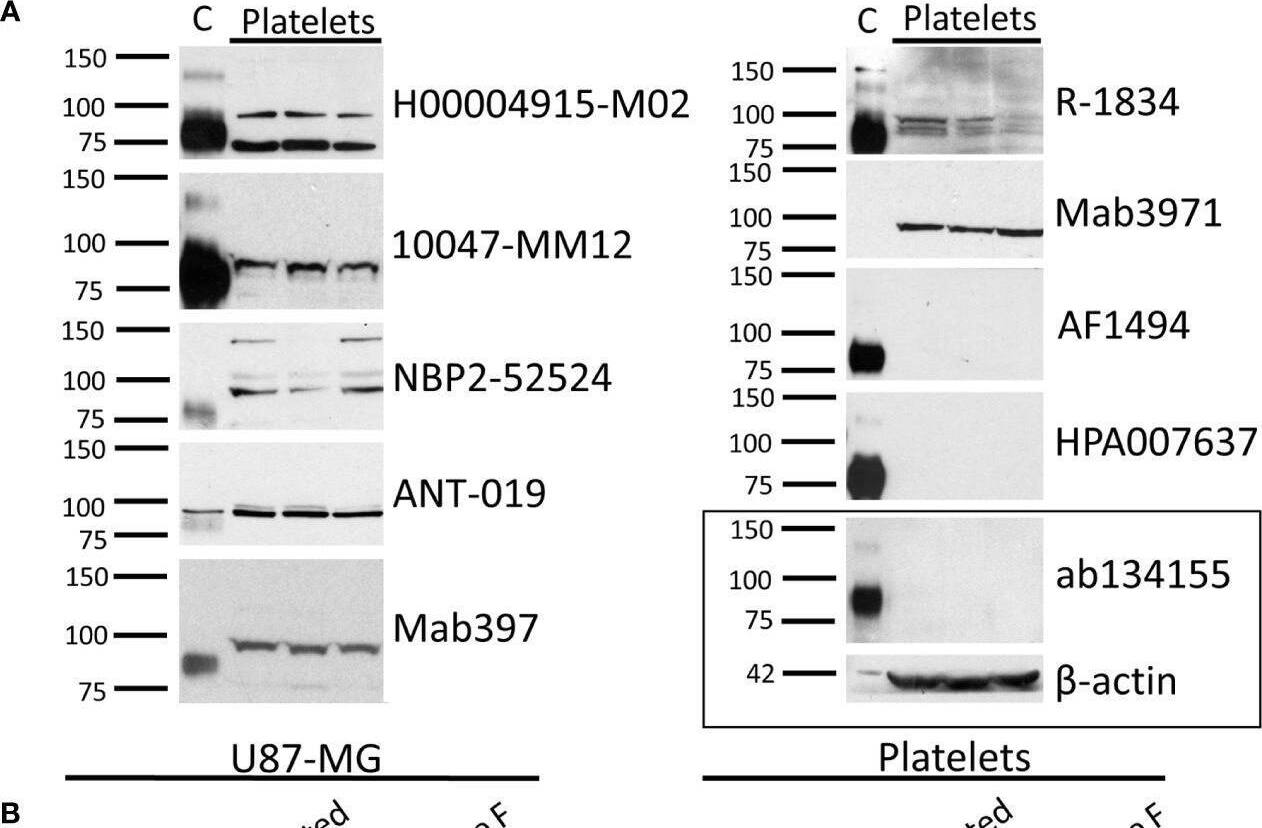
Scientific images may be resized, cropped, or adjusted for brightness or contrast for presentation purposes. These updates are limited to presentation and do not affect the underlying scientific interpretation of the data. Where available, additional source data may be provided upon request.
Conjugate
Catalog #
Key Product Details
Species Reactivity
Validated:
Human
Cited:
Human
Applications
Validated:
Flow Cytometry, CyTOF-ready
Cited:
Immunohistochemistry-Frozen, Western Blot, Flow Cytometry, Immunocytochemistry, Immunoprecipitation, ELISA Detection
Label
Unconjugated
Antibody Source
Monoclonal Mouse IgG1 Clone # 72509
Product Specifications
Immunogen
Mouse myeloma cell line NS0-derived recombinant human TrkB
Cys32-His430
Accession # Q16620
Cys32-His430
Accession # Q16620
Specificity
Detects human TrkB in direct ELISAs and Western blots. In Western blots, no cross-reactivity with recombinant human (rh) TrkA, recombinant rat TrkA, recombinant mouse (rm) TrkB, rhTrkC, or rmTrkC is observed.
Clonality
Monoclonal
Host
Mouse
Isotype
IgG1
Scientific Data Images for Human TrkB Antibody
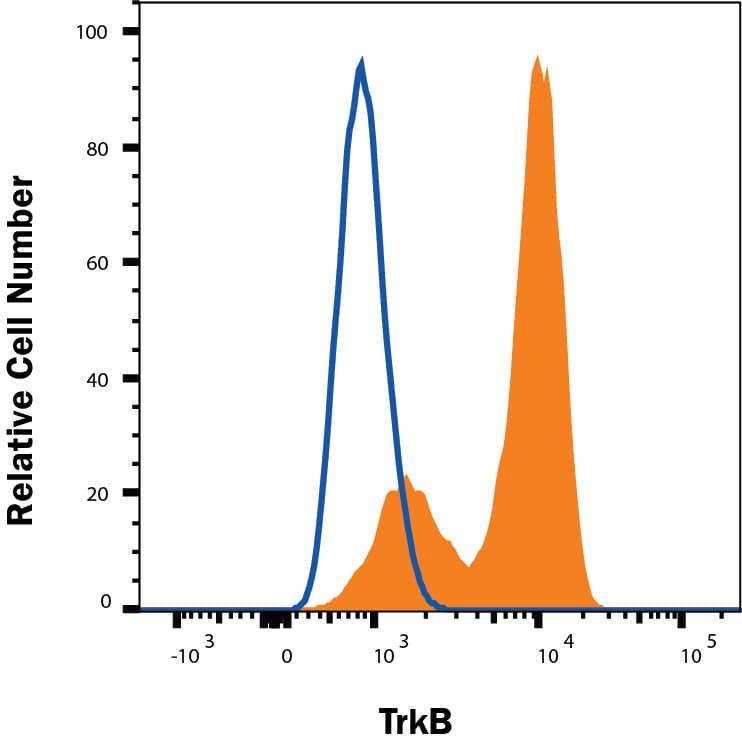
Detection of TrkB in Baf3 cells by Flow Cytometry.
Baf3 cells transfected with Human TrkB (filled histogram) vs Irrelevant transfectant cells (open histogram) were stained with Mouse Anti-Human TrkB Monoclonal Antibody (Catalog # MAB3971) followed by Fluorescein-conjugated Anti-Mouse IgG Secondary Antibody (Catalog # F0103B). View our protocol for Staining Membrane-associated Proteins.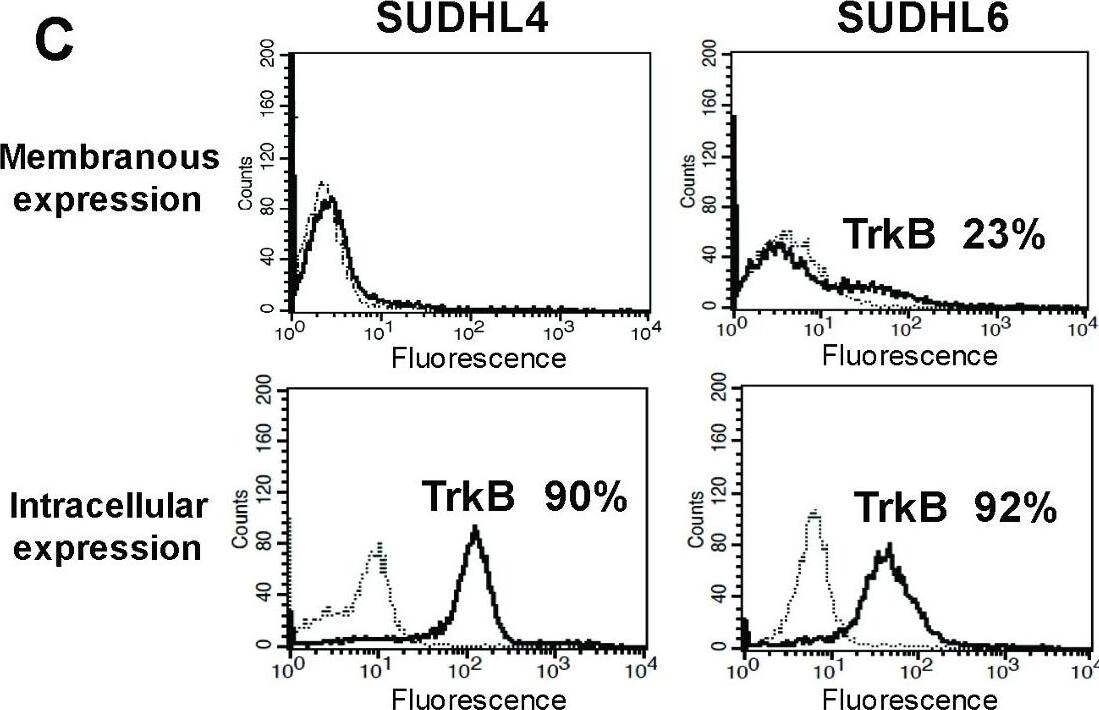
Detection of TrkB by Flow Cytometry
DLBCL cell lines express neurotrophin receptors.A: RT-PCR detection of p75NTR, and its co-receptor sortilin, TrkA and truncated gp95TrkB mRNA was performed on SUDHL cells cultured with 10% FCS for 72 h. beta-actin was included as a control of cDNA quality. B: The truncated TrkB, p75NTR and sortilin receptor protein expression was confirmed by western blotting of cell lysates. Blots were reprobed with anti- beta-actin as a loading control. C: Flow cytometry analysis demonstrating TrkB membrane detection expressed in percentage of positive cells (bold line) in unpermeabilized SUDHL6 cells in contrast to SUDHL4 cells, whereas both cell lines expressed intracellular TrkB (dotted line: the isotypic controls). D: Immunofluorescence staining was performed, as described in Materials and Methods, in DLBCL cell lines that confirmed surface TrkB expression (in green) in some BDNF (inset in red) positive SUDHL6 cells (in blue: DAPI staining). The neuroblastoma cell line, IMR32, was used as a positive control. Data are representative of four independent experiments. Image collected and cropped by CiteAb from the following open publication (https://pubmed.ncbi.nlm.nih.gov/22076137), licensed under a CC-BY license. Not internally tested by R&D Systems.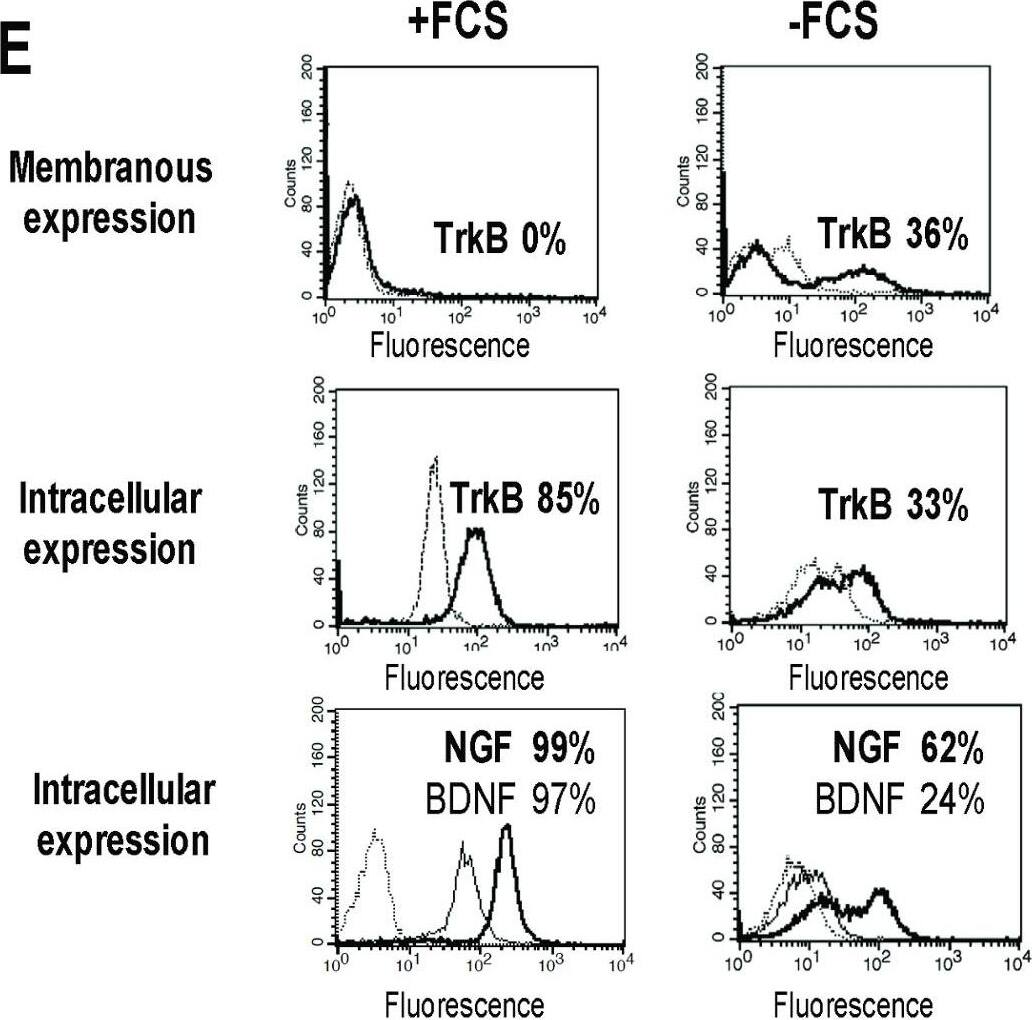
Detection of TrkB by Flow Cytometry
Modulation of neurotrophin and TrkB expression by SHDHL4 cells is induced by serum deprivation.A: RT-PCR analysis of NGF, BDNF, TrkA, gp95TrkB, p75NTR and sortilin mRNA on SUDHL4 cells submitted to 72 h serum deprivation (−FCS) as compared to standard culture conditions (10% FCS, +FCS). beta-actin was included as a control of cDNA quality. B: Western blott detection of truncated TrkB and p75NTR protein expression. Blots were reprobed with anti- beta-actin as a loading control. C: Immunoprecipitation of sortilin (IP) and western blotting analysis (IB, immunoblotting with anti-p75NTR or anti-sortilin as control) demonstrating the association of sortilin with p75NTR in cell lysates of both culture conditions. D: secretion of BDNF detected in cell supernatants after immunoprecipitation and western blotting. E: Flow cytometry analysis demonstrating membranous expression of TrkB (bold line) and intracellular TrkB, NGF (bold line) and BDNF expressions expressed in percentage of SUDHL4 positive cells cultured with or without FCS (dotted line: isotypic controls). Data are representative of four independent experiments. Image collected and cropped by CiteAb from the following open publication (https://pubmed.ncbi.nlm.nih.gov/22076137), licensed under a CC-BY license. Not internally tested by R&D Systems.Applications for Human TrkB Antibody
Application
Recommended Usage
CyTOF-ready
Ready to be labeled using established conjugation methods. No BSA or other carrier proteins that could interfere with conjugation.
Flow Cytometry
0.25 µg/106 cells
Sample: Baf3 cells transfected with Human TrkB vs Irrelevant transfectant cells
Sample: Baf3 cells transfected with Human TrkB vs Irrelevant transfectant cells
Formulation, Preparation, and Storage
Purification
Protein A or G purified from hybridoma culture supernatant
Reconstitution
Reconstitute at 0.5 mg/mL in sterile PBS. For liquid material, refer to CoA for concentration.
Formulation
Lyophilized from a 0.2 μm filtered solution in PBS with Trehalose. *Small pack size (SP) is supplied either lyophilized or as a 0.2 µm filtered solution in PBS.
Shipping
Lyophilized product is shipped at ambient temperature. Liquid small pack size (-SP) is shipped with polar packs. Upon receipt, store immediately at the temperature recommended below.
Stability & Storage
Use a manual defrost freezer and avoid repeated freeze-thaw cycles.
- 12 months from date of receipt, -20 to -70 °C as supplied.
- 1 month, 2 to 8 °C under sterile conditions after reconstitution.
- 6 months, -20 to -70 °C under sterile conditions after reconstitution.
Background: TrkB
NT‑4/5 and TrkC binds NT-3. All Trk family proteins share a conserved complex subdomain organization consisting of a signal peptide, two cysteine-rich domains, a cluster of three leucine-rich motifs, and two immunoglobulin-like domains in the extracellular region, as well as an intracellular region that contains the tyrosine kinase domain. Natural splice variants of the different Trks, including TrkB variants lacking the first cysteine-rich domain, the first and second or all three of the leucine-rich motifs, or the tyrosine kinase domain, have been described. The role of the different extracellular subdomains of TrkB in mediating neurotrophin binding and discrimination is currently being investigated. At the protein sequence level, human and rat TrkB are greater than 90% identical and the proteins exhibit cross-species activity. TrkB is primarily expressed in the nervous system. However, low levels of TrkB expression have also been observed in a wide variety of tissues (pancreas, kidneys, ovary) outside the nervous system.
References
- Ninkina, N. et al. (1997) J. Biol. Chem. 272:13019.
- Middlemas, D.S. et al. (1991) Mol. Cell Biol. 11:143.
- Soppet, D. et al. (1991) Cell 65:895.
Long Name
Neurotrophic Tyrosine Kinase Receptor B
Alternate Names
NTRK2
Gene Symbol
NTRK2
UniProt
Additional TrkB Products
Product Documents for Human TrkB Antibody
Product Specific Notices for Human TrkB Antibody
For research use only
Loading...
Loading...
Loading...
Loading...
Loading...
Loading...