
Human LAP TGF-beta 1 Biotinylated Antibody
R&D Systems, part of Bio-Techne | Catalog # BAF246

Scientific images may be resized, cropped, or adjusted for brightness or contrast for presentation purposes. These updates are limited to presentation and do not affect the underlying scientific interpretation of the data. Where available, additional source data may be provided upon request.
Conjugate
Catalog #
Key Product Details
Species Reactivity
Validated:
Human
Cited:
Human, Mouse, Primate - Macaca mulatta (Rhesus Macaque)
Applications
Validated:
Western Blot
Cited:
Immunohistochemistry-Paraffin, Western Blot, Flow Cytometry, Immunoprecipitation
Label
Biotin
Antibody Source
Polyclonal Goat IgG
Product Specifications
Immunogen
S. frugiperda insect ovarian cell line Sf 21-derived recombinant human LAP TGF‑ beta1 and Chinese hamster ovary cell line CHO-derived recombinant human LAP TGF‑ beta1
Leu30-Ser390
Accession # P01137
Leu30-Ser390
Accession # P01137
Specificity
Detects human LAP TGF-beta 1 in Western blots. In this format, less than 1% cross-reactivity with mature recombinant human (rh) TGF‑ beta1, porcine TGF‑ beta2, rhTGF‑ beta3, and recombinant amphibian TGF‑ beta5 is observed.
Clonality
Polyclonal
Host
Goat
Isotype
IgG
Scientific Data Images for Human LAP TGF-beta 1 Biotinylated Antibody
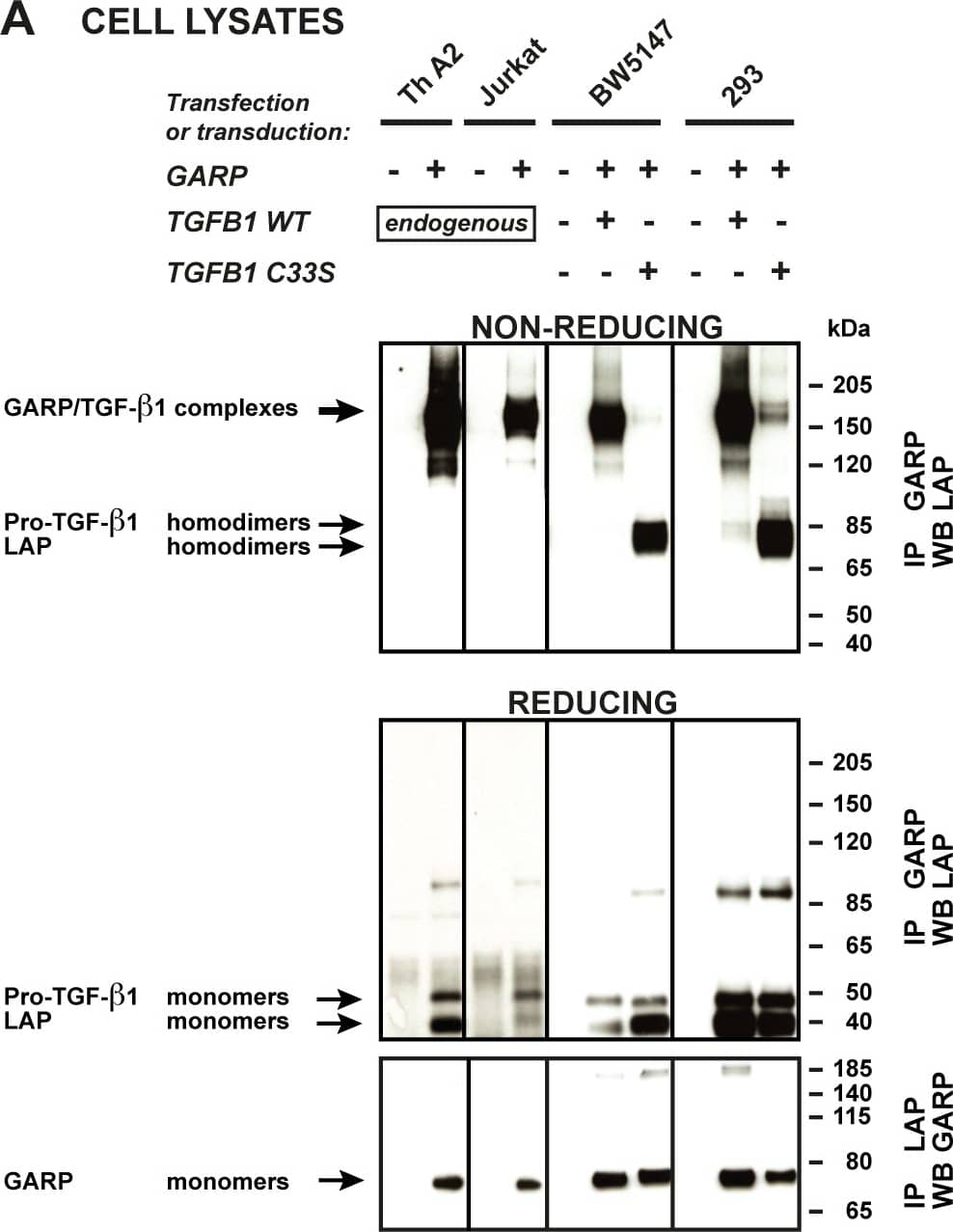
Detection of Human LAP (TGF-beta 1) by Western Blot
Disulfide-linked GARP/TGF-beta 1 complexes are released in the supernatant of T cells, but not 293 cells.A. Cells described in Figure 2 were lysed and immunoprecipitated (IP) with anti-GARP or anti-LAP antibodies. IP products were submitted to SDS-PAGE under non-reducing or reducing conditions, followed by WB with anti-LAP antibodies (top and middle panels), or anti-GARP antibodies (bottom panels). Pro-TGF-beta 1 and LAP homodimers in the top panels are not clearly resolved, but can be distinguished better with longer migrations or higher concentrations of polyacrylamide. The +/- 85-90 kDa bands that appear in the middle panel correspond to non-specific bands, or to incompletely reduced pro-TGF-beta 1. B. Cells (2x10⁶/ml for murine and human T cells, 2.5x10⁵/ml for transfected 293 cells) were incubated in serum free medium during 24 hours. Different cell concentrations were used to adjust for the different amounts of secreted TGF-beta 1 (see Figure 2). Human Th A2 and Jurkat cells were stimulated with anti-CD3/CD28 antibodies to increase secretion. Supernatants (0.5-10 µl) were analyzed by WB under non-reducing conditions with anti-GARP and anti-LAP antibodies. * Band that also appears when the secondary anti-IgG2b-HRP antibody is used alone (without anti-GARP antibody), due to cross reactivity against the anti-CD3/CD28 antibodies used for T cell stimulation. Image collected and cropped by CiteAb from the following publication (https://dx.plos.org/10.1371/journal.pone.0076186), licensed under a CC-BY license. Not internally tested by R&D Systems.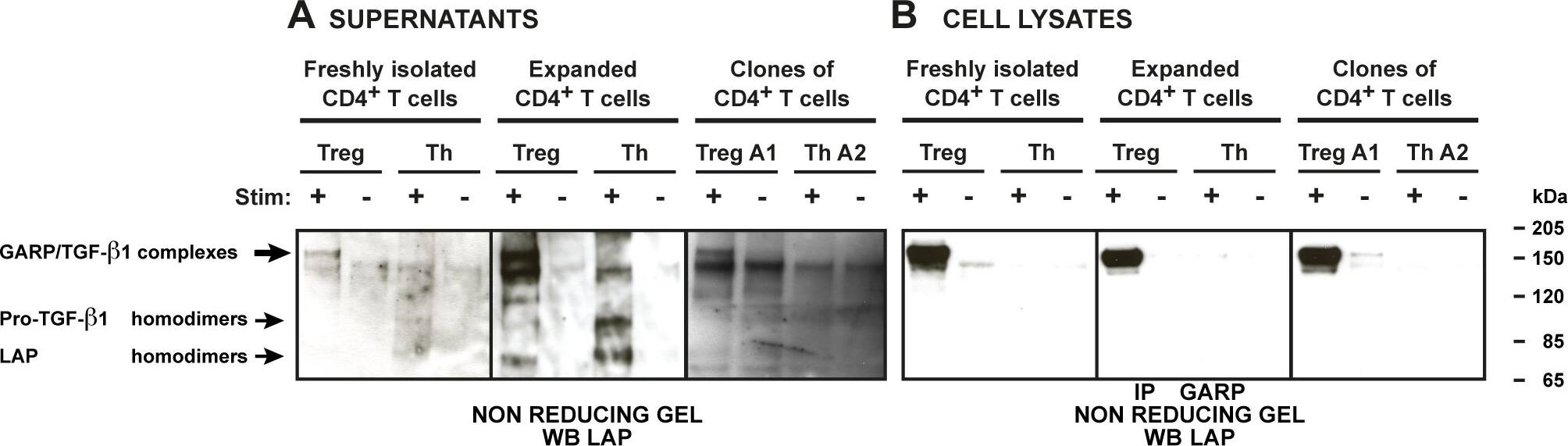
Detection of Human LAP (TGF-beta 1) by Western Blot
Disulfide-linked GARP/TGF-beta 1 complexes are released by stimulated human Tregs, which naturally express GARP.The indicated Treg and Th cell populations were left resting or stimulated with anti-CD3/CD28 antibodies in serum-free medium. A. Supernatants were collected after 48 hours. B. Cell lysates were collected after 24 hours and IP with an anti-GARP antibody. Supernatants (A) and immunoprecipitated lysates (B) were submitted to SDS-PAGE under non-reducing conditions, then analyzed by WB with anti-LAP antibodies. Similar results were obtained with freshly isolated CD4+ T cells from 2 other donors and with expanded CD4+ T cells from 5 others donors. Image collected and cropped by CiteAb from the following publication (https://dx.plos.org/10.1371/journal.pone.0076186), licensed under a CC-BY license. Not internally tested by R&D Systems.Applications for Human LAP TGF-beta 1 Biotinylated Antibody
Application
Recommended Usage
Western Blot
0.1 µg/mL
Sample: Recombinant Human LAP TGF-beta 1 (Catalog # 246-LP)
Sample: Recombinant Human LAP TGF-beta 1 (Catalog # 246-LP)
Formulation, Preparation, and Storage
Purification
Antigen Affinity-purified
Reconstitution
Reconstitute at 0.2 mg/mL in sterile PBS.
Formulation
Lyophilized from a 0.2 μm filtered solution in PBS with BSA as a carrier protein.
Shipping
The product is shipped at ambient temperature. Upon receipt, store it immediately at the temperature recommended below.
Stability & Storage
Use a manual defrost freezer and avoid repeated freeze-thaw cycles.
- 12 months from date of receipt, -20 to -70 °C as supplied.
- 1 month, 2 to 8 °C under sterile conditions after reconstitution.
- 6 months, -20 to -70 °C under sterile conditions after reconstitution.
Background: LAP (TGF-beta 1)
TGF-beta 1 (transforming growth factor beta 1) and the closely related TGF-beta 2 and -beta 3 are members of the large TGF-beta superfamily. TGF- beta proteins are highly pleiotropic cytokines that regulate processes such as immune function, proliferation and epithelial-mesenchymal transition (1-3). Human TGF-beta 1 cDNA encodes a 390 amino acid (aa) precursor that contains a 29 aa signal peptide and a 361 aa proprotein (4). A furin-like convertase processes the proprotein within the trans-Golgi to generate an N‑terminal 249 aa (aa 30-278) latency-associated peptide (LAP) and a C-terminal 112 aa (aa 279-390) mature TGF- beta1 (4-6). Disulfide-linked homodimers of LAP and TGF-beta 1 remain non‑covalently associated after secretion, forming the small latent TGF-beta 1 complex (4-8). Purified LAP is also capable of associating with active TGF-beta with high affinity, and can neutralize TGF-beta activity (9). Covalent linkage of LAP to one of three latent TGF-beta binding proteins (LTBPs) creates a large latent complex that may interact with the extracellular matrix (5‑7). TGF-beta activation from latency is controlled both spatially and temporally, by multiple pathways that include actions of proteases such as plasmin and MMP9, and/or by thrombospondin 1 or selected integrins (5, 8). The LAP portion of human TGF-beta 1 shares 91%, 92%, 85%, 86% and 88% aa identity with porcine, canine, mouse, rat and equine TGF-beta 1 LAP, respectively, while mature human TGF-beta 1 portion shares 100% aa identity with porcine, canine and bovine TGF-beta 1, and 99% aa identity with mouse, rat and equine TGF-beta 1. Although different isoforms of TGF-beta are naturally associated with their own distinct LAPs, the TGF-beta 1 LAP is capable of complexing with, and inactivating, all other human TGF-beta isoforms and those of most other species (9). Mutations within the LAP are associated with Camurati-Engelmann disease, a rare sclerosing bone dysplasia characterized by inappropriate presence of active TGF-beta 1 (10).
References
- Dunker, N. & K. Krieglstein (2000) Eur. J. Biochem. 267:6982.
- Wahl, S.M. (2006) Immunol. Rev. 213:213.
- Chang, H. et al. (2002) Endocr. Rev. 23:787.
- Derynck, R. et al. (1985) Nature 316:701.
- Dabovic, B. and D.B. Rifkin (2008) “TGF-beta Bioavailability” in The TGF-beta Family. Derynck, R. and K. Miyazono (eds): Cold Spring Harbor Laboratory Press, p. 179.
- Brunner, A.M. et al. (1989) J. Biol. Chem. 264:13660.
- Miyazono, K. et al. (1991) EMBO J. 10:1091.
- Oklu, R. and R. Hesketh (2000) Biochem. J. 352:601.
- Miller, D.M. et al. (1992) Mol. Endocrinol. 6:694.
- Janssens, K. et al. (2003) J. Biol. Chem. 278:7718.
Long Name
Latency-associated Peptide
Alternate Names
LAP (TGFbeta 1)
Entrez Gene IDs
7040 (Human)
Gene Symbol
TGFB1
UniProt
Additional LAP (TGF-beta 1) Products
Product Documents for Human LAP TGF-beta 1 Biotinylated Antibody
Product Specific Notices for Human LAP TGF-beta 1 Biotinylated Antibody
For research use only
Loading...
Loading...
Loading...
Loading...
Loading...