
Human IFN-gamma R1/CD119 Antibody
R&D Systems, part of Bio-Techne | Catalog # MAB6732

Scientific images may be resized, cropped, or adjusted for brightness or contrast for presentation purposes. These updates are limited to presentation and do not affect the underlying scientific interpretation of the data. Where available, additional source data may be provided upon request.
Conjugate
Catalog #
Key Product Details
Species Reactivity
Validated:
Human
Cited:
Human, Mouse
Applications
Validated:
Neutralization
Cited:
Neutralization, Blocking
Label
Unconjugated
Antibody Source
Monoclonal Mouse IgG1 Clone # GIR208
Product Specifications
Immunogen
Human placenta-derived IFN‑ gamma R1/CD119
Specificity
Detects human IFN‑ gamma R1/CD119 in direct ELISAs and Western blots. In direct ELISAs, no cross-reactivity with recombinant mouse IFN-gamma R1, recombinant human (rh) IFN-gamma R2, or rhIL-10 R beta is observed.
Clonality
Monoclonal
Host
Mouse
Isotype
IgG1
Endotoxin Level
<0.10 EU per 1 μg of the antibody by the LAL method.
Scientific Data Images for Human IFN-gamma R1/CD119 Antibody
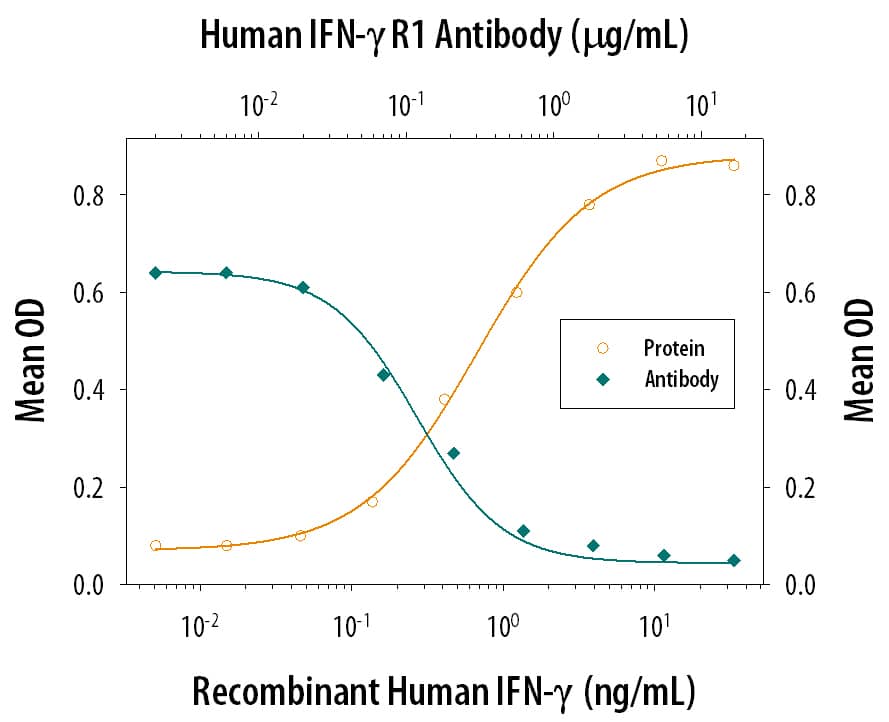
IFN‑ gamma Inhibition of EMCV-induced Cytopathy and Neutralization by Human IFN‑ gamma R1/CD119 Antibody.
Recombinant Human IFN-gamma (Catalog # 285-IF) reduces the Encephalomyocarditis Virus (EMCV)-induced cytopathy in the HeLa human cervical epithelial carcinoma cell line in a dose-dependent manner (orange line). Inhibition of EMCV activity elicited by Recombinant Human IFN-gamma (2 ng/mL) is neutralized (green line) by increasing concentrations of Mouse Anti-Human IFN-gamma R1/CD119 Mono-clonal Antibody (Catalog # MAB6732). The ND50 is typically 0.03-0.15 µg/mL.Applications for Human IFN-gamma R1/CD119 Antibody
Application
Recommended Usage
Neutralization
Measured by its ability to neutralize IFN-gamma R1/CD119-mediated inhibition of EMCV-induced cytopathy in the HeLa human cervical epithelial carcinoma cell line. The Neutralization Dose (ND50) is typically 0.03-0.15 µg/mL in the presence of 2 ng/mL Recombinant Human IFN-gamma.
Formulation, Preparation, and Storage
Purification
Protein A or G purified from hybridoma culture supernatant
Reconstitution
Reconstitute at 0.5 mg/mL in sterile PBS. For liquid material, refer to CoA for concentration.
Formulation
Lyophilized from a 0.2 μm filtered solution in PBS with Trehalose. *Small pack size (SP) is supplied either lyophilized or as a 0.2 µm filtered solution in PBS.
Shipping
Lyophilized product is shipped at ambient temperature. Liquid small pack size (-SP) is shipped with polar packs. Upon receipt, store immediately at the temperature recommended below.
Stability & Storage
Use a manual defrost freezer and avoid repeated freeze-thaw cycles.
- 12 months from date of receipt, -20 to -70 °C as supplied.
- 1 month, 2 to 8 °C under sterile conditions after reconstitution.
- 6 months, -20 to -70 °C under sterile conditions after reconstitution.
Background: IFN-gamma R1/CD119
The high-affinity IFN-gamma receptor complex is made up of two type I membrane proteins, IFN-gamma R1 (IFN-gamma R alpha) and IFN-gamma R2 (IFN-gamma R beta). Both proteins are members of the type II cytokine receptor family and share approximately 52% amino acid sequence identity. IFN-gamma R1 is the ligand-binding subunit that is necessary and sufficient for IFN-gamma binding and receptor internalization. IFN-gamma R2 is required for IFN-gamma signaling but does not bind IFN-gamma by itself. Human IFN-gamma R1 cDNA encodes a 499 amino acid (aa) protein with a 17 aa signal peptide, a 228 aa extracellular domain, a 23 aa transmembrane domain, and a 221 aa intracellular domain. Human and mouse IFN-gamma R1 share 52% aa identity and bind IFN-gamma in a species-specific manner. IFN-gamma R1 is constitutively expressed in most cell types. Soluble IFN-gamma R1 that binds IFN-gamma has been detected in biological fluids.
References
- Bach, E.A. et al. (1997) Annu. Rev. Immunol. 15:563.
Long Name
Interferon gamma Receptor 1
Alternate Names
CD119, IFN-gR1, IFNgammaR1, IFNGR1
Gene Symbol
IFNGR1
Additional IFN-gamma R1/CD119 Products
Product Documents for Human IFN-gamma R1/CD119 Antibody
Product Specific Notices for Human IFN-gamma R1/CD119 Antibody
For research use only
Loading...
Loading...
Loading...
Loading...