
Human HAI-2 Antibody
R&D Systems, part of Bio-Techne | Catalog # AF1106

Conjugate
Catalog #
Key Product Details
Species Reactivity
Validated:
Human
Cited:
Human
Applications
Validated:
Western Blot, Immunoprecipitation
Cited:
Western Blot
Label
Unconjugated
Antibody Source
Polyclonal Goat IgG
Product Specifications
Immunogen
Mouse myeloma cell line NS0-derived recombinant human HAI-2A
Ala28-Lys197
Accession # O43291
Ala28-Lys197
Accession # O43291
Specificity
Detects human HAI-2 in direct ELISAs and Western blots. In direct ELISAs and Western blots, less than 5% cross-reactivity with recombinant human HAI‑1 and recombinant mouse HAI-2B is observed.
Clonality
Polyclonal
Host
Goat
Isotype
IgG
Scientific Data Images for Human HAI-2 Antibody
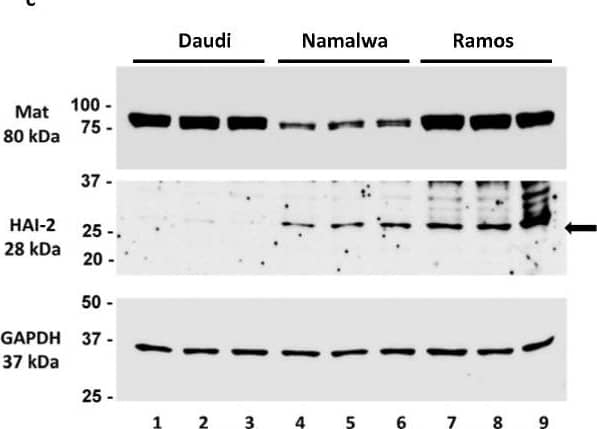
Detection of HAI-2 by Western Blot
Expression analysis of matriptase, HAI-1, HAI-2, and prostasin in B cancer cells by reverse-transcription/qPCR (a,b), western blotting (c–e), and flow cytometry (f). (a) Bar graph of relative mRNA expression levels of matriptase (Mat), HAI-1, HAI-2, prostasin (Pro) in Daudi (n = 4), Namalwa (n = 5), Ramos (n = 3), Raji (n = 3), JeKo-1 (n = 3), and RS4;11 cells (n = 2) using GAPDH as the reference. The prostasin bars do not appear in the bar graph, as the actual qPCR readouts were registered as “N/A” by the instrument. (b) Bar graph of mRNA quantity ratio of HAI-2 to matriptase after normalization with the GAPDH level in each cell line in (a). (c) Western blotting images of matriptase (Ab: A300-221A), HAI-2, and GAPDH. Twenty micrograms of total protein from the cell lysate of each individual culture (including 2 repeats) were analyzed. Daudi, lanes 1–3; Namalwa, lanes 4–6; Ramos, lanes 7–9. Top panel, matriptase (Mat); middle panel, HAI-2; bottom panel, GAPDH. (d) Densitometry bar graph of relative protein quantities of matriptase and HAI-2 using GAPDH as the reference. (e) The quantitative ratio of HAI-2 to matriptase in each cell line. (f) Flow cytometry histogram of matriptase expression evaluation in Ramos cells. The Ramos cells (4 × 10⁵) were labeled with the matriptase antibody as described in the Materials and Methods section. The matriptase-positive cells are shown in the PE-A subset (blue peak). Cells without the matriptase antibody labeling (red peak) were not detected in the PE-A subset and were used as the gating control. Image collected and cropped by CiteAb from the following open publication (https://pubmed.ncbi.nlm.nih.gov/37568664), licensed under a CC-BY license. Not internally tested by R&D Systems.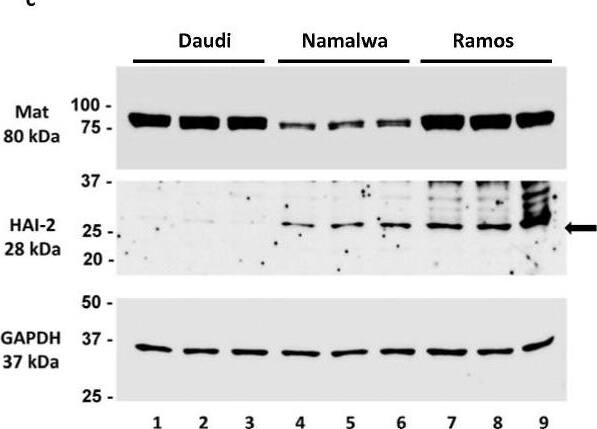
Detection of HAI-2 by Western Blot
Expression analysis of matriptase, HAI-1, HAI-2, and prostasin in B cancer cells by reverse-transcription/qPCR (a,b), western blotting (c–e), and flow cytometry (f). (a) Bar graph of relative mRNA expression levels of matriptase (Mat), HAI-1, HAI-2, prostasin (Pro) in Daudi (n = 4), Namalwa (n = 5), Ramos (n = 3), Raji (n = 3), JeKo-1 (n = 3), and RS4;11 cells (n = 2) using GAPDH as the reference. The prostasin bars do not appear in the bar graph, as the actual qPCR readouts were registered as “N/A” by the instrument. (b) Bar graph of mRNA quantity ratio of HAI-2 to matriptase after normalization with the GAPDH level in each cell line in (a). (c) Western blotting images of matriptase (Ab: A300-221A), HAI-2, and GAPDH. Twenty micrograms of total protein from the cell lysate of each individual culture (including 2 repeats) were analyzed. Daudi, lanes 1–3; Namalwa, lanes 4–6; Ramos, lanes 7–9. Top panel, matriptase (Mat); middle panel, HAI-2; bottom panel, GAPDH. (d) Densitometry bar graph of relative protein quantities of matriptase and HAI-2 using GAPDH as the reference. (e) The quantitative ratio of HAI-2 to matriptase in each cell line. (f) Flow cytometry histogram of matriptase expression evaluation in Ramos cells. The Ramos cells (4 × 10⁵) were labeled with the matriptase antibody as described in the Materials and Methods section. The matriptase-positive cells are shown in the PE-A subset (blue peak). Cells without the matriptase antibody labeling (red peak) were not detected in the PE-A subset and were used as the gating control. Image collected and cropped by CiteAb from the following open publication (https://pubmed.ncbi.nlm.nih.gov/37568664), licensed under a CC-BY license. Not internally tested by R&D Systems.Applications for Human HAI-2 Antibody
Application
Recommended Usage
Immunoprecipitation
25 µg/mL
Sample: Conditioned cell culture medium spiked with Recombinant Human HAI‑2A (Catalog # 1106‑PI), see our available Western blot detection antibodies
Sample: Conditioned cell culture medium spiked with Recombinant Human HAI‑2A (Catalog # 1106‑PI), see our available Western blot detection antibodies
Western Blot
0.1 µg/mL
Sample: Recombinant Human HAI-2A (Catalog # 1106-PI)
Sample: Recombinant Human HAI-2A (Catalog # 1106-PI)
Formulation, Preparation, and Storage
Purification
Antigen Affinity-purified
Reconstitution
Reconstitute at 0.2 mg/mL in sterile PBS. For liquid material, refer to CoA for concentration.
Formulation
Lyophilized from a 0.2 μm filtered solution in PBS with Trehalose. *Small pack size (SP) is supplied either lyophilized or as a 0.2 µm filtered solution in PBS.
Shipping
Lyophilized product is shipped at ambient temperature. Liquid small pack size (-SP) is shipped with polar packs. Upon receipt, store immediately at the temperature recommended below.
Stability & Storage
Use a manual defrost freezer and avoid repeated freeze-thaw cycles.
- 12 months from date of receipt, -20 to -70 °C as supplied.
- 1 month, 2 to 8 °C under sterile conditions after reconstitution.
- 6 months, -20 to -70 °C under sterile conditions after reconstitution.
Background: HAI-2
Two alternatively spliced forms of HAI-2 have been found in human tissues (1). HAI-2A, the full-length molecule and also known as placental bikunin, is a major form expressed in human tissues. Encoded by the SPINT2 gene, HAI-2A consists of two Kunitz domains, and a C-terminal transmembrane domain (1-5). Both Kunitz domains can function as inhibitors independent of each other. In addition to HGF activator and trysin, HAI-2A strongly inhibits plasmin, tissue and plasma kallikreins, and factor XIa. In comparison, HAI-2A is a weaker inhibitor of factor VIIa-tissue factor, factors IXa, Xa, and XIIa. Recombinant HAI-2A prolonged the clotting time in an activated partial thromboplastin time assay.
References
- Kataoka, H. et al. (2002) Biochem. Biophys. Res. Comm. 290:1096.
- Kawaguchi, T. et al. (1997) J. Biol. Chem. 272:27558.
- Marlor. C.W. et al. (1997) J. Biol. Chem. 272:12202.
- Muller-Pillasch, F. et al. (1998) Biochim. Biophys. Acta 1395:88.
- Delaria, K.A. et al. (1997) J. Biol. Chem. 272:12209.
Long Name
HGF Activator Inhibitor Type 2
Alternate Names
HAI2
Gene Symbol
SPINT2
UniProt
Additional HAI-2 Products
Product Documents for Human HAI-2 Antibody
Product Specific Notices for Human HAI-2 Antibody
For research use only
Loading...
Loading...
Loading...
Loading...