
Human ESAM APC-conjugated Antibody
R&D Systems, part of Bio-Techne | Catalog # FAB4204A

Conjugate
Catalog #
Key Product Details
Species Reactivity
Human
Applications
Flow Cytometry
Label
Allophycocyanin (Excitation = 620-650 nm, Emission = 660-670 nm)
Antibody Source
Monoclonal Mouse IgG2B Clone # 408519
Product Specifications
Immunogen
Mouse myeloma cell line NS0-derived recombinant human ESAM
Gln30-Ala247
Accession # Q96AP7
Gln30-Ala247
Accession # Q96AP7
Specificity
Detects human ESAM in direct ELISAs. In direct ELISAs, no cross-reactivity with recombinant mouse ESAM is observed.
Clonality
Monoclonal
Host
Mouse
Isotype
IgG2B
Scientific Data Images for Human ESAM APC-conjugated Antibody
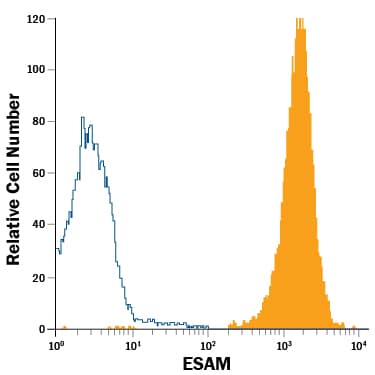
Detection of ESAM in HUVEC Human Cell Line by Flow Cytometry.
HUVEC human umbilical vein endothelial cell line was stained with Mouse Anti-Human ESAM APC-conjugated Monoclonal Antibody (Catalog # FAB4204A, filled histogram) or isotype control antibody (Catalog # IC0041A, open histogram). View our protocol for Staining Membrane-associated Proteins.Applications for Human ESAM APC-conjugated Antibody
Application
Recommended Usage
Flow Cytometry
10 µL/106 cells
Sample: HUVEC human umbilical vein endothelial cell line
Sample: HUVEC human umbilical vein endothelial cell line
Spectra Viewer
Plan Your Experiments
Use our spectra viewer to interactively plan your experiments, assessing multiplexing options. View the excitation and emission spectra for our fluorescent dye range and other commonly used dyes.
Spectra Viewer
Formulation, Preparation, and Storage
Purification
Protein A or G purified from hybridoma culture supernatant
Formulation
Supplied in a saline solution containing BSA and Sodium Azide.
Shipping
The product is shipped with polar packs. Upon receipt, store it immediately at the temperature recommended below.
Stability & Storage
Store the unopened product at 2 - 8° C. Do not use past expiration date. Protect from light.
Background: ESAM
Endothelial cell-selective adhesion molecule (ESAM) is a 55 kDa type I transmembrane glycoprotein that belongs to the JAM family of immunoglobulin superfamily molecules (1, 2). Human ESAM is synthesized as a 390 amino acid (aa) protein composed of a 29 aa signal peptide, a 216 aa extracellular region, a putative 26 aa transmembrane segment, and a 119 aa cytoplasmic domain. The extracellular region contains one V-type and one C2-type Ig domain and is involved in homophilic adhesion (1). In the cytoplasmic domain, there is a docking site for the multifunctional adaptor protein MAGI-1 (3). The extracellular region of human ESAM shows 90%, 74%, 69%, and 67% aa identity with monkey, canine, mouse, and rat extracellular ESAM, respectively. ESAM is expressed on endothelial cells, activated platelets, and megakaryocytes and can be found associated with cell-to-cell junctions. Whether ESAM is restricted to a particular junctional type is not clear (1, 2). ESAM deficient mice have no defect in vascularization but do have reduced angiogenic potential. This may be due to a decreased migratory response to FGF-2 (4).
References
- Hirata, K-I. et al. (2001) J. Biol. Chem. 276:16223.
- Nasdala, I. et al. (2002) J. Biol. Chem. 277:16294.
- Wegmann, F. et al. (2004) Exp. Cell Res. 300:121.
- Ishida, T. et. al. (2003) J. Biol. Chem. 278:34598.
Long Name
Endothelial Cell Adhesion Molecule
Alternate Names
2310008D05Rik, endothelial cell adhesion molecule, endothelial cell-selective adhesion molecule, HUEL (C4orf1)-interacting protein, LP4791 protein, W117m
Gene Symbol
ESAM
UniProt
Additional ESAM Products
Product Documents for Human ESAM APC-conjugated Antibody
Product Specific Notices for Human ESAM APC-conjugated Antibody
For research use only
Loading...
Loading...
Loading...
Loading...
Loading...