
Human EGFR (aa 746-750 deletion) Antibody
R&D Systems, part of Bio-Techne | Catalog # MAB8336

Scientific images may be resized, cropped, or adjusted for brightness or contrast for presentation purposes. These updates are limited to presentation and do not affect the underlying scientific interpretation of the data. Where available, additional source data may be provided upon request.
Conjugate
Catalog #
Key Product Details
Species Reactivity
Human
Applications
Western Blot, Immunocytochemistry, Simple Western
Label
Unconjugated
Antibody Source
Monoclonal Mouse IgG2A Clone # 752502
Product Specifications
Immunogen
Human EGFR synthetic peptide
CPVAIKTSPKAN
Accession # P00533
CPVAIKTSPKAN
Accession # P00533
Specificity
Detects human EGFR with the aa 746-750 deletion in direct ELISAs and Western blots.
Clonality
Monoclonal
Host
Mouse
Isotype
IgG2A
Scientific Data Images for Human EGFR (aa 746-750 deletion) Antibody
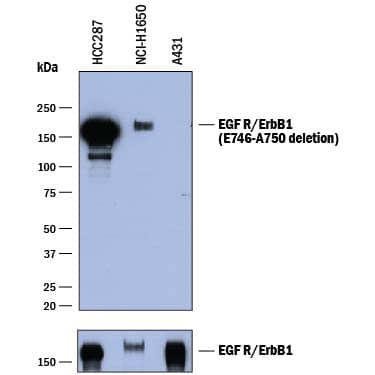
Detection of Human EGFR (aa 746-750 deletion) by Western Blot.
Western blot shows lysates of HCC827 human non-small cell lung cancer cell line, HCT-116 human colorectal carcinoma cell line, and A431 human epithelial carcinoma cell line. PVDF membrane was probed with 2 µg/mL of Mouse Anti-Human EGFR (aa 746-750 deletion) Monoclonal Antibody (Catalog # MAB8336) followed by HRP-conjugated Anti-Mouse IgG Secondary Antibody (Catalog # HAF018). A specific band was detected for EGFR (aa 746-750 deletion) at approximately 170 kDa (as indicated). For additional reference total EGFR was detected using Goat Anti-Human EGFR Antigen Affinity-purified Polyclonal Antibody (lower panel, Catalog # AF231). This experiment was conducted under reducing conditions and using Immunoblot Buffer Group 1.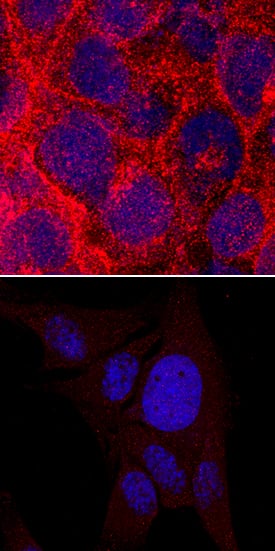
EGFR (aa 746-750 deletion) in HCC827 Human Cell Line.
EGFR (aa 746-750 deletion) was detected in immersion fixed HCC827 human non-small cell lung cancer cell line using Mouse Anti-Human EGFR (aa 746-750 deletion) Monoclonal Antibody (Catalog # MAB8336) at 5 µg/mL for 3 hours at room temperature. Cells were stained using the NorthernLights™ 557-conjugated Anti-Mouse IgG Secondary Antibody (red; Catalog # NL007) and counterstained with DAPI (blue). Specific staining was localized to plasma membranes and cytoplasm. Negative staining shown in the lower panel with NCI-H1975 human lung epithelial cell line. View our protocol for Fluorescent ICC Staining of Cells on Coverslips.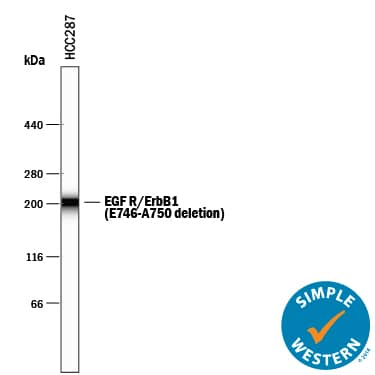
Detection of Human EGFR by Simple WesternTM.
Simple Western lane view shows lysates of HCC827 human non-small cell lung cancer cell line, loaded at 0.5 mg/mL. A specific band was detected for EGFR at approximately 200 kDa (as indicated) using 20 µg/mL of Mouse Anti-Human EGFR (aa 746-750 deletion) Monoclonal Antibody (Catalog # MAB8336). This experiment was conducted under reducing conditions and using the 66-440 kDa separation system.Applications for Human EGFR (aa 746-750 deletion) Antibody
Application
Recommended Usage
Immunocytochemistry
8-25 µg/mL
Sample: Immersion fixed HCC827 human lung epithelial cell line
Sample: Immersion fixed HCC827 human lung epithelial cell line
Simple Western
20 µg/mL
Sample: HCC827 human non-small cell lung cancer cell line
Sample: HCC827 human non-small cell lung cancer cell line
Western Blot
2 µg/mL
Sample: HCC827 human non-small cell lung cancer cell line, HCT‑116 human colorectal carcinoma cell line, and A431 human epithelial carcinoma cell line
Sample: HCC827 human non-small cell lung cancer cell line, HCT‑116 human colorectal carcinoma cell line, and A431 human epithelial carcinoma cell line
Formulation, Preparation, and Storage
Purification
Protein A or G purified from hybridoma culture supernatant
Reconstitution
Reconstitute at 0.5 mg/mL in sterile PBS. For liquid material, refer to CoA for concentration.
Formulation
Lyophilized from a 0.2 μm filtered solution in PBS with Trehalose. *Small pack size (SP) is supplied either lyophilized or as a 0.2 µm filtered solution in PBS.
Shipping
Lyophilized product is shipped at ambient temperature. Liquid small pack size (-SP) is shipped with polar packs. Upon receipt, store immediately at the temperature recommended below.
Stability & Storage
Use a manual defrost freezer and avoid repeated freeze-thaw cycles.
- 12 months from date of receipt, -20 to -70 °C as supplied.
- 1 month, 2 to 8 °C under sterile conditions after reconstitution.
- 6 months, -20 to -70 °C under sterile conditions after reconstitution.
Background: EGFR
Epidermal growth factor receptor (EGFR, also known as ErbB1 and HER1) is the founding member of the ErbB family of receptor tyrosine kinases. Ligand binding induces receptor dimerization and autophosphorylation on multiple tyrosine residues. EGFR exon 19 deletions are in-frame deletions occurring within
exon 19, which encodes part of the kinase domain. This mutation occurs
with a frequency of approximately 48% in EGFR mutant lung tumors. It affects the catalytic domain (amino acids 746-750), and is predominantly associated with non-small cell lung cancer (1). In a metastatic setting, EGFR deletions like aa746-750 are predictors of efficacy of the EGFR tyrosine kinase inhibitors (1, 2).
References
- Lynch, T. et al. (2004) N Engl J Med. 350:2129.
- Carey, K. et al. (2006) Cancer Res 66:8163.
Long Name
Epidermal Growth Factor Receptor
Alternate Names
EGF R, ErbB, ErbB1, HER-1
Gene Symbol
EGFR
UniProt
Additional EGFR Products
Product Documents for Human EGFR (aa 746-750 deletion) Antibody
Product Specific Notices for Human EGFR (aa 746-750 deletion) Antibody
For research use only
Loading...
Loading...
Loading...
Loading...
Loading...