
Human CXCR4 PE-conjugated Antibody
R&D Systems, part of Bio-Techne | Catalog # FAB173P

Scientific images may be resized, cropped, or adjusted for brightness or contrast for presentation purposes. These updates are limited to presentation and do not affect the underlying scientific interpretation of the data. Where available, additional source data may be provided upon request.
Conjugate
Catalog #
Key Product Details
Species Reactivity
Validated:
Human
Cited:
Human
Applications
Validated:
Flow Cytometry
Cited:
Flow Cytometry
Label
Phycoerythrin (Excitation = 488 nm, Emission = 565-605 nm)
Antibody Source
Monoclonal Mouse IgG2B Clone # 44717
Product Specifications
Immunogen
Mouse 3T3 cells transfected with human CXCR4
Specificity
Reacts specifically with human and non-human cells expressing human CXCR4 (fusin) as detected by flow cytometry. It will also react with cells expressing feline CXCR4 but not rat CXCR4. This antibody does not cross-react with other chemokine receptors.
Clonality
Monoclonal
Host
Mouse
Isotype
IgG2B
Scientific Data Images for Human CXCR4 PE-conjugated Antibody
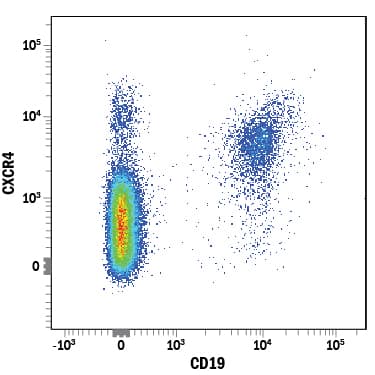
Detection of CXCR4 in Human Blood Lymphocytes by Flow Cytometry.
Human peripheral blood lymphocytes were stained with Mouse Anti-Human CXCR4 PE-conjugated Monoclonal Antibody (Catalog # FAB173P) and Mouse Anti-Human CD19 APC-conjugated Monoclonal Antibody (FAB4867A) for 15 minutes at 37°C followed by 15 minutes at room temperature. View our protocol for Staining Membrane-associated Proteins.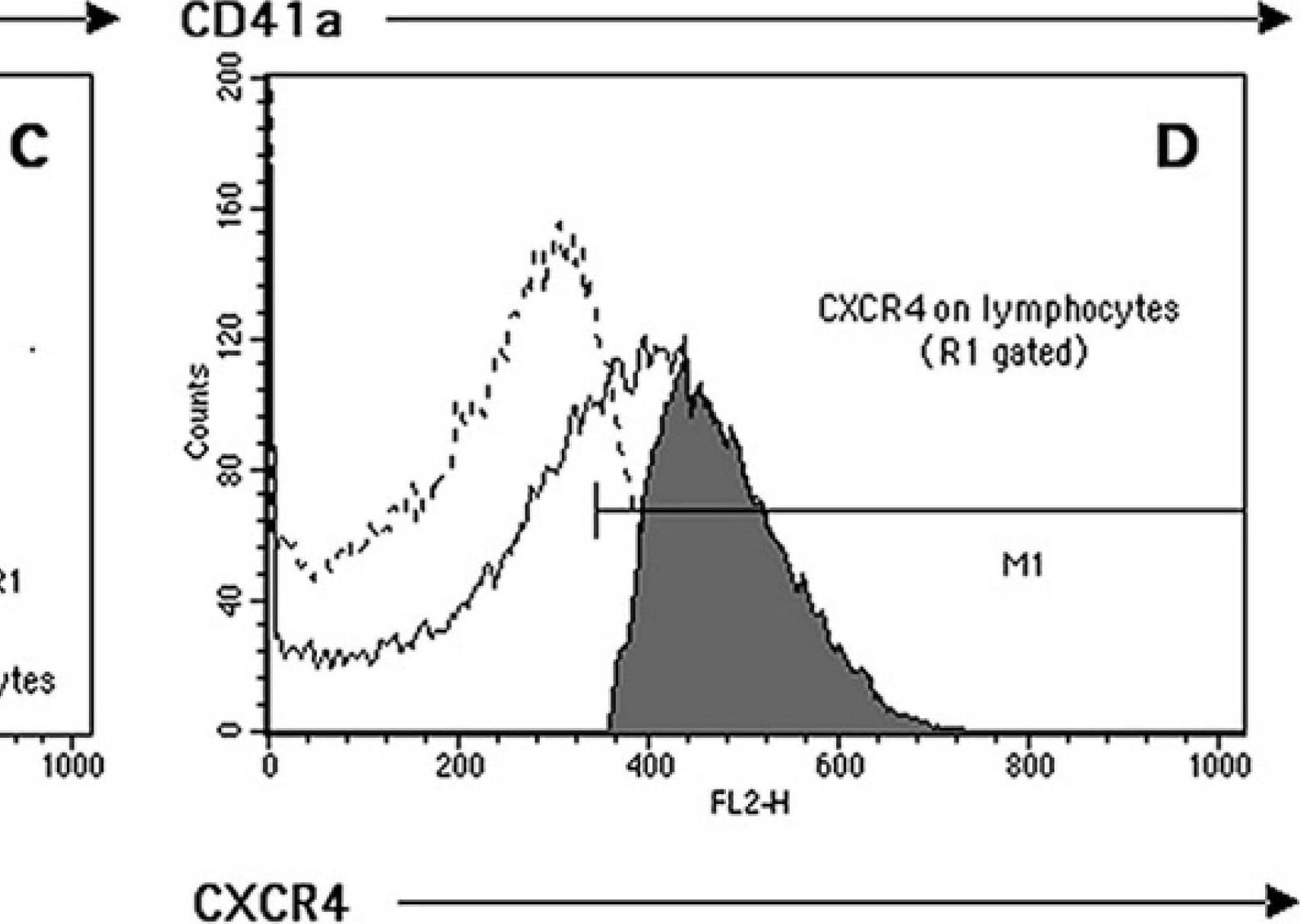
Detection of CXCR4 by Flow Cytometry
Representative example of flow cytometry quantification of complexes neutrophil–CD41a+ (NPAs, neutrophil–platelet aggregates) and lymphocyte markers’ expression. (A) Neutrophil cluster identification (region R1) based on its low CD14 expression (FL3) and side-scattering (SSC) morphological characteristics. (B) The R1-based histogram’s subtraction analysis (positive events (continuous line) minus isotype control (dotted line)) was used to quantify both the percentage of complexes CD41a+ (grey events in M1) and their RFI (median of M1 histogram minus median of the isotype control). (C) Lymphocyte cluster identification based on its forward- (FSC) and side-scattering characteristics (region R1). (D) Representative quantification of lymphocyte CXCR4 expression following the overlay histogram’s subtraction analysis (see above). Image collected and cropped by CiteAb from the following open publication (https://pubmed.ncbi.nlm.nih.gov/36836785), licensed under a CC-BY license. Not internally tested by R&D Systems.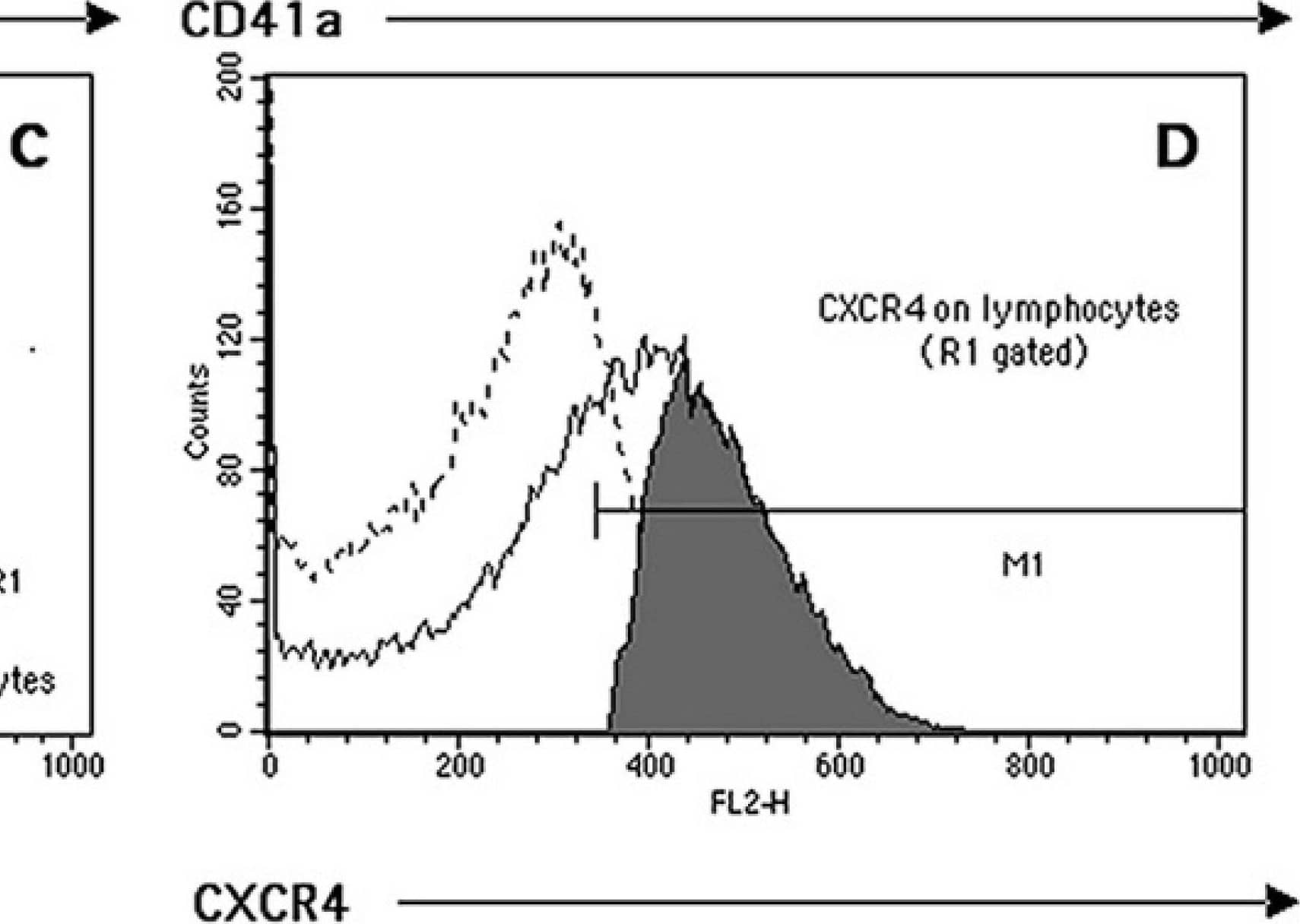
Detection of CXCR4 by Flow Cytometry
Representative example of flow cytometry quantification of complexes neutrophil–CD41a+ (NPAs, neutrophil–platelet aggregates) and lymphocyte markers’ expression. (A) Neutrophil cluster identification (region R1) based on its low CD14 expression (FL3) and side-scattering (SSC) morphological characteristics. (B) The R1-based histogram’s subtraction analysis (positive events (continuous line) minus isotype control (dotted line)) was used to quantify both the percentage of complexes CD41a+ (grey events in M1) and their RFI (median of M1 histogram minus median of the isotype control). (C) Lymphocyte cluster identification based on its forward- (FSC) and side-scattering characteristics (region R1). (D) Representative quantification of lymphocyte CXCR4 expression following the overlay histogram’s subtraction analysis (see above). Image collected and cropped by CiteAb from the following open publication (https://pubmed.ncbi.nlm.nih.gov/36836785), licensed under a CC-BY license. Not internally tested by R&D Systems.Applications for Human CXCR4 PE-conjugated Antibody
Application
Recommended Usage
Flow Cytometry
10 µL/106 cells
Sample: Human peripheral blood lymphocytes
Sample: Human peripheral blood lymphocytes
Reviewed Applications
Read 1 review rated 5 using FAB173P in the following applications:
Spectra Viewer
Plan Your Experiments
Use our spectra viewer to interactively plan your experiments, assessing multiplexing options. View the excitation and emission spectra for our fluorescent dye range and other commonly used dyes.
Spectra Viewer
Formulation, Preparation, and Storage
Purification
Protein A or G purified from ascites
Formulation
Supplied in a saline solution containing BSA and Sodium Azide.
Shipping
The product is shipped with polar packs. Upon receipt, store it immediately at the temperature recommended below.
Stability & Storage
Protect from light. Do not freeze.
- 12 months from date of receipt, 2 to 8 °C as supplied.
Background: CXCR4
Long Name
C-X-C Motif Chemokine Receptor 4
Alternate Names
CD184, D2S201E, FB22, Fusin, HM89, HSY3RR, LAP-3, LAP3, LCR1, LESTR, NPY3R, NPYRL, NPYY3R, WHIMS
Gene Symbol
CXCR4
Additional CXCR4 Products
Product Documents for Human CXCR4 PE-conjugated Antibody
Product Specific Notices for Human CXCR4 PE-conjugated Antibody
For research use only
Loading...
Loading...
Loading...
Loading...
Loading...