
Human B7-H1/PD-L1 PerCP-conjugated Antibody
R&D Systems, part of Bio-Techne | Catalog # FAB1561C

Conjugate
Catalog #
Key Product Details
Validated by
Biological Validation
Species Reactivity
Human
Applications
Flow Cytometry
Label
PerCP (Excitation = 482 nm, Emission = 675 nm)
Antibody Source
Monoclonal Mouse IgG1 Clone # 130021
Product Specifications
Immunogen
Mouse myeloma cell line NS0-derived recombinant human B7‑H1/PD‑L1
Phe19-Thr239
Accession # Q9NZQ7
Phe19-Thr239
Accession # Q9NZQ7
Specificity
Detects human B7‑H1/PD‑L1 in direct ELISAs. In direct ELISAs, no cross-reactivity with recombinant human (rh) B7-1, -2, -H2, -H3, -H3b,-H4, rhPD-L2, recombinant mouse B7-H1, recombinant rat (rr) B7-1, or rrB7-2 is observed.
Clonality
Monoclonal
Host
Mouse
Isotype
IgG1
Scientific Data Images for Human B7-H1/PD-L1 PerCP-conjugated Antibody
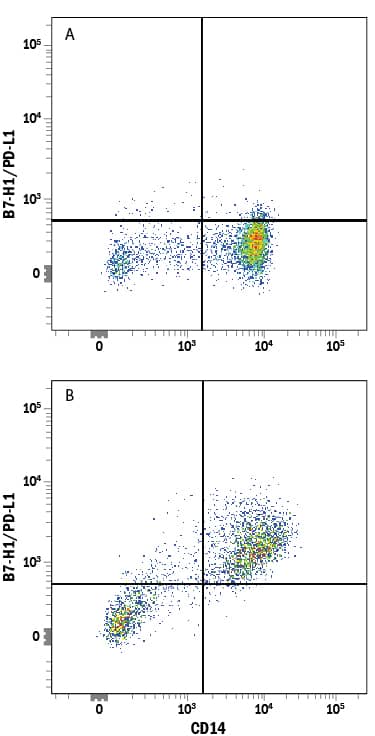
Detection of B7-H1/PD-L1 in Human PBMCs by Flow Cytometry.
Human peripheral blood mononuclear cells (PBMCs) (A) resting or (B) treated with 1 µg/mL LPS overnight were stained with Mouse Anti-Human CD14 Fluorescein-conjugated Monoclonal Antibody (Catalog # FAB3832F) and Mouse Anti-Human B7-H1/PD-L1 PerCP-conjugated Monoclonal Antibody (Catalog # FAB1561C). Quadrant markers were set based on control antibody staining (Catalog # IC002C). View our protocol for Staining Membrane-associated Proteins.Applications for Human B7-H1/PD-L1 PerCP-conjugated Antibody
Application
Recommended Usage
Flow Cytometry
10 µL/106 cells
Sample: Human peripheral blood mononuclear cells (PBMCs) treated with LPS
Sample: Human peripheral blood mononuclear cells (PBMCs) treated with LPS
Spectra Viewer
Plan Your Experiments
Use our spectra viewer to interactively plan your experiments, assessing multiplexing options. View the excitation and emission spectra for our fluorescent dye range and other commonly used dyes.
Spectra Viewer
Formulation, Preparation, and Storage
Purification
Protein A or G purified from hybridoma culture supernatant
Formulation
Supplied in a saline solution containing BSA and Sodium Azide.
Shipping
The product is shipped with polar packs. Upon receipt, store it immediately at the temperature recommended below.
Stability & Storage
Protect from light. Do not freeze.
- 12 months from date of receipt, 2 to 8 °C as supplied.
Background: PD-L1/B7-H1
Human B7 homolog 1 (B7-H1), also called programmed death ligand 1 (PD-L1) and programmed cell death 1 ligand 1 (PDCD1L1), is a member of the growing B7 family of immune proteins that provide signals for both stimulating and inhibiting T cell activation. Other family members include B7-1, B7-2, B7-H2, PDL2 and B7-H3. B7 proteins are members of the immunoglobulin (Ig) superfamily. Their extracellular domains contain 2 Ig-like domains and all members have short cytoplasmic domains. Among the family members, there is about 20-25% amino acid identity. Human and mouse B7-H1 share approximately 70% amino acid sequence identity. B7-H1 has been identified as one of two ligands for programmed death-1 (PD-1), a member of the CD28 family of immunoreceptors. The B7-H1 gene encodes a 291 amino acid (aa) type I membrane precursor protein with a putative 18 aa signal peptide, a 220 aa extracellular domain, a 21 aa transmembrane region, and a 31 aa cytoplasmic domain. Human B7-H1 is constitutively expressed in several organs such as heart, skeletal muscle, placenta and lung, and in lower amounts in thymus, spleen, kidney and liver. B7-H1 expression is upregulated in a small fraction of activated T and B cells and a much larger fraction of activated monocytes. B7-H1 expression is also induced in dendritic cells and keratinocytes after IFN-gamma stimulation. Interaction of B7-H1 with PD-1 results in inhibition of TCR-mediated proliferation and cytokine production. The B7-H1:PD-1 pathway is involved in the negative regulation of some immune responses and may play an important role in the regulation of peripheral tolerance.
References
- Nishimura, H. and T. Honjo (2001) Trends Immunol. 22:265.
- Freeman, G.J. et al. (2000) J. Exp. Med. 192:1027.
- Latchman, Y. et al. (2001) Nat. Immunol. 2:261.
Long Name
Programmed Death Ligand 1
Alternate Names
B7-H1, B7H1, CD274, PDCD1L1, PDCD1LG1, PDL1
Entrez Gene IDs
Gene Symbol
CD274
UniProt
Additional PD-L1/B7-H1 Products
Product Documents for Human B7-H1/PD-L1 PerCP-conjugated Antibody
Product Specific Notices for Human B7-H1/PD-L1 PerCP-conjugated Antibody
For research use only
Loading...
Loading...
Loading...
Loading...
Loading...