
CD39/ENTPD1 Antibody (A1)
Novus Biologicals, part of Bio-Techne | Catalog # NBP3-48409

Conjugate
Catalog #
Key Product Details
Species Reactivity
Human
Applications
Flow Cytometry, Immunohistochemistry-Paraffin
Label
Unconjugated
Antibody Source
Monoclonal Mouse IgG1 kappa Clone # A1
Concentration
1.0 mg/ml
Product Specifications
Immunogen
PHA activated human lymphocytes
Clonality
Monoclonal
Host
Mouse
Isotype
IgG1 kappa
Description
Novus Biologicals Mouse CD39/ENTPD1 Antibody (A1) (NBP3-48409) is a monoclonal antibody validated for use in IHC and Flow. All Novus Biologicals antibodies are covered by our 100% guarantee.
Scientific Data Images for CD39/ENTPD1 Antibody (A1)
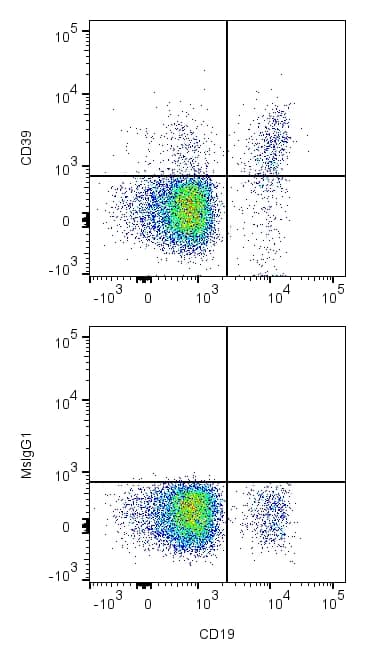
Detection of CD39/ENTPD1 (A1) in Human PBMC lymphocytes by Flow Cytometry.
Human peripheral blood mononuclear cell (PBMC) lymphocytes were stained with CD19 Monoclonal Antibody and either (top) Mouse Anti-Human CD39 (catalog #NBP3-48409) or (bottom) matched isotype control antibody.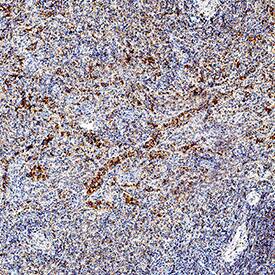
Detection of CD39 in Human Spleen.
CD39 was detected in immersion fixed paraffin-embedded sections of human spleen using Mouse Anti-Human CD39 Monoclonal Antibody (Catalog #NBP3-48409) at 5 µg/ml for 1 hour at room temperature followed by incubation with the Anti-Mouse IgG VisUCyte™ HRP Polymer Antibody (Catalog # VC001). Before incubation with the primary antibody, tissue was subjected to heat-induced epitope retrieval using VisUCyte Antigen Retrieval Reagent-Basic (Catalog # VCTS021). Tissue was stained using DAB (brown) and counterstained with hematoxylin (blue).Applications for CD39/ENTPD1 Antibody (A1)
Application
Recommended Usage
Flow Cytometry
Optimal dilutions of this antibody should be experimentally determined.
Immunohistochemistry-Paraffin
Optimal dilutions of this antibody should be experimentally determined.
Formulation, Preparation, and Storage
Purification
Protein G purified
Formulation
PBS
Preservative
0.02% Sodium Azide
Concentration
1.0 mg/ml
Stability & Storage
Store at 4C short term. Aliquot and store at -20C long term. Avoid freeze-thaw cycles.
Background: CD39/ENTPD1
Long Name
Ecto-Nucleoside Triphosphate Diphosphohydrolase 1
Alternate Names
ADPase, ATP-diphosphatase, CD39, ENTPD1, NTPD1
Gene Symbol
ENTPD1
Additional CD39/ENTPD1 Products
Product Documents for CD39/ENTPD1 Antibody (A1)
Product Specific Notices for CD39/ENTPD1 Antibody (A1)
This product is for research use only and is not approved for use in humans or in clinical diagnosis. Primary Antibodies are guaranteed for 1 year from date of receipt.
Loading...
Loading...
Loading...
Loading...
Loading...