
C. difficile Toxin B/TcdB Antibody
R&D Systems, part of Bio-Techne | Catalog # AF6246

Conjugate
Catalog #
Key Product Details
Species Reactivity
Validated:
C. difficile
Cited:
Human, Hamster, Hamster - Cricetulus (Chinese Hamster)
Applications
Validated:
Western Blot
Cited:
Western Blot, Immunocytochemistry
Label
Unconjugated
Antibody Source
Polyclonal Sheep IgG
Product Specifications
Immunogen
E. coli-derived recombinant C. difficile Toxin B/TcdB
Ser2-Leu543
Accession # P18177
Ser2-Leu543
Accession # P18177
Specificity
Detects C. difficile Toxin B/TcdB in direct ELISAs and Western blots.
Clonality
Polyclonal
Host
Sheep
Isotype
IgG
Scientific Data Images for C. difficile Toxin B/TcdB Antibody
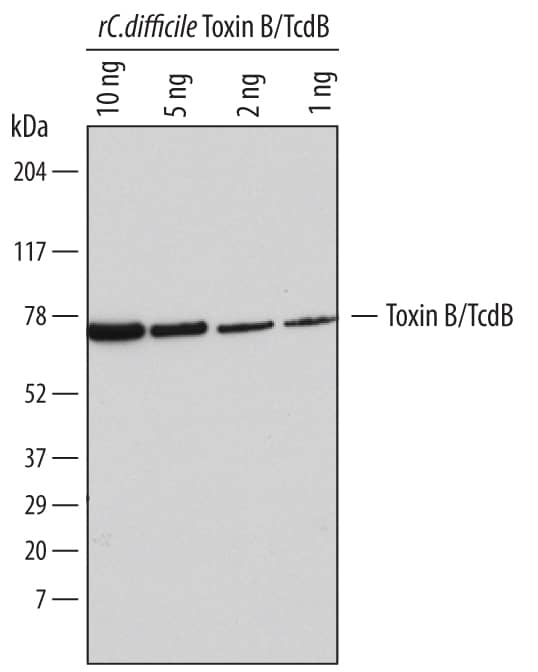
Detection ofC. difficileToxin B/TcdB by Western Blot.
Western blot shows recombinantC. difficileToxin B/TcdB (Catalog # 6246-GT). PVDF membrane was probed with 1 µg/mL of Sheep Anti-C. difficileToxin B/TcdB Antigen Affinity-purified Polyclonal Antibody (Catalog # AF6246) followed by HRP-conjugated Anti-Sheep IgG Secondary Antibody (Catalog # HAF016). A specific band was detected for Toxin B/TcdB at approximately 75 kDa (as indicated). This experiment was conducted under reducing conditions and using Immunoblot Buffer Group 1.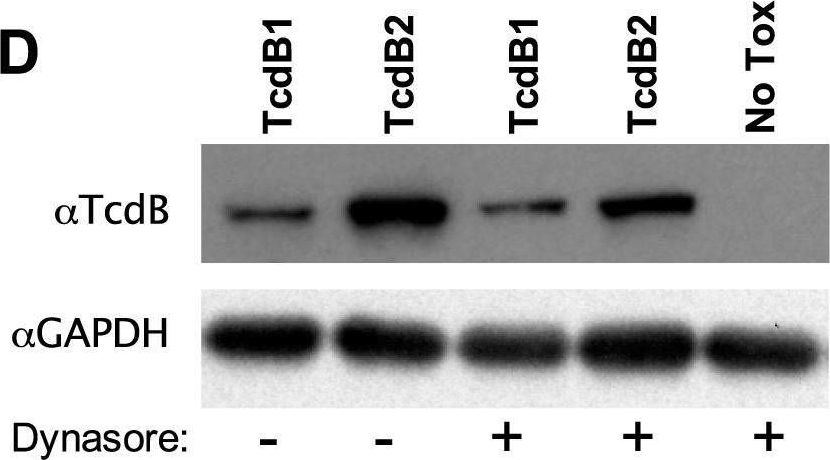
Detection of C. difficile Toxin B/TcdB by Western Blot
Effective TcdB cell interactions correlate with endocytosis. (A, B) Representative confocal maximum-intensity projections of CHO-K1 cells stained with 250 nM Alexa Fluor 647-labeled TcdB1 B2′B3 (red) (A) or Alexa Fluor 647-labeled TcdB2 B2′B3 (red) (B). Ten micromolar calcein AM (green) was used to counterstain the cytoplasm of live cells with intact membranes, and 0.5 μg/ml Hoechst 33258 (blue) was used to visualize the nucleus. (C) Quantification of the images in panels A and B, expressed as corrected total cell fluorescence. (D) Representative immunoblotting of full-length TcdB1 and TcdB2 associated with CHO-K1 cells in the presence or absence the dynamin inhibitor dynasore (80 μM). Incubations were carried out for 30 min at 37°C. (E) Quantification of data presented in panel D, expressed as relative band density. (F) Representative immunoblotting of full-length TcdB1 and TcdB2 associated with CHO-K1 cells when incubations were carried out for 30 min at a temperature that permits (37°C) or inhibits (ice) endocytosis. (G) Quantification of data presented in panel F, expressed as relative band density. GAPDH, glyceraldehyde-3-phosphate dehydrogenase. Image collected and cropped by CiteAb from the following open publication (https://pubmed.ncbi.nlm.nih.gov/28776043), licensed under a CC-BY license. Not internally tested by R&D Systems.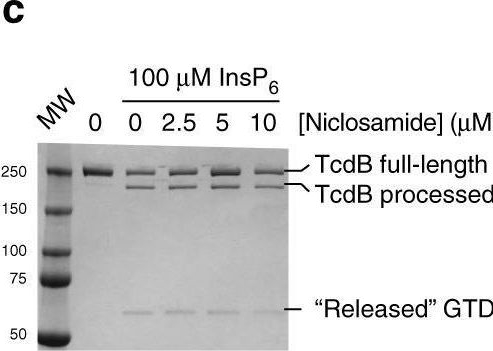
Detection of C. difficile Toxin B/TcdB by Western Blot
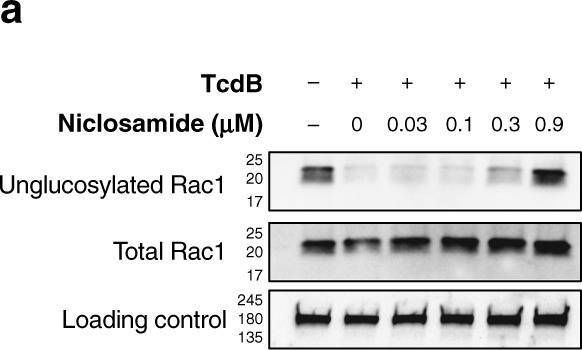
Mechanism-of-action of niclosamide inhibition of TcdB intoxication. c In vitro auto-processing assay. Compound or DMSO was added to 100 nM TcdB, and pre-incubated for 60 min. To initiate auto-processing, InsP6 was added (100 μM) and incubated @ 37 °C for 20 min before stopping with Laemlii sample buffer. Niclosamide at concentrations up to 10 μM did not affect auto-processing (n = 2). Image collected and cropped by CiteAb from the following open publication (https://pubmed.ncbi.nlm.nih.gov/30531960), licensed under a CC-BY license. Not internally tested by R&D Systems.Applications for C. difficile Toxin B/TcdB Antibody
Application
Recommended Usage
Western Blot
1 µg/mL
Sample: Recombinant C. difficile Toxin B/TcdB (Catalog # 6246-GT)
Sample: Recombinant C. difficile Toxin B/TcdB (Catalog # 6246-GT)
Formulation, Preparation, and Storage
Purification
Antigen Affinity-purified
Reconstitution
Sterile PBS to a final concentration of 0.2 mg/mL. For liquid material, refer to CoA for concentration.
Formulation
Lyophilized from a 0.2 μm filtered solution in PBS with Trehalose. *Small pack size (SP) is supplied either lyophilized or as a 0.2 µm filtered solution in PBS.
Shipping
Lyophilized product is shipped at ambient temperature. Liquid small pack size (-SP) is shipped with polar packs. Upon receipt, store immediately at the temperature recommended below.
Stability & Storage
Use a manual defrost freezer and avoid repeated freeze-thaw cycles.
- 12 months from date of receipt, -20 to -70 °C as supplied.
- 1 month, 2 to 8 °C under sterile conditions after reconstitution.
- 6 months, -20 to -70 °C under sterile conditions after reconstitution.
Background: Toxin B/TcdB
Clostridium difficile is the leading cause of hospital-acquired diarrhea, known as C. difficile-associated disease. The estimated number of cases of C. difficile-associated disease exceeds 250,000 per year (1), with health care costs approaching US $1 billion annually (2). The major virulence factors produced by C. difficile are two toxins, TcdA and TcdB. Both toxins can monoglucosylate and inactivate Rho family small GTPases within target cells, leading to disruption of vital signaling pathways in the cell, subsequently causing diarrhea, inflammation, and damage of colonic mucosa (3, 4, 5). Both toxins have a similar tripartite structure comprised of an N‑terminal glucosyltransferase domain, a C-terminal receptor binding domain, and a small hydrophobic span possibly involved in toxin translocation (6). Our recombinant TcdB consists of the enzymatic domain. Both TcdA and TcdB also have potassium-dependent UDP-Glc hydrolase activity, which is essentially glucosyltransferase activity with water as the acceptor molecule (7). Under same conditions, UDP-glucose hydrolysis by TcdB occurs at a rate about 5-fold greater than that of TcdA.
References
- Wilkins, T.D. and Lyerly, D.M. (2003) J. Clin. Microbiol 41:53.
- Kyne, L. et al. (2002) Clin. Infect. Dis. 34:346.
- Voth, D.E. and Ballard, J.D. (2005) Clin. Microbiol. Rev. 18:247.
- Chaves-Olarte, E. et al. (1996) J. Biol. Chem. 271:6925.
- Just I, et al. (1995) J. Biol. Chem. 270:13932.
- Hammond, G.A. and Johnson, J.L. (1995) Microb. Pathog. 19:203.
- Ciesla, W.P. Jr. and Bobak, D.A. (1998) J. Biol. Chem. 273:16021.
Alternate Names
toxB
Entrez Gene IDs
4914074 (C. difficile)
Gene Symbol
TCDB
UniProt
Additional Toxin B/TcdB Products
Product Documents for C. difficile Toxin B/TcdB Antibody
Product Specific Notices for C. difficile Toxin B/TcdB Antibody
For research use only
Loading...
Loading...
Loading...
Loading...
Loading...