
ARID5B Antibody - BSA Free
Novus Biologicals, part of Bio-Techne | Catalog # NBP1-83622

Key Product Details
Species Reactivity
Validated:
Human, Mouse
Cited:
Human, Mouse
Applications
Validated:
Immunocytochemistry/ Immunofluorescence
Cited:
Immunohistochemistry-Paraffin, Western Blot, Immunocytochemistry/ Immunofluorescence, Chromatin Immunoprecipitation (ChIP), Chemotaxis
Label
Unconjugated
Antibody Source
Polyclonal Rabbit IgG
Format
BSA Free
Concentration
Concentrations vary lot to lot. See vial label for concentration. If unlisted please contact technical services.
Product Specifications
Immunogen
This antibody was developed against Recombinant Protein corresponding to amino acids: TSKYPSRDMYRESENSSFPSHRHQEKLHVNYLTSLHLQDKKSAAAEAPTDDQPTDLSLPKNPHKPTGKVLGLAHSTTGPQESKGISQFQVLGSQSRDCHPKACRVSPMTMSGPKKYPESLSRSGKPHHVRLENFRKME
Reactivity Notes
Mouse reactivity reported in scientific literature (PMID: 24276541).
Clonality
Polyclonal
Host
Rabbit
Isotype
IgG
Scientific Data Images for ARID5B Antibody - BSA Free
![Immunocytochemistry/ Immunofluorescence: ARID5B Antibody [NBP1-83622]](https://resources.bio-techne.com/images/products/ARID5B-Antibody-Immunocytochemistry-Immunofluorescence-NBP1-83622-img0003.jpg "Immunocytochemistry/ Immunofluorescence: ARID5B Antibody [NBP1-83622]")
Immunocytochemistry/ Immunofluorescence: ARID5B Antibody [NBP1-83622]
Immunocytochemistry/Immunofluorescence: ARID5B Antibody [NBP1-83622] - Staining of human cell line BJ shows localization to nucleoplasm & endoplasmic reticulum. Antibody staining is shown in green.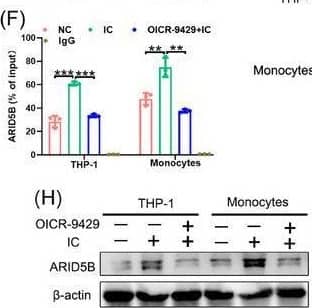
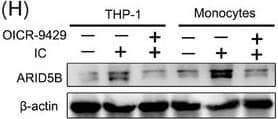
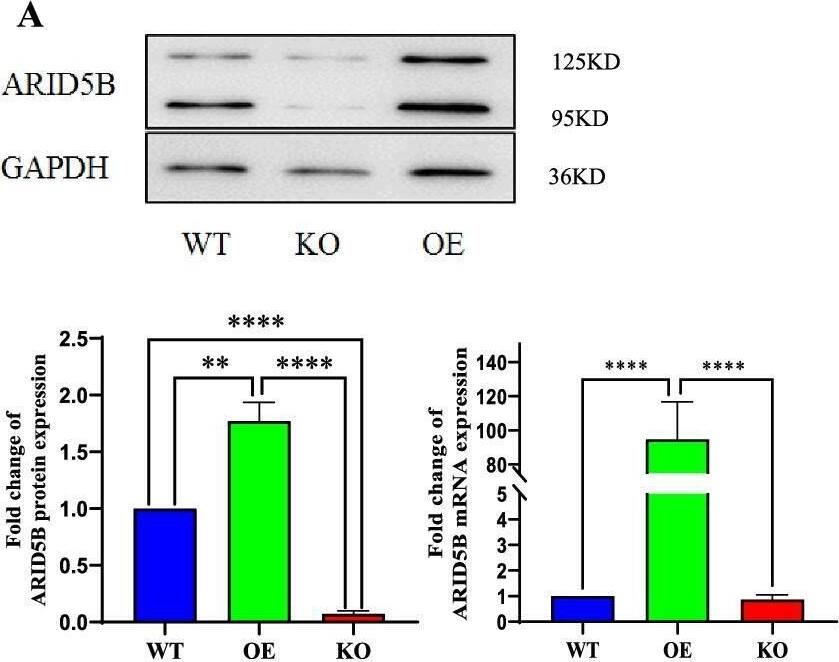
Western Blot: ARID5B Antibody - BSA Free [NBP1-83622] -
Trimethylation of histone 3 lysine 4 (H3K4me3)‐mediated ARID5B expression at its promoter. (A) Workflow of beta2GPI/anti‐ beta2GPI immune complex (IC) treatment and OICR‐9424 exposure in an ex vivo monocyte or THP‐1 cell model that partially mimicked antiphospholipid syndrome (APS). (B) Heatmaps of H3K4me3 Cleavage Under Targets and Tagmentation (CUT&Tag) in an ex vivo THP‐1 cell and monocyte model of APS. (C) Heatmaps of Transposase‐Accessible Chromatin using sequencing (ATAC‐Seq) in an ex vivo THP‐1 cell and monocyte model of APS. (D) Venn diagram showed the intersection of the unique peaks (ARID5B) in the IC group compared to that in the negative control (NC) group between H3K4me3 CUT&Tag and ATAC‐Seq. (E) Integrative Genomics Viewer (IGV) and (F) quantitative PCR (qPCR) showed the relative enrichment levels of H3K4me3 at the promoter of ARID5B. (G) Chromatin accessibility at the ARID5B promoter was displayed using IGV. (H) The protein levels of ARID5B in the ex vivo model of APS were detected using western blotting. (I) Real‐time quantitative PCR (RT‐qPCR) determined the mRNA expression of ARID5B in the ex vivo model of APS. Data information: error bars represent the mean +/- SD of at least three independent experiments. **p < .01; ***p < .001. beta2GPI, beta2‐glycoprotein I. Image collected and cropped by CiteAb from the following open publication (https://pubmed.ncbi.nlm.nih.gov/38224186), licensed under a CC-BY license. Not internally tested by Novus Biologicals.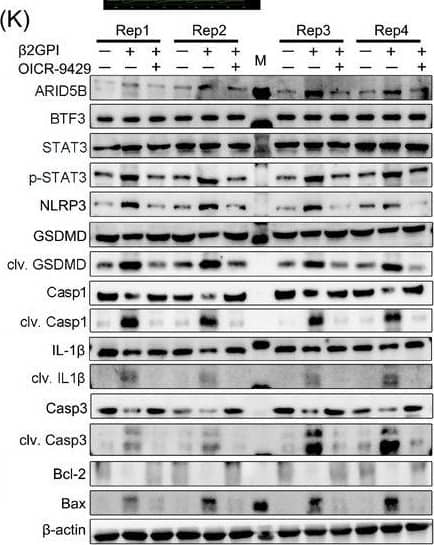
Western Blot: ARID5B Antibody - BSA Free [NBP1-83622] -
The activation of ARID5B/LINC01128/BTF3/STAT3 signalling in mice with antiphospholipid syndrome (APS). (A) Workflow of beta2‐glycoprotein I ( beta2GPI) intraperitoneal injection and OICR‐9429 exposure, beta2GPI was injected once a week for 3 weeks to generate mice with vascular APS in vivo (number of mice in each group = 5). (B) Anti‐ beta2GPI levels, (C) activated partial thromboplastin time (APTT) and (D) platelet count (PLT) were detected in the negative control (NC), beta2GPI and OICR‐9429+ beta2GPI groups. (E) The blood velocity of the ascending aorta was tested using Doppler ultrasound in the three groups of mice. (F) The thrombus size of the carotid artery was tested by haematoxylin–eosin (HE) staining in the three groups of mice; original magnification, 100×. (G–I) ELISA displaying the serum levels of interleukin (IL)‐18, IL‐1 beta and tissue factor (TF), respectively. (J) Real‐time quantitative PCR (RT‐qPCR) to detect the expression of LINC01128 in the three groups of mice. (K) Western blotting indicated the expression of ARID5B, BTF3 and p‐STAT3/STAT3, the activity of pyroptosis and apoptosis pathways in the three groups of mice. (L) Schematic diagram illustrating the potential mechanism of ARID5B‐mediated LINC01128 in p‐STAT3‐induced pyroptosis and apoptosis activation in APS. Data information: error bars represent the mean +/- SD of at least three independent experiments. M, marker; ns, not significant; **p < .01; ***p < .001. Image collected and cropped by CiteAb from the following open publication (https://pubmed.ncbi.nlm.nih.gov/38224186), licensed under a CC-BY license. Not internally tested by Novus Biologicals.
Applications for ARID5B Antibody - BSA Free
Application
Recommended Usage
Immunocytochemistry/ Immunofluorescence
0.25-2 ug/ml
Application Notes
ICC/IF Fixation Permeabilization: Use PFA/Triton X-100.
Formulation, Preparation, and Storage
Purification
Affinity purified
Formulation
PBS (pH 7.2) and 40% Glycerol
Format
BSA Free
Preservative
0.02% Sodium Azide
Concentration
Concentrations vary lot to lot. See vial label for concentration. If unlisted please contact technical services.
Shipping
The product is shipped with polar packs. Upon receipt, store it immediately at the temperature recommended below.
Stability & Storage
Store at 4C short term. Aliquot and store at -20C long term. Avoid freeze-thaw cycles.
Background: ARID5B
Alternate Names
ARID domain-containing protein 5B, AT rich interactive domain 5B (MRF1-like), DESRTAT-rich interactive domain-containing protein 5B, FLJ21150, Modulator recognition factor 2, modulator recognition factor 2 (MRF2), MRF-2, MRF2MRF1-like protein
Gene Symbol
ARID5B
Additional ARID5B Products
Product Documents for ARID5B Antibody - BSA Free
Product Specific Notices for ARID5B Antibody - BSA Free
This product is for research use only and is not approved for use in humans or in clinical diagnosis. Primary Antibodies are guaranteed for 1 year from date of receipt.
Loading...
Loading...
Loading...
Loading...