
alpha-Synuclein [Nitrate Tyr125, Nitrate Tyr133] Antibody (24.8)
Novus Biologicals, part of Bio-Techne | Catalog # NBP1-26380

Scientific images may be resized, cropped, or adjusted for brightness or contrast for presentation purposes. These updates are limited to presentation and do not affect the underlying scientific interpretation of the data. Where available, additional source data may be provided upon request.
Discontinued Product
NBP1-26380 has been discontinued.
View all alpha-Synuclein products.
Key Product Details
Species Reactivity
Validated:
Human, Mouse
Cited:
Human, Mouse
Applications
Validated:
Immunohistochemistry, Immunohistochemistry-Paraffin, Immunohistochemistry-Frozen, Western Blot, Flow Cytometry, Immunocytochemistry/ Immunofluorescence
Cited:
Immunohistochemistry-Frozen, IF/IHC
Label
Unconjugated
Antibody Source
Monoclonal Mouse IgG1 kappa Clone # 24.8
Concentration
1 mg/ml
Product Specifications
Immunogen
This alpha-Synuclein [Nitrate Tyr125, Nitrate Tyr133] Antibody (24.8) was developed against nitrated human alpha-Synuclein .
Epitope
2 nitrated residues Y125, Y133
Modification
Nitrate Tyr125, Nitrate Tyr133
Localization
Cytoplasm. Membrane. Nucleus. Membrane-bound in dopaminergic neurons.
Clonality
Monoclonal
Host
Mouse
Isotype
IgG1 kappa
Theoretical MW
14 kDa.
Disclaimer note: The observed molecular weight of the protein may vary from the listed predicted molecular weight due to post translational modifications, post translation cleavages, relative charges, and other experimental factors.
Disclaimer note: The observed molecular weight of the protein may vary from the listed predicted molecular weight due to post translational modifications, post translation cleavages, relative charges, and other experimental factors.
Scientific Data Images for alpha-Synuclein [Nitrate Tyr125, Nitrate Tyr133] Antibody (24.8)
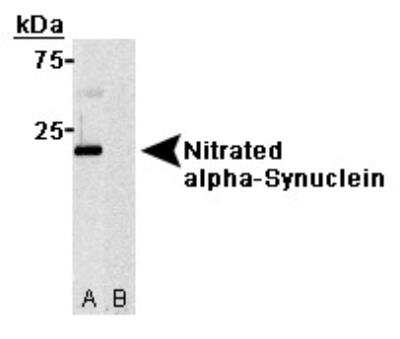
Western Blot: alpha-Synuclein [Nitrate Tyr125, Nitrate Tyr133] Antibody (24.8) [NBP1-26380] - (A) Nitrated Synuclein-alpha protein and (B) Non-nitrated Synuclein-alpha protein.
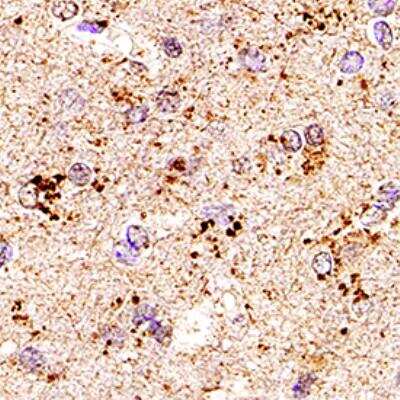
Immunohistochemistry-Paraffin: alpha-Synuclein [Nitrate Tyr125, Nitrate Tyr133] Antibody (24.8) [NBP1-26380] - Analysis of FFPE human brain using alpha-Synuclein antibody (clone 24.8) at 1:200 on a Bond Rx autostainer (Leica Biosystems). The assay involved 20 minutes of heat induced antigen retrieval (HIER) using 10mM sodium citrate buffer (pH 6.0) and endogenous peroxidase quenching with peroxide block. The sections were incubated with primary antibody for 30 minutes and Bond Polymer Refine Detection (Leica Biosystems) with DAB was used for signal development followed by counterstaining with hematoxylin. Whole slide scanning and capturing of representative images was performed using Aperio AT2 (Leica Biosystems). Cytoplasmic puncta and varicosities staining was observed. Staining was performed by Histowiz.
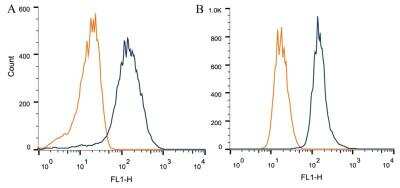
Flow Cytometry: alpha-Synuclein [Nitrate Tyr125, Nitrate Tyr133] Antibody (24.8) [NBP1-26380] - Intracellular flow cytometric staining of 1 x 10^6 CHO (A) and HeLa (B) cells using Synuclein-alpha [Nitrate Tyr125, Nitrate Tyr133] antibody (dark blue). Isotype control shown in orange. An antibody concentration of 1 ug/1x10^6 cells was used.
Applications for alpha-Synuclein [Nitrate Tyr125, Nitrate Tyr133] Antibody (24.8)
Application
Recommended Usage
Flow Cytometry
1 ug per million cells
Immunohistochemistry
1:200-1:500
Immunohistochemistry-Paraffin
1:200-1:500
Western Blot
1:500-1:1500
Application Notes
This alpha-Synuclein antibody is useful for for Flow Cytometry, Immunohistochemisty paraffin embedded sections and Western blot, where a band is seen at ~14 kDa. Immunohistochemistry-Frozen was reported in scientific literature. Use in Immunofluorescence was reported in the scientific literature (PMID: 22033456).
Formulation, Preparation, and Storage
Purification
Protein G purified
Formulation
Tris-Glycine and 0.15M NaCl
Preservative
0.05% Sodium Azide
Concentration
1 mg/ml
Shipping
The product is shipped with polar packs. Upon receipt, store it immediately at the temperature recommended below.
Stability & Storage
Store at 4C short term. Aliquot and store at -20C long term. Avoid freeze-thaw cycles.
Background: alpha-Synuclein
A number of studies have revealed that alpha-synuclein aggregation is a hallmark feature in a number of neurodegenerative diseases, referred to as synucleinopathies (2-4). Alpha-synuclein protein aggregates are a large component of Lewy bodies that are present in Parkinson's disease (PD), Lewy body dementia (LBD), and multiple system atrophy (1-6). Research has shown phosphorylation of alpha-synuclein at Ser129 moves the protein from the nucleus to the cytoplasm and promotes fibril formation associated with synucleinopathies (1,2,5). Recent studies also suggest that alpha-synuclein accumulation can prevent mitochondrial import machinery causing mitochondrial dysfunction that is often observed in neurodegeneration (5). It is thought that preventing alpha-synuclein aggregation may prevent PD, thus alpha-synuclein is a target for many potential therapeutic interventions aimed at decreasing aggregate formation or increasing clearance (1,2,4-6).
References
1. Villar-Pique, A., Lopes da Fonseca, T., & Outeiro, T. F. (2016). Structure, function and toxicity of alpha-synuclein: the Bermuda triangle in synucleinopathies. Journal of neurochemistry. https://doi.org/10.1111/jnc.13249
2. Emamzadeh F. N. (2016). Alpha-synuclein structure, functions, and interactions. Journal of research in medical sciences : the official journal of Isfahan University of Medical Sciences. https://doi.org/10.4103/1735-1995.181989
3. Burre J. (2015). The Synaptic Function of alpha-Synuclein. Journal of Parkinson's disease. https://doi.org/10.3233/JPD-150642
4. Lashuel, H. A., Overk, C. R., Oueslati, A., & Masliah, E. (2013). The many faces of alpha-synuclein: from structure and toxicity to therapeutic target. Nature reviews. Neuroscience. https://doi.org/10.1038/nrn3406
5. Rocha, E. M., De Miranda, B., & Sanders, L. H. (2018). Alpha-synuclein: Pathology, mitochondrial dysfunction and neuroinflammation in Parkinson's disease. Neurobiology of disease. https://doi.org/10.1016/j.nbd.2017.04.004
6. O'Leary, E. I., & Lee, J. C. (2019). Interplay between alpha-synuclein amyloid formation and membrane structure. Biochimica et biophysica acta. Proteins and proteomics. https://doi.org/10.1016/j.bbapap.2018.09.012
Alternate Names
NACP, PARK1, PARK4, SNCA, Synuclein-alpha
Entrez Gene IDs
6622 (Human)
Gene Symbol
SNCA
UniProt
Additional alpha-Synuclein Products
Product Documents for alpha-Synuclein [Nitrate Tyr125, Nitrate Tyr133] Antibody (24.8)
Product Specific Notices for alpha-Synuclein [Nitrate Tyr125, Nitrate Tyr133] Antibody (24.8)
This product is for research use only and is not approved for use in humans or in clinical diagnosis. Primary Antibodies are guaranteed for 1 year from date of receipt.
Loading...
Loading...
Loading...
Loading...
Loading...
Loading...