
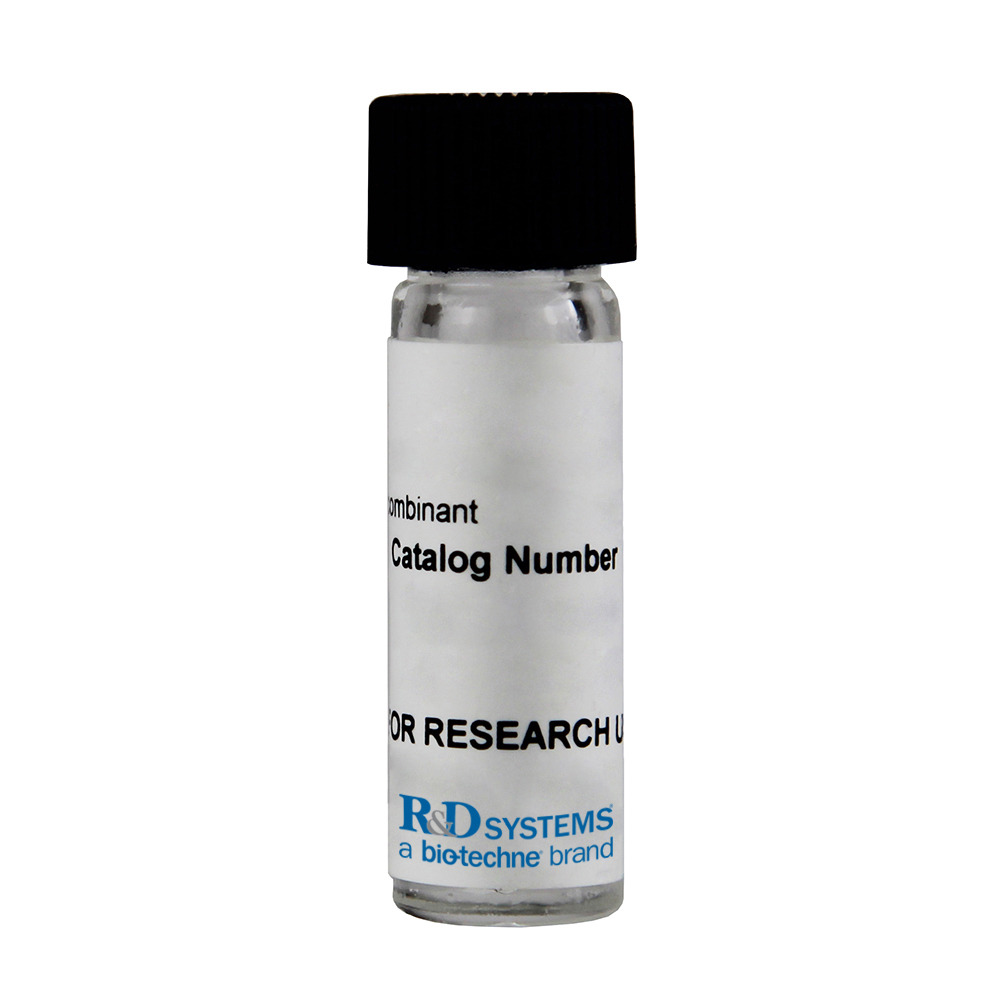
Recombinant Human IL-15 Protein
R&D Systems, part of Bio-Techne | Catalog # 247-IL

Key Product Details
Product Specifications
Source
E. coli-derived human IL-15 protein
Asn49-Ser162
Asn49-Ser162
Purity
>97%, by SDS-PAGE under reducing conditions and visualized by silver stain.
Endotoxin Level
1.0 EU per 1 μg of the protein by the LAL method.
N-terminal Sequence Analysis
Asn49
Predicted Molecular Mass
12.5 kDa
Activity
Measured in a cell proliferation assay using MO7e human megakaryocytic leukemic cells.
The ED50 for this effect is typically 0.3-2.6 ng/mL.
The specific activity of Recombinant Human IL-15 is approximately 4.5 x 10⁵ U/μg, which is calibrated against recombinant human IL-15 WHO International Standard (NIBSC code: 95/554).
The ED50 for this effect is typically 0.3-2.6 ng/mL.
The specific activity of Recombinant Human IL-15 is approximately 4.5 x 10⁵ U/μg, which is calibrated against recombinant human IL-15 WHO International Standard (NIBSC code: 95/554).
Reviewed Applications
Read 1 review rated 5 using 247-IL in the following applications:
Formulation, Preparation and Storage
247-IL
| Formulation | Lyophilized from a 0.2 μm filtered solution in PBS with BSA as a carrier protein. |
| Reconstitution | Reconstitute at 50 μg/mL in sterile PBS containing at least 0.1% human or bovine serum albumin. |
| Shipping | The product is shipped at ambient temperature. Upon receipt, store it immediately at the temperature recommended below. |
| Stability & Storage | Use a manual defrost freezer and avoid repeated freeze-thaw cycles.
|
Background: IL-15
References
- De Sabatino, A. et al. (2011) Cytokine Growth Factor Rev. 22:19.
- Grabstein, K. et al. (1994) Science 264:965.
- Tagaya, Y. et al. (1997) Proc. Natl. Acad. Sci. USA 94:14444.
- Giri, J.G. et al. (1995) EMBO J. 14:3654.
- Giri, J. et al. (1994) EMBO J. 13:2822.
- Dubois, S. et al. (2002) Immunity 17:537.
- Castillo, E.F. and K.S. Schluns (2012) Cytokine 59:479.
- Budagian, V. et al. (2004) J. Biol. Chem. 279:40368.
- Mortier, E. et al. (2004) J. Immunol. 173:1681.
- Bergamaschi, C. et al. (2012) Blood 120:e1.
- Budagian, V. et al. (2004) J. Biol. Chem. 279:42192.
- Mortier, E. et al. (2003) J. Exp. Med. 205:1213.
- Gordy, L.E. et al. (2011) J. Immunol. 187:6335.
- Harris, K.M. (2011) J. Leukoc. Biol. 90:727.
- Xia, J. et al. (2010) Clin. Immunol. 134:130.
- Schluns, K.S. et al. (2002) J. Immunol. 168:4827.
- Davies, E. et al. (2010) J. Leukoc. Biol. 88:529.
- Barra, N.G. et al. (2010) Obesity 18:1601.
Long Name
Interleukin 15
Alternate Names
IL15
Entrez Gene IDs
Gene Symbol
IL15
UniProt
Additional IL-15 Products
Product Documents for Recombinant Human IL-15 Protein
Product Specific Notices for Recombinant Human IL-15 Protein
For research use only
Loading...
Loading...
Loading...
Loading...