
Methylcellulose Stock Solution Best Seller
R&D Systems, part of Bio-Techne | Catalog # HSC001

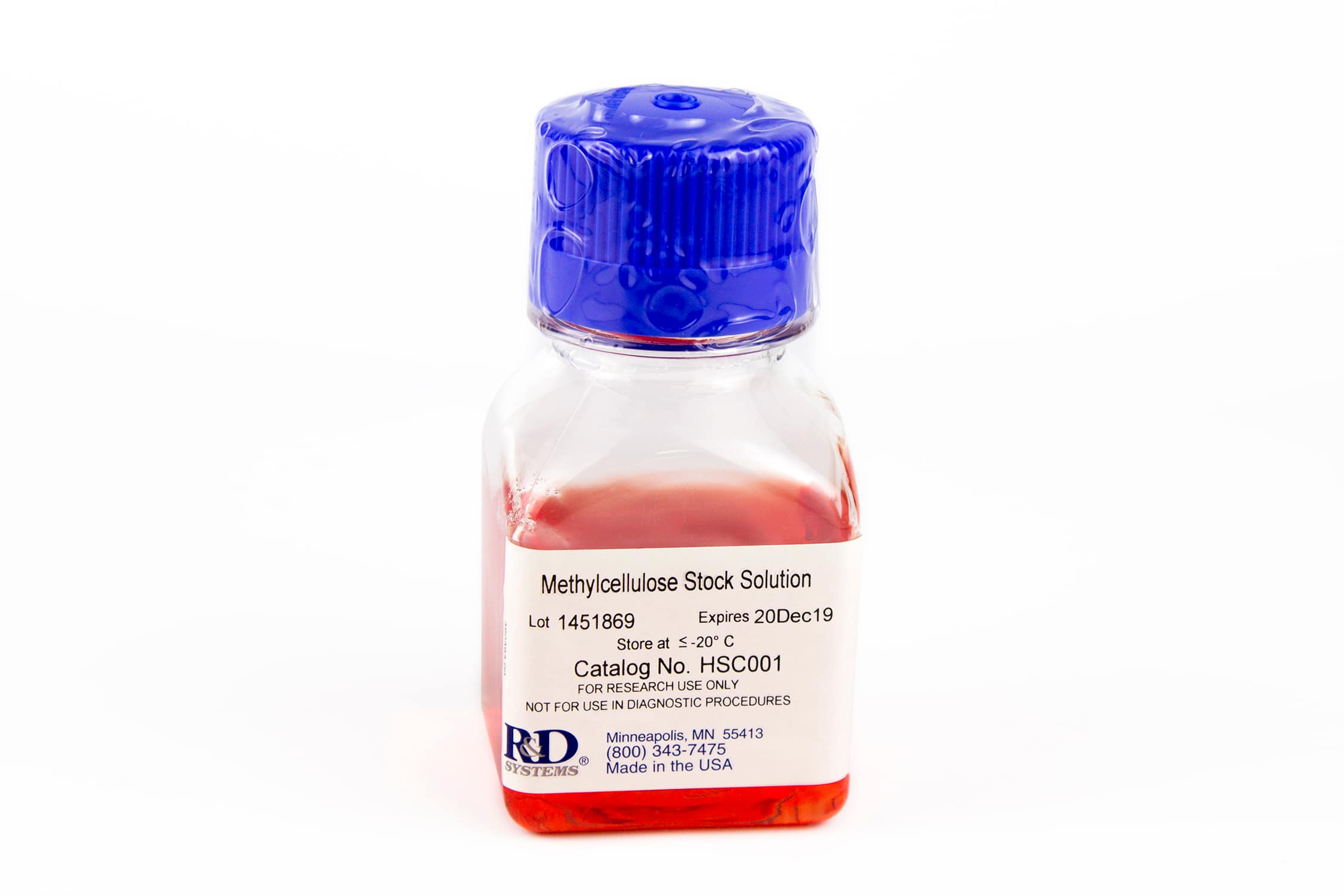
Product Summary for Methylcellulose Stock Solution
Kit Summary
For the growth and differentiation of human, mouse, and rat hematopoietic stem cells using Iscove’s Modified Dulbecco’s Media.
Key Benefits
- Can be supplemented with user-defined cytokines and growth factors
- Excellent optical clarity facilitates colony identification
- High lot-to-lot consistency decreases variation
Why is it Important to Verify Hematopoietic Progenitor Cell Identity using Established Markers?
Colony forming cell (CFC) assays, which are used to enumerate and quantify multi-potent and single lineage hematopoietic progenitors, can be time consuming and laborious.
Successful growth and enumeration of cell colonies is dependent on factors such as accurate cell counts, the presence of growth factors and/or cytokines, adequate humidity, and the use of high quality media. R&D Systems offers high quality Methylcellulose Stock Solution with superior optical clarity to support optimal colony growth, enumeration, and identification.
R&D Systems Methylcellulose Stock Solution:
- Optical clarity facilitates colony identification.
- High lot-to-lot consistency decreases variation.
- Supports reproducible in vitro growth of hematopoietic stem and progenitor cells.
- Can be supplemented with user-defined cytokines and growth factors.
- Increased cloning efficiency and improved colony growth compared to agar.
Kit Contents
- 100 mL of 3% Methylcellulose in Iscove's Modified Dulbecco's Medium.
| Contents | Concentration |
| Methylcellulose (1500 cps) in Iscove’s Modified Dulbecco's Medium |
3.0% |
Stability and Storage
Methylcellulose Stock Solution should be stored at =-20 °C upon receipt. Storage at 2 °C to 8 °C is not recommended.
Precautions
The acute and chronic effects of overexposure to this media are unknown. Safe laboratory procedures should be followed and protective clothing should be worn when handling this media.
Limitations
- The safety and efficacy of this product in diagnostic or other clinical uses has not been established.
- The reagent should not be used beyond the expiration date indicated on the label.
- Human hematopoietic progenitors derived from different individuals may cause results to vary.
Guide to Choosing Media for the Colony Forming Cell (CFC) Assay
Human Methylcellulose Stock and Base Media
| Catalog # | Product Description | Volume | Colonies Selected for | Contains Serum | Cytokines Included |
| HSC001 | Methylcellulose Stock Solution | 100 mL | N/A* | No | None |
| HSC002 | Human Methylcellulose Base Media |
90 mL | N/A* | Yes | None |
| HSC011 | StemXVivo® Methylcellulose Concentrate |
50 mL | N/A* | No | None |
Complete Human Methylcellulose Media
| Catalog # | Product Description | Volume | Colonies Selected for | Contains Serum | Cytokines Included |
| HSC003 | Human Methylcellulose Complete Media | 100 mL | BFU-E CFU-E CFU-G CFU-GEMM CFU-GM CFU-M |
Yes | Epo GM-CSF IL-3 SCF |
| HSC004 | Human Methylcellulose Complete Media without Epo | 100 mL | CFU-G CFU-GM CFU-M |
Yes | SCF GM-CSF IL-3 |
| HSC005 | Human Methylcellulose Enriched Media |
100 mL | BFU-E CFU-E CFU-G CFU-GEMM CFU-GM CFU-M |
Yes | Epo G-CSF GM-CSF IL-3 IL-6 SCF |
| HSC005SF | Human Methylcellulose Serum-Free Enriched Media |
100 mL | BFU-E CFU-E CFU-G CFU-GEMM CFU-GM CFU-M |
No | Epo G-CSF GM-CSF IL-3 IL-6 SCF |
Mouse Methylcellulose Stock and Base Media
| Catalog # | Product Description | Volume | Colonies Selected for | Contains Serum | Cytokines Included |
| HSC001 | Methylcellulose Stock Solution | 100 mL | N/A* | No | None |
| HSC006 | Mouse Methylcellulose | 90 mL | N/A* | Yes | None |
| HSC011 | StemXVivo® Methylcellulose Concentrate |
50 mL | N/A* | No | None |
Complete Mouse Methylcellulose Media
| Catalog # | Product Description | Volume | Colonies Selected for | Contains Serum | Cytokines Included |
| HSC007 | Mouse Methylcellulose Complete Media | 100 mL | BFU-E CFU-E CFU-G CFU-GEMM CFU-GM CFU-M |
Yes | Epo IL-3 IL-6 SCF |
*Base media and stock solutions do not contain cytokines and will not support colony growth unless conditioned media, cytokines, or other culture supplements are added.
Scientific Data Images for Methylcellulose Stock Solution

Human Hematopoietic Colony Formation Using the Methylcellulose-based Colony Forming Cell Assay.
Colony forming unit-erythroid (CFU-E) are clonogenic progenitors that produce only one or two clusters with each cluster containing from 8 to approximately 100 hemoglobinized erythroblasts. It represents the more mature erythroid progenitors that have less proliferative capacity.B. Colony forming unit-granulocyte (CFU-G) are clonogenic progenitors of granulocytes that give rise to a homogeneous population of eosinophils, basophils, or neutrophils.C. Colony forming unit-granulocyte, macrophage (CFU-GM) are progenitors that give rise to colonies containing a heterogeneous population of macrophages and granulocytes. The morphology is similar to the CFU-M and CFU-G descriptions.D. Burst forming unit-erythroid (BFU-E) colonies can be described as small (3 to 8 clusters), intermediate (9 to 16 clusters), or large (more than 16 clusters) according to the number of clusters present. These are primitive erythroid progenitors that have high proliferative capacity.E. Colony forming unit-macrophage (CFU-M) are clonogenic progenitors of macrophages that give rise to a homogenous population of macrophages.F. Colony forming unit-granulocyte, erythrocyte, macrophage, megakaryocyte (CFU-GEMM) are multi-lineage progenitors that give rise to erythroid, granulocyte, macrophage and megakaryocyte lineages, as the name indicates.
Mouse Hematopoietic Colony Formation Using the Methylcellulose-based Colony Forming Cell Assay.
A. Burst forming unit-erythroid (BFU-E) colonies are defined as clusters with a minimal of 30 cells that can be seen from day 7 onward. Each individual cluster consisted of tiny, irregular shaped cells that may appear fused together. Each cluster normally contains 5-8 cells, and the size of the cluster is similar to that of a single macrophage. The cluster may vary in sizes and color. A large BFU-E is usually bright red and is differentiable even without the use of a microscope. Smaller BFU-E may not appear red in color but is distinguishable based on the morphology. B. Colony forming unit-macrophage (CFU-M; left) are clonogenic progenitors of macrophages that give rise to a homogenous population of macrophages. Colony forming unit-granulocyte (CFU-G; right) are clonogenic progenitors of granulocytes that give rise to a homogeneous population of eosinophils, basophils, or neutrophils. C. Colony forming unit-granulocyte, macrophage (CFU-GM) are progenitors that give rise to colonies containing a heterogeneous population of macrophages and granulocytes. The morphology is similar to the CFU-M and CFU-G descriptions. D. Colony forming unit-granulocyte, erythrocyte, macrophage, megakaryocyte (CFU-GEMM) are multi-lineage progenitors that give rise to the lineage of erythroid, granulocytes, macrophages, and megakaryocytes as the name indicates. It can be identified as reddish colored cells (erythroid) mixed with colorless cells (granulocytes, macrophages, and megakaryocytes) in a single colony. This progenitor is typically the largest colony on the culture dish; occasionally CFU-GM may attain a size comparable or larger than that of CFU-GEMM.
Tips to Identify CFU-GEMM Colonies in the Human Colony Forming Unit Assay.
CFU-GEMMs contain a mixture of granulocytes, erythrocytes, megakaryocytes, and macrophages. Human CFU-GEMMs have the obvious red color of the BFU-E as well as the complex morphological features of both the small, compact granulocytes and the large, round macrophages. Viewing the cluster in multiple focal planes is again important to ensure that the colony contains all of the GEMM cell types. CFU-GEMM appearance is similar for human and mouse cells. For more tips please visit watch our CFC Assay video tutorial.Formulation, Preparation, and Storage
Shipping
The product is shipped with dry ice or equivalent. Upon receipt, store it immediately at the temperature recommended below.
Storage
Store the unopened product at -20 to -70 °C. Use a manual defrost freezer and avoid repeated freeze-thaw cycles. Do not use past expiration date.
Background: Hematopoietic Stem Cells
The definitive hematopoietic system is made up of all adult blood cell types including megakaryocytes, erythrocytes, and cells of the myeloid and lymphoid lineages. All of these cells are derived from multipotent hematopoietic stem cells (HSCs) through a succession of precursors with progressively limited potential. Hematopoietic stem cells are tissue-specific stem cells that exhibit remarkable self-renewal capacity and are responsible for the life-long mainteÂnance of the hematopoietic system. HSCs are rare cells that reside in adult bone marrow where hematopoiesis is continuÂously taking place. They can also be found in cord blood, fetal liver, adult spleen, and peripheral blood. R&D Systems offers several products for studying hematopoietic lineage cells including serum-free media, lineage depleÂtion antibodies and kits, and reagents for performing colony forming cell (CFC) assays.
Additional Hematopoietic Stem Cells Products
Product Documents for Methylcellulose Stock Solution
Product Specific Notices for Methylcellulose Stock Solution
For research use only
Loading...
Loading...
Loading...
Loading...
Loading...