
Recombinant Human BDNF Protein
R&D Systems, part of Bio-Techne | Catalog # 248-BD
100% sequence homology with Mouse, Rat, Canine, Equine and all other mammalian proteins examined.

Key Product Details
Product Specifications
Source
Spodoptera frugiperda, Sf 21 (baculovirus)-derived BDNF protein
His129-Arg247
Accession # P23560
100% sequence homology with Mouse, Rat, Canine, Equine and all other mammalian proteins examined.
His129-Arg247
Accession # P23560
100% sequence homology with Mouse, Rat, Canine, Equine and all other mammalian proteins examined.
Purity
>97%, by SDS-PAGE under reducing conditions and visualized by silver stain.
Endotoxin Level
0.10 EU per 1 μg of the protein by the LAL method.
N-terminal Sequence Analysis
His129
Predicted Molecular Mass
13.5 kDa
SDS-PAGE
13-14 kDa, reducing conditions
Activity
Measured in a cell proliferation assay using BaF mouse pro-B cells transfected with TrkB.
The ED50 for this effect is 0.2-2 ng/mL.
The specific activity of Recombinant Human BDNF is approximately 1.3 x 10³ units/μg, which is calibrated against recombinant human BDNF WHO Standard (NIBSC code: 96/534).
Measured by its binding ability in a functional ELISA.
When Recombinant Human TrkB Fc Chimera (Catalog # 688-TK) is coated at 1 μg/mL, Recombinant Human BDNF binds with an apparent Kd <1 nM.
The ED50 for this effect is 0.2-2 ng/mL.
The specific activity of Recombinant Human BDNF is approximately 1.3 x 10³ units/μg, which is calibrated against recombinant human BDNF WHO Standard (NIBSC code: 96/534).
Measured by its binding ability in a functional ELISA.
When Recombinant Human TrkB Fc Chimera (Catalog # 688-TK) is coated at 1 μg/mL, Recombinant Human BDNF binds with an apparent Kd <1 nM.
Reviewed Applications
Read 7 reviews rated 5 using 248-BD in the following applications:
Scientific Data Images for Recombinant Human BDNF Protein
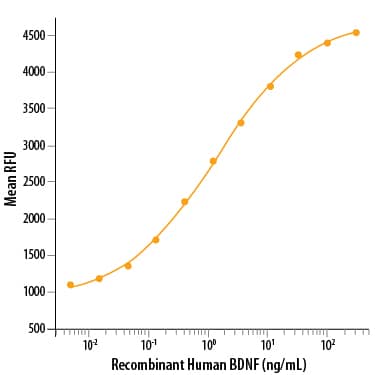
Recombinant Human BDNF (Catalog # 248‑BD) stimulates cell proliferation in the BaF mouse pro-B cell line transfected with TrkB. The ED50 for this effect is 0.2-2 ng/mL.
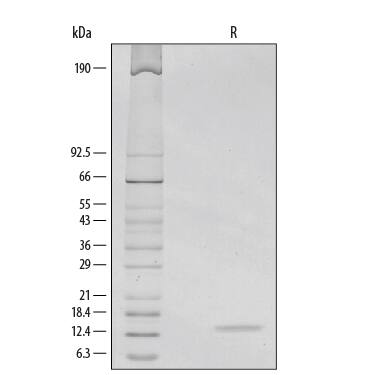
1 μg/lane of Recombinant Human BDNF was resolved with SDS-PAGE under reducing (R) conditions and visualized by silver staining, showing a single band at 13 kDa.
Formulation, Preparation and Storage
248-BD
| Formulation | Lyophilized from a 0.2 μm filtered solution in Sodium Citrate and NaCl with BSA as a carrier protein. |
| Reconstitution | Reconstitute at 25 μg/mL in sterile PBS containing at least 0.1% human or bovine serum albumin. |
| Shipping | The product is shipped at ambient temperature. Upon receipt, store it immediately at the temperature recommended below. |
| Stability & Storage | Use a manual defrost freezer and avoid repeated freeze-thaw cycles.
|
Background: BDNF
Brain-derived neurotrophic factor (BDNF) is a member of the NGF family of neurotrophic factors (also named neurotrophins) that are required for the differentiation and survival of specific neuronal subpopulations in both the central as well as the peripheral nervous system. The neurotrophin family is comprised of at least four proteins including NGF, BDNF, NT-3, and NT-4/5. These secreted cytokines are synthesized as prepropeptides that are proteolytically processed to generate the mature proteins (1, 2). All neurotrophins have six conserved cysteine residues that are involved in the formation of three disulfide bonds and all share approximately 55% sequence identity at the amino acid level. Similarly to NGF, bioactive BDNF is predicted to be a non-covalently linked homodimer.
BDNF cDNA encodes a 247 amino acid residue precursor protein with a signal peptide and a proprotein that are cleaved to yield the 119 amino acid residue mature BDNF. The amino acid sequence of mature BDNF is identical in all mammals examined. High levels of expression of BDNF have been detected in the hippocampus, cerebellum, fetal eye and placenta. In addition, low levels of BDNF expression are also found in the pituitary gland, spinal cord, heart, lung and skeletal muscle. BDNF binds with high affinity and specifically activates the TrkB tyrosine kinase receptor (3).
References
- Eide, F.F. et al. (1993) Exp. Neurol. 121:200.
- Snider, W.D. (1994) Cell 77:627.
- Barbacid, M. (1994) J. Neurobiol. 25:1386.
Long Name
Brain-derived Neurotrophic Factor
Alternate Names
Abrineurin, ANON2, BULN2, Neurotrophin
Gene Symbol
BDNF
UniProt
Additional BDNF Products
Product Documents for Recombinant Human BDNF Protein
Product Specific Notices for Recombinant Human BDNF Protein
For research use only
Loading...
Loading...
Loading...
Loading...