
Recombinant Escherichia T7 phage RNA polymerase Protein, CF
R&D Systems, part of Bio-Techne | Catalog # 11662-T7
His-tag

Key Product Details
- R&D Systems E. coli-derived Recombinant Escherichia T7 phage RNA polymerase Protein (11662-T7)
- Quality control testing to verify active proteins with lot specific assays by in-house scientists
- All R&D Systems proteins are covered with a 100% guarantee
Product Specifications
Source
E. coli-derived e. coli T7 phage RNA polymerase protein
Asn2-Ala883 with a N-terminal Met and 6-His tag
Asn2-Ala883 with a N-terminal Met and 6-His tag
Purity
>95%, by SDS-PAGE visualized with Silver Staining and quantitative densitometry by Coomassie® Blue Staining.
Endotoxin Level
<0.10 EU per 1 μg of the protein by the LAL method.
N-terminal Sequence Analysis
Met
Predicted Molecular Mass
100 kDa
SDS-PAGE
89-98 kDa, under reducing conditions
Activity
Measured by its ability to produce 4.1 kB RNA per agarose gel electrophoresis from a defined linearized DNA plasmid template quantified using a fluorescent detection assay.
The RNA yield is >2500 ng, as measured under the described conditions.
The RNA yield is >2500 ng, as measured under the described conditions.
Scientific Data Images for Recombinant Escherichia T7 phage RNA polymerase Protein, CF
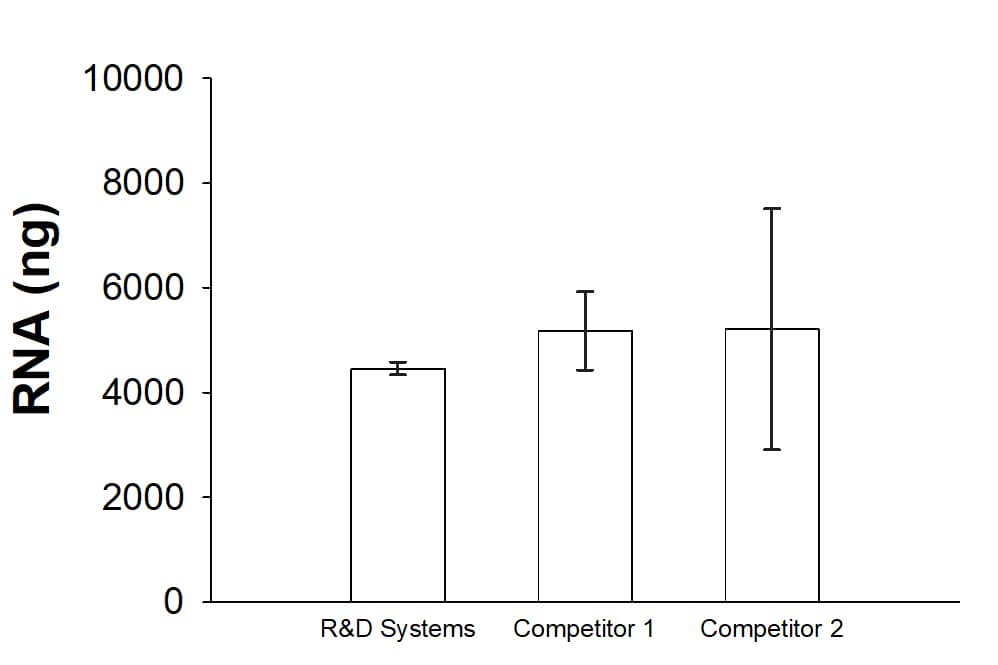
Recombinant E. coli T7 phage RNA polymerase His-tag Protein Enzyme Activity.
Recombinant T7phage RNA polymerase (T7 RNAP) (Catalog # 11662-T7) from R&D Systems and other competitors produce similar amounts of RNA in direct side-by-side comparison using the insert assay protocol described.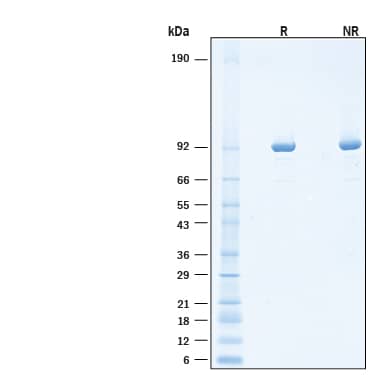
Recombinant E. coli T7 phage RNA polymerase His-tag Protein SDS-PAGE.
2 μg/lane of Recombinant E. coli T7 phage RNA polymerase His-tag Protein (Catalog # 11662-T7) was resolved with SDS-PAGE under reducing (R) and non-reducing (NR) conditions and visualized by Coomassie® Blue staining, showing bands at 89-98 kDa, under reducing conditions.Formulation, Preparation and Storage
11662-T7
| Formulation | Supplied as a 0.2 μm filtered solution in Sodium Phosphate, NaCl, TCEP and Glycerol. |
| Shipping | The product is shipped with dry ice or equivalent. Upon receipt, store it immediately at the temperature recommended below. |
| Stability & Storage | Use a manual defrost freezer and avoid repeated freeze-thaw cycles.
|
Background: T7 phage RNA polymerase
References
- Chung, Y.B. and D.C. Hickle (1990) J. Biol. Chem. 216:927.
- Zhang, X. and F.W. Studier (2004) J. Mol Biol. 340:707.
- Jeruzalmi, D. and T.A. Steitz (1998) EMBO J. 17:4101.
- Sousa, R. and S. Mukherjee (2003) Prog. Nucleic Acid Res. Mol. Biol. 73:1.
- Wang, W. et al. (2018) Biotechnol. Adv. 36:2129.
- Lyakhoc, D.L. et al. (1998) J. Mol. Biol. 280:201.
- Cheetham, G.M. and T.A. Steitz (2000) Curr. Opin. Struct. Biol. 10:117.
- Yunitskaya, V.L. and S.N. Kochetkov (2002) Biochemistry 67:1124.
- Borkotoky, S. and A. Murali (2018) Int. J. Biol. Macromol. 118:49.
- Rong, M. et. al. (1998) Proc. Natl. Acad. Sci. USA. 95:515.
- Nair, A. and Z. Kis (2024) Front. Mol. Biosci. 11:1504876.
Long Name
Escherichia T7 phage RNA polymerase
Alternate Names
T7p07
Entrez Gene IDs
1261050 (Viral)
Gene Symbol
T7P07
UniProt
Additional T7 phage RNA polymerase Products
Product Documents for Recombinant Escherichia T7 phage RNA polymerase Protein, CF
Product Specific Notices for Recombinant Escherichia T7 phage RNA polymerase Protein, CF
For research use only
Loading...
Loading...
Loading...
Loading...