
Mouse Mast Cell Protease-6/Mcpt6 Antibody
R&D Systems, part of Bio-Techne | Catalog # MAB3736

Conjugate
Catalog #
Key Product Details
Species Reactivity
Validated:
Mouse
Cited:
Mouse
Applications
Validated:
Western Blot, Immunoprecipitation
Cited:
Western Blot, Immunocytochemistry
Label
Unconjugated
Antibody Source
Monoclonal Rat IgG1 Clone # 286820
Product Specifications
Immunogen
Mouse myeloma cell line NS0-derived recombinant mouse Mast Cell Protease‑6/Mcpt6
Ile32-Ser276
Accession # P21845
Ile32-Ser276
Accession # P21845
Specificity
Detects mouse Mast Cell Protease‑6/Mcpt6 in direct ELISAs and Western blots. In Western blots, 10% cross-reactivity with recombinant mouse (rm) MCP‑7 is observed and no cross-reactivity with rmMCP‑1 is observed.
Clonality
Monoclonal
Host
Rat
Isotype
IgG1
Scientific Data Images for Mouse Mast Cell Protease-6/Mcpt6 Antibody
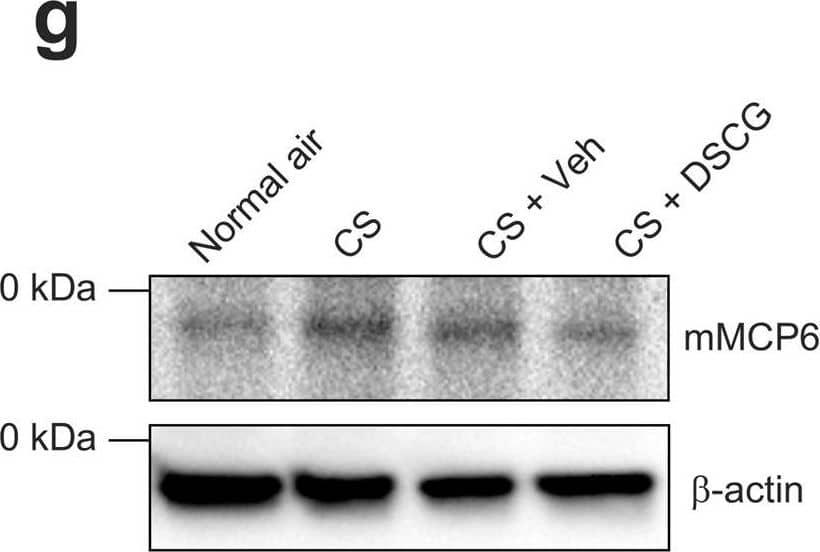
Detection of Mouse Mast Cell Protease-6/Mcpt6 by Western Blot
Treatment with a mast cell degranulation stabilizer completely inhibits the development of experimental COPD and increases in the levels of mast cell tryptase.Wild-type BALB/c mice (6–8 weeks old, female) were exposed to cigarette smoke (CS) for 8 weeks and treated with disodium cromoglycate (DSCG) intranasally from weeks 6–8. control mice received equal volumes of vehicle. DSCG completely inhibited the development of chronic airway inflammation, emphysema and impaired lung function in CS exposed mice. a Total leukocyte, b macrophage and c neutrophil numbers in bronchoalveolar lavage fluid (BALF) after 8 weeks of CS exposure (n = 8 per group). d Lung sections were stained with hematoxylin and eosin (scale bar = 50 μm), and e alveolar diameter was assessed as a measure of emphysema (n = 8 per group). f Lung function, in terms of transpulmonary resistance (n = 8 per group). g mMCP6 protein was assessed in whole mouse lung tissues by immunoblot (n = 8 per group), and h fold change of densitometry analysis of mMCP6 protein was normalized to beta-actin. Results are mean ± s.e.m, Statistical differences were determined using one-way ANOVA followed by Bonferroni post-test. Source data are provided as a Source Data file. Image collected and cropped by CiteAb from the following open publication (https://pubmed.ncbi.nlm.nih.gov/37963864), licensed under a CC-BY license. Not internally tested by R&D Systems.Applications for Mouse Mast Cell Protease-6/Mcpt6 Antibody
Application
Recommended Usage
Immunoprecipitation
25 µg/mL
Sample: Conditioned cell culture medium spiked with Recombinant Mouse Mast Cell Protease-6/Mcpt6 (Catalog # 3736-SE), see our available Western blot detection antibodies
Sample: Conditioned cell culture medium spiked with Recombinant Mouse Mast Cell Protease-6/Mcpt6 (Catalog # 3736-SE), see our available Western blot detection antibodies
Western Blot
1 µg/mL
Sample: Recombinant Mouse Mast Cell Protease-6/Mcpt6 (Catalog # 3736-SE)
Sample: Recombinant Mouse Mast Cell Protease-6/Mcpt6 (Catalog # 3736-SE)
Formulation, Preparation, and Storage
Purification
Protein A or G purified from hybridoma culture supernatant
Reconstitution
Reconstitute at 0.5 mg/mL in sterile PBS. For liquid material, refer to CoA for concentration.
Formulation
Lyophilized from a 0.2 μm filtered solution in PBS with Trehalose. *Small pack size (SP) is supplied either lyophilized or as a 0.2 µm filtered solution in PBS.
Shipping
Lyophilized product is shipped at ambient temperature. Liquid small pack size (-SP) is shipped with polar packs. Upon receipt, store immediately at the temperature recommended below.
Stability & Storage
Use a manual defrost freezer and avoid repeated freeze-thaw cycles.
- 12 months from date of receipt, -20 to -70 °C as supplied.
- 1 month, 2 to 8 °C under sterile conditions after reconstitution.
- 6 months, -20 to -70 °C under sterile conditions after reconstitution.
Background: Mast Cell Protease-6/Mcpt6
Tryptases are trypsin-like serine proteases, and beta tryptases appear to be the main isoenzymes expressed in mast cells (1). Mast cell protease-6 (MCP-6, Mcpt6, or Tpsb2) is one of beta tryptases produced from mouse mast cells. It is stored in secretory granules of mast cells, where it forms active tetramers with heparin proteoglycan. Because of the unique arrangement of the active sites in the tetramer, which are facing a narrow central pore, Mcpt6 is resistant to macromolecular protease inhibitors (2). When mast cells are activated, Mcpt6 is released along with other proteins in secretory granules, participating in provoking inflammatory conditions (3). Mcpt6 has been implicated as a mediator in the pathogenesis of asthma and other allergic disorders in mouse models.
References
- Caughey, G. H. (2004) in Handbook of Proteolytic Enzymes, Barrett, A.J. et al. eds. p. 1535.
- Sommerhoff, C.P. et al. (1999) Proc. Natl. Acad. Sci. USA. 96:10984.
- Hallgren, J. and G. Pejler, (2006) FEBS J. 273:1871.
Alternate Names
Mast Cell Protease6, Mcpt6
Gene Symbol
TPSAB1
UniProt
Additional Mast Cell Protease-6/Mcpt6 Products
Product Documents for Mouse Mast Cell Protease-6/Mcpt6 Antibody
Product Specific Notices for Mouse Mast Cell Protease-6/Mcpt6 Antibody
For research use only
Loading...
Loading...
Loading...
Loading...
Loading...